
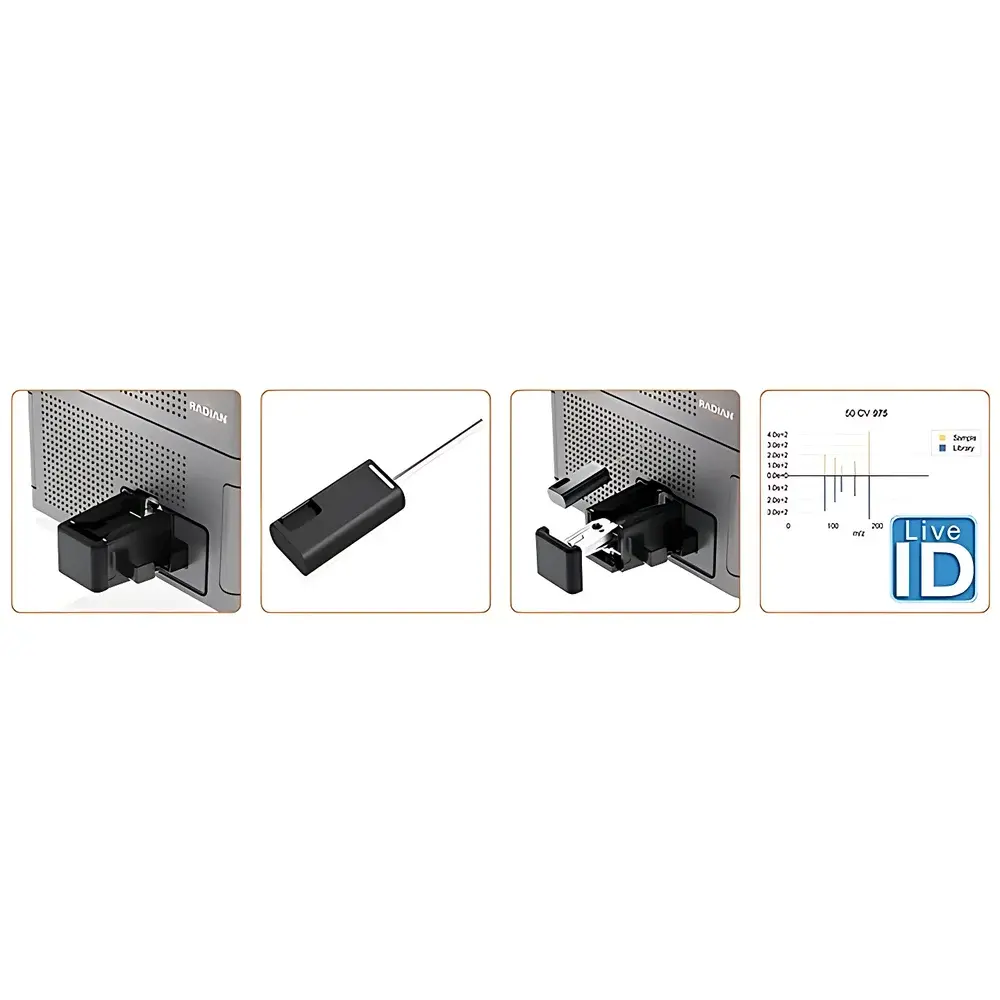
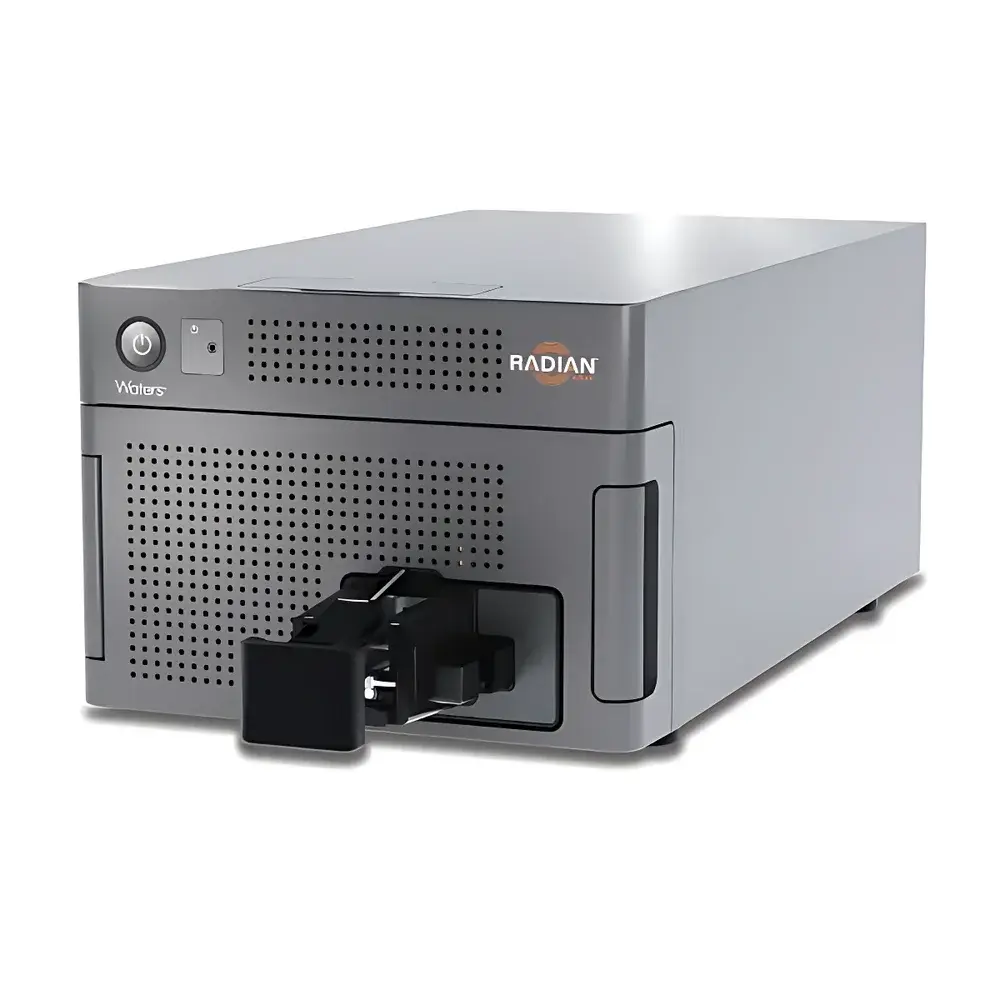
Waters RADIAN ASAP Direct Mass Spectrometry Detector
| Brand | Waters |
|---|---|
| Origin | United Kingdom |
| Model | RADIAN ASAP |
| Ionization Principle | Atmospheric Pressure Solid Analysis Probe (ASAP) |
| Mass Analyzer | Single Quadrupole |
| Detection Mode | Full Scan / Selected Ion Monitoring (SIM) |
| Sample Introduction | Direct Solid & Liquid Analysis |
| Software Platform | LiveID, IonLynx, OpenLynx |
| Compliance Support | FDA 21 CFR Part 11 (audit trail, electronic signature), GLP/GMP-ready workflows |
| Dimensions | Compact benchtop footprint (< 60 cm width) |
| Typical Analysis Time | < 30 seconds per sample |
Overview
The Waters RADIAN ASAP Direct Mass Spectrometry Detector is an ambient ionization mass spectrometer engineered for rapid, label-free molecular analysis of untreated solids and liquids. Unlike conventional LC-MS or GC-MS platforms requiring chromatographic separation and extensive sample preparation, the RADIAN ASAP integrates a robust single quadrupole mass analyzer with an atmospheric pressure solid analysis probe (ASAP), enabling direct desorption and ionization at ambient conditions. This configuration leverages thermal desorption coupled with atmospheric-pressure chemical ionization (APCI)-like mechanisms to generate reproducible, high-fidelity mass spectra from raw samples—including tablets, powders, plant tissues, polymers, and liquid extracts—without solvent extraction, derivatization, or matrix addition. Designed for laboratories prioritizing throughput over method development overhead, the system delivers quantitative-grade spectral data suitable for identity confirmation, impurity screening, and compositional classification in regulated and non-regulated environments.
Key Features
- Direct analysis capability: No chromatography, no sample cleanup, no derivatization required—analysis begins immediately after sample placement.
- Benchtop form factor: Compact mechanical design (< 60 cm width) optimizes space-constrained QC, forensic, or teaching labs.
- Single quadrupole architecture: Provides stable mass accuracy (±0.2 Da typical), unit mass resolution, and linear dynamic range > 10⁴ for semi-quantitative assessment.
- ASAP probe integration: Heated nitrogen gas stream enables controlled thermal desorption across diverse solid matrices; adjustable temperature gradient (50–450 °C) supports method optimization for thermally labile or refractory compounds.
- Real-time spectral acquisition: Full-scan MS data acquired in < 30 seconds per sample, with immediate transfer to LiveID for on-the-fly interpretation.
- Regulatory-ready software suite: All data acquisition, processing, and reporting modules comply with audit trail, user access control, and electronic signature requirements per FDA 21 CFR Part 11.
Sample Compatibility & Compliance
The RADIAN ASAP accepts a broad range of unprocessed specimens: pharmaceutical tablets and capsules, illicit drug seizures (powders, plant material), food commodities (spices, oils, dairy powders), polymer pellets, catalysts, and environmental swabs. Its ambient ionization mechanism minimizes fragmentation for intact molecular ion detection—particularly advantageous for small molecules (< 1,000 Da), including APIs, alkaloids, pesticides, and flavor compounds. The system meets ISO/IEC 17025 documentation standards for testing laboratories and supports GLP-compliant workflows through traceable metadata logging, instrument calibration records, and version-controlled method templates. For forensic applications, it aligns with SWGDRUG Category A recommendations for rapid drug identification; in food authenticity studies, it satisfies EU Commission Decision 2002/657/EC criteria for confirmatory screening when paired with validated LiveID models.
Software & Data Management
Three integrated software modules define the analytical workflow: LiveID enables real-time classification using chemometric models (PCA, PLS-DA) trained on authenticated reference materials—outputting binary “genuine/fraudulent” decisions with confidence metrics. LiveID also performs live spectral library matching against NIST, Wiley, or custom-built libraries, scoring matches on a 0–1000 scale based on spectral similarity and isotopic fidelity. IonLynx quantifies target analytes in complex mixtures without chromatographic deconvolution, applying response factor normalization and internal standard correction where applicable. OpenLynx automates report generation in PDF, HTML, or printed formats—including mass-to-charge confirmation tables, peak intensity ratios, and pass/fail flags aligned with pre-defined acceptance criteria. All software modules maintain full data provenance, supporting retrospective reprocessing and regulatory inspection readiness.
Applications
- Forensic Toxicology: Rapid categorization of seized substances (e.g., synthetic cannabinoids, fentanyl analogues) via spectral library search and pattern recognition—reducing turnaround time from days to minutes.
- Pharmaceutical Development: Reaction monitoring of Suzuki couplings or amide formations; direct analysis of crude reaction mixtures to assess conversion and byproduct formation without workup.
- Food Authenticity: Detection of olive oil adulteration with hazelnut or soybean oil; verification of botanical origin in herbal supplements using discriminant models trained on authentic reference sets.
- Materials Science: Identification of polymer additives (plasticizers, flame retardants) directly from extruded pellets or molded parts; thermal degradation profiling via programmed probe temperature ramping.
- Academic Teaching: Undergraduate laboratory instruction in mass spectrometry fundamentals—students acquire, interpret, and compare spectra from everyday materials (coffee, chocolate, aspirin) with minimal instrumentation training.
FAQ
Does RADIAN ASAP require vacuum pump maintenance?
No—the system uses a sealed, oil-free turbomolecular vacuum pump with >15,000-hour service life; routine maintenance is limited to annual calibration verification and probe cleaning.
Can LiveID models be transferred between instruments?
Yes—models are instrument-agnostic and portable across RADIAN ASAP systems running identical firmware versions; cross-platform validation is recommended for regulatory submissions.
Is chromatographic separation ever necessary with this platform?
Not for qualitative screening or binary classification tasks; however, LC coupling (e.g., via optional interface module) may be employed for isomeric differentiation or trace-level quantitation in complex matrices.
What sample forms are incompatible with ASAP ionization?
Highly volatile liquids (e.g., ether, pentane) and thermally unstable biomacromolecules (e.g., intact proteins > 50 kDa) are not suitable; analysis of such samples requires alternative ambient probes (e.g., DESI) or soft ionization sources.
How does RADIAN ASAP ensure data integrity under GLP conditions?
All raw data files are cryptographically hashed upon acquisition; audit trails log every user action, parameter change, and software update with timestamps and operator IDs—fully compliant with Annex 11 and ALCOA+ principles.
Related Products




