
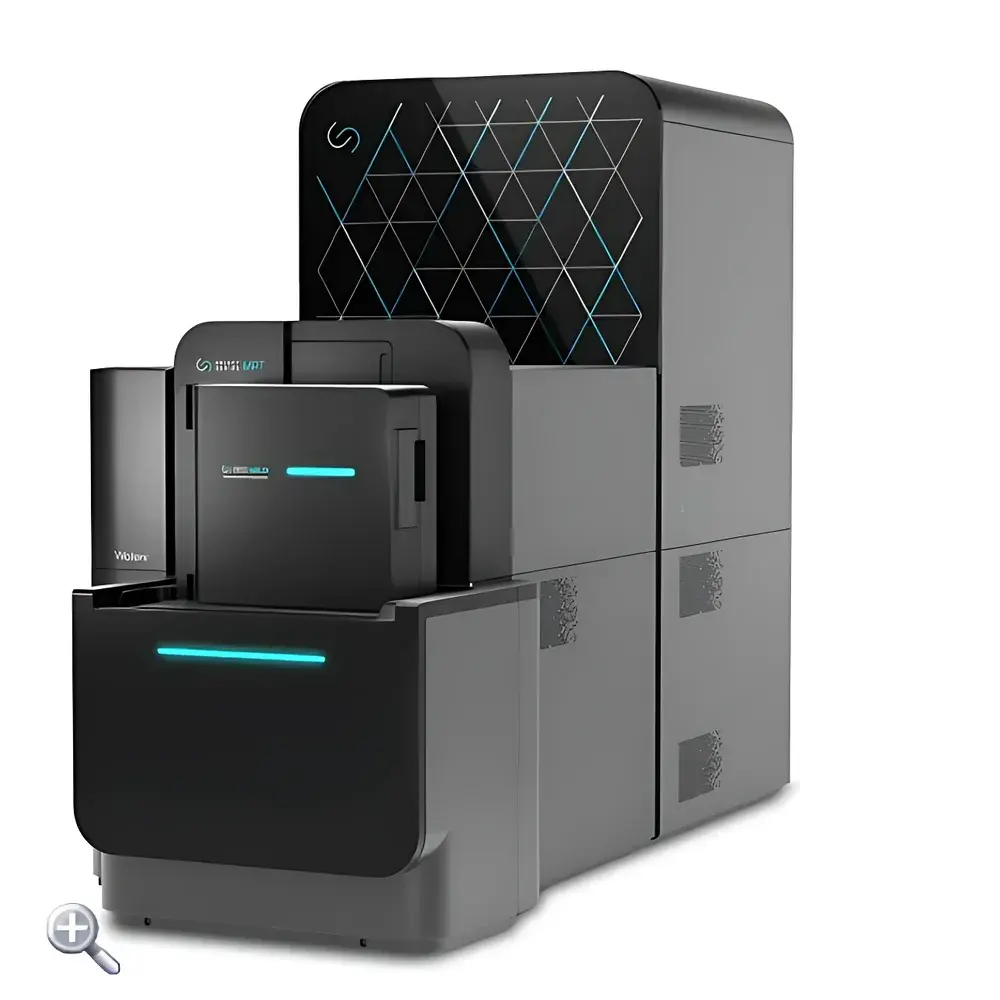
Waters SELECT SERIES MRT Quadrupole Time-of-Flight Mass Spectrometer
| Brand | Waters |
|---|---|
| Origin | USA |
| Model | SELECT SERIES MRT |
| Mass Analyzer Type | Multi-Reflecting Time-of-Flight (MRT-TOF) |
| Instrument Class | High-Resolution Accurate-Mass (HRAM) LC-MS/MS System |
| Application Scope | Universal (Life Sciences, Clinical Research, Forensics, Materials Surface Analysis) |
| Pressure Range | Not Applicable (Vacuum-operated analyzer) |
| Ion Sources Supported | DESI XS, SELECT SERIES MALDI, Electrospray (ESI), APCI |
Overview
The Waters SELECT SERIES MRT is a high-resolution, accurate-mass quadrupole time-of-flight (Q-TOF) mass spectrometer engineered for uncompromised analytical performance in both qualitative and quantitative workflows. At its core lies the proprietary Multi-Reflecting Time-of-Flight (MRT) mass analyzer—a breakthrough architecture that extends ion flight paths through multiple reflections between two gridless electrostatic mirrors. Unlike conventional orthogonal-acceleration TOF or magnetic sector instruments, the MRT design maintains consistent mass resolution (>60,000 FWHM across m/z 100–2,000) and sub-ppb mass accuracy (<1 ppm RMS error) independent of acquisition speed, duty cycle, or transient duration. This stability arises from periodic spatial re-focusing of ion packets via an array of dynamic ion lenses after each reflection—preserving signal intensity while enabling ultra-high resolving power. The system operates under high vacuum conditions and integrates seamlessly with UPLC and nanoLC separations, supporting both full-scan MS and data-dependent MS/MS acquisition modes without resolution trade-offs.
Key Features
- Multi-Reflecting Time-of-Flight (MRT) mass analyzer delivering sustained >60,000 resolution at 1 Hz scan rate across broad m/z range
- Sub-ppb mass accuracy (≤1 ppm RMS) maintained across all acquisition speeds and dynamic ranges
- Simultaneous high-resolution MS and MS/MS acquisition with minimal duty cycle loss
- Native support for isotopic fine structure resolution—enabling unambiguous elemental composition assignment
- Ion mobility compatibility-ready architecture (via optional add-on modules)
- Integrated quadrupole precursor selection with variable isolation width (0.1–5 Da) and high transmission efficiency
- Real-time lockmass correction using internal or external reference ions for long-duration imaging and profiling experiments
Sample Compatibility & Compliance
The SELECT SERIES MRT accommodates diverse sample introduction methods including electrospray ionization (ESI), atmospheric pressure chemical ionization (APCI), desorption electrospray ionization (DESI XS), and matrix-assisted laser desorption/ionization (SELECT SERIES MALDI). Its open-source .raw file format complies with Proteomics Standards Initiative (PSI) specifications and supports conversion to standardized interchange formats including imzML (for MSI), mzML, and mzXML. Data integrity meets GLP/GMP requirements through MassLynx software’s audit-trail functionality, electronic signatures, and adherence to FDA 21 CFR Part 11 guidelines. Instrument validation protocols align with ASTM E2987 (mass spectrometer performance verification) and ISO/IEC 17025 calibration traceability frameworks.
Software & Data Management
Controlled by Waters MassLynx v4.2 or later, the platform provides a unified interface for method development, real-time data acquisition, on-the-fly processing, and retrospective analysis. The software natively supports high-throughput imaging workflows—including automated stage movement synchronization, pixel-by-pixel spectral reconstruction, and co-registration with optical histology images. Raw data files are optimized for storage efficiency: typical MSI datasets exhibit ~30% smaller file sizes compared to legacy TOF systems at equivalent resolution. APIs enable integration with third-party tools such as SCiLS Lab, MSiReader, and Python-based libraries (e.g., pyImagingMS, imzMLParser), facilitating reproducible, script-driven quantitation and multivariate statistical modeling.
Applications
- Tissue Imaging: Spatial mapping of lipids, metabolites, peptides, and drugs in FFPE and frozen sections at ≤15 µm lateral resolution using MALDI; label-free molecular histology with DESI XS for rapid surface interrogation
- Forensic Toxicology: Detection and localization of trace-level drugs of abuse, novel psychoactive substances (NPS), and endogenous biomarkers in latent fingerprints and skin swabs
- Pharmaceutical Development: In situ distribution analysis of active pharmaceutical ingredients (APIs) and metabolites in preclinical tissue models; formulation homogeneity assessment on solid dosage forms
- Materials Science: Identification and spatial profiling of organic contaminants on semiconductor wafers, polymer surfaces, and cosmetic substrates (e.g., tape-lifted epidermal layers)
- Structural Biology: Top-down and middle-down proteomics with intact protein characterization; native MS-compatible workflows for complex assemblies
FAQ
What distinguishes the MRT analyzer from standard TOF or Orbitrap platforms?
The MRT architecture achieves resolution scalability without sacrificing sensitivity or speed—unlike electrostatic traps or FT-based analyzers, it imposes no inherent duty cycle penalty during high-resolution scanning.
Can the SELECT SERIES MRT perform quantitative analysis with regulatory compliance?
Yes—when operated with MassLynx and configured with appropriate calibration standards, it supports validated bioanalytical workflows compliant with FDA, EMA, and ICH M10 guidelines.
Is ion mobility integration available?
While not factory-standard, the instrument’s vacuum interface and control architecture support post-purchase installation of traveling wave ion mobility (TWIM) modules for enhanced peak capacity and conformational analysis.
How does the system handle large-scale imaging datasets?
MassLynx includes built-in data compression algorithms and parallelized spectral processing engines, reducing analysis time for gigabyte-scale MSI files by up to 40% versus prior-generation platforms.
What MALDI target plate formats are supported?
All standard MTP geometries (e.g., 96-well, 384-well, custom-cut slides) are compatible; the stage accommodates full 10 × 10 cm tissue sections with motorized autofocus and auto-alignment routines.




