
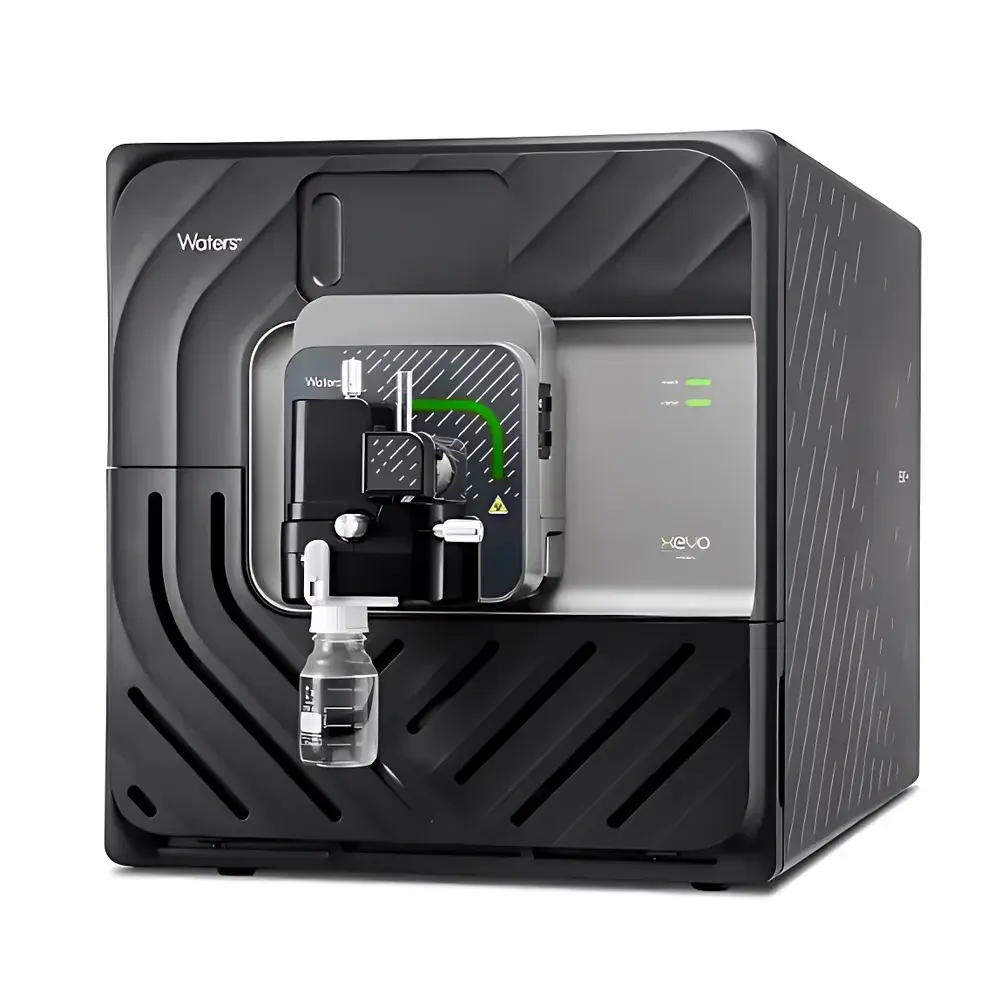
Waters Xevo CDMS Charge Detection Mass Spectrometer
| Brand | Waters |
|---|---|
| Origin | United Kingdom |
| Manufacturer Type | Authorized Distributor |
| Origin Category | Imported |
| Model | Xevo CDMS |
| Pricing | Available Upon Request |
Overview
The Waters Xevo CDMS is a purpose-built charge detection mass spectrometer engineered to resolve the mass and charge heterogeneity of intact macromolecular assemblies in the mega-Dalton (MDa) range — a regime inaccessible to conventional mass spectrometry techniques. Unlike traditional high-mass MS platforms that rely on deconvolution of multiply charged ion envelopes or indirect inference from fragment ions, the Xevo CDMS operates on the principle of single-particle charge detection. It employs an electrostatic linear ion trap (ELIT) to isolate and measure individual ions in real time, simultaneously recording both their time-of-flight (TOF) and induced image charge signal. From these two orthogonal measurements — m/z-dependent arrival time and charge-dependent signal amplitude — the instrument computes the absolute mass of each ion with no reliance on calibration standards or charge-state assignment algorithms. This direct, label-free, single-ion mass measurement enables unambiguous characterization of highly heterogeneous, non-covalent complexes including viral vectors, virus-like particles (VLPs), ribonucleoprotein assemblies, mRNA-lipid nanoparticles, and multi-subunit protein complexes.
Key Features
- Electrostatic Linear Ion Trap (ELIT) architecture for stable trapping and parallel detection of single ions across broad mass and charge ranges
- Simultaneous acquisition of time-of-flight and induced charge signals for direct, calibration-free mass calculation
- No requirement for charge-state deconvolution or spectral fitting — each detected ion yields a discrete mass value
- Native-like analysis conditions compatible with volatile and semi-volatile buffers, preserving non-covalent interactions
- Integrated high-vacuum differential pumping system optimized for low-noise charge detection and minimal ion scattering
- Modular front-end compatibility with electrospray ionization (ESI), nano-ESI, and native MS-compatible sources
Sample Compatibility & Compliance
The Xevo CDMS supports analysis of intact biomolecular assemblies ranging from ~100 kDa to >100 MDa, including adeno-associated virus (AAV) capsids, lentiviral vectors, extracellular vesicles, synthetic lipid nanoparticles (LNPs), and large ribosomal subunits. Sample introduction is compatible with standard native MS workflows using ammonium acetate, Tris-HCl, or HEPES-based buffers at near-physiological pH. Instrument design adheres to ISO 9001-certified manufacturing protocols. Data acquisition and processing modules support audit trails, electronic signatures, and user access controls aligned with FDA 21 CFR Part 11 and EU Annex 11 requirements. Full traceability is maintained through instrument log files, method versioning, and raw data immutability features — essential for GLP- and GMP-regulated environments in biopharmaceutical development.
Software & Data Management
Instrument control, data acquisition, and visualization are managed via UNIFI Scientific Information System — Waters’ enterprise-grade platform for regulated laboratories. The CDMS-specific module provides automated peak detection, mass distribution histogram generation, charge-state-resolved mass spectra, and statistical evaluation of polydispersity (e.g., mass distribution width, modal mass, skewness). All raw datasets are stored in vendor-neutral .CDF format, enabling third-party reprocessing and long-term archival compliance. Batch processing workflows support IQ/OQ/PQ documentation templates, and integration with LIMS systems is achieved via RESTful APIs and standardized data exchange protocols (e.g., ASTM E1703, HL7 FHIR). Audit trail reports include timestamps, operator IDs, parameter changes, and data export events — fully compliant with ALCOA+ principles.
Applications
- Characterization of AAV vector empty/full ratios and aggregate content without chromatographic separation
- Quantitative assessment of mRNA encapsulation efficiency and payload integrity in LNPs
- Determination of stoichiometry and assembly fidelity in multi-domain therapeutic proteins and fusion constructs
- Structural stability profiling of VLPs under varying buffer, temperature, or excipient conditions
- Comparative analysis of biosimilar higher-order structure against reference products
- Supporting CMC development by providing orthogonal mass evidence for regulatory submissions (ICH Q5E, Q5C)
FAQ
What mass range is supported by the Xevo CDMS?
The instrument is validated for intact biomolecular analysis from approximately 100 kDa up to and beyond 100 MDa, with optimal performance observed between 500 kDa and 50 MDa.
Does the Xevo CDMS require special sample preparation?
No specialized derivatization or digestion is needed. Native electrospray-compatible buffers and standard desalting protocols (e.g., SEC, dialysis, spin filtration) are sufficient.
How does CDMS differ from native top-down or HDX-MS?
CDMS measures absolute mass of intact ions without fragmentation or isotopic labeling; it complements rather than replaces structural probing techniques by providing definitive mass validation.
Is the system compatible with existing UNIFI deployments?
Yes — the Xevo CDMS integrates natively into UNIFI v2.5+ environments, sharing method libraries, user permissions, and reporting infrastructure.
What regulatory documentation is provided for qualification?
Waters supplies comprehensive IQ/OQ protocols, factory acceptance test (FAT) reports, and risk-based PQ guidance aligned with ISO/IEC 17025 and USP .






