
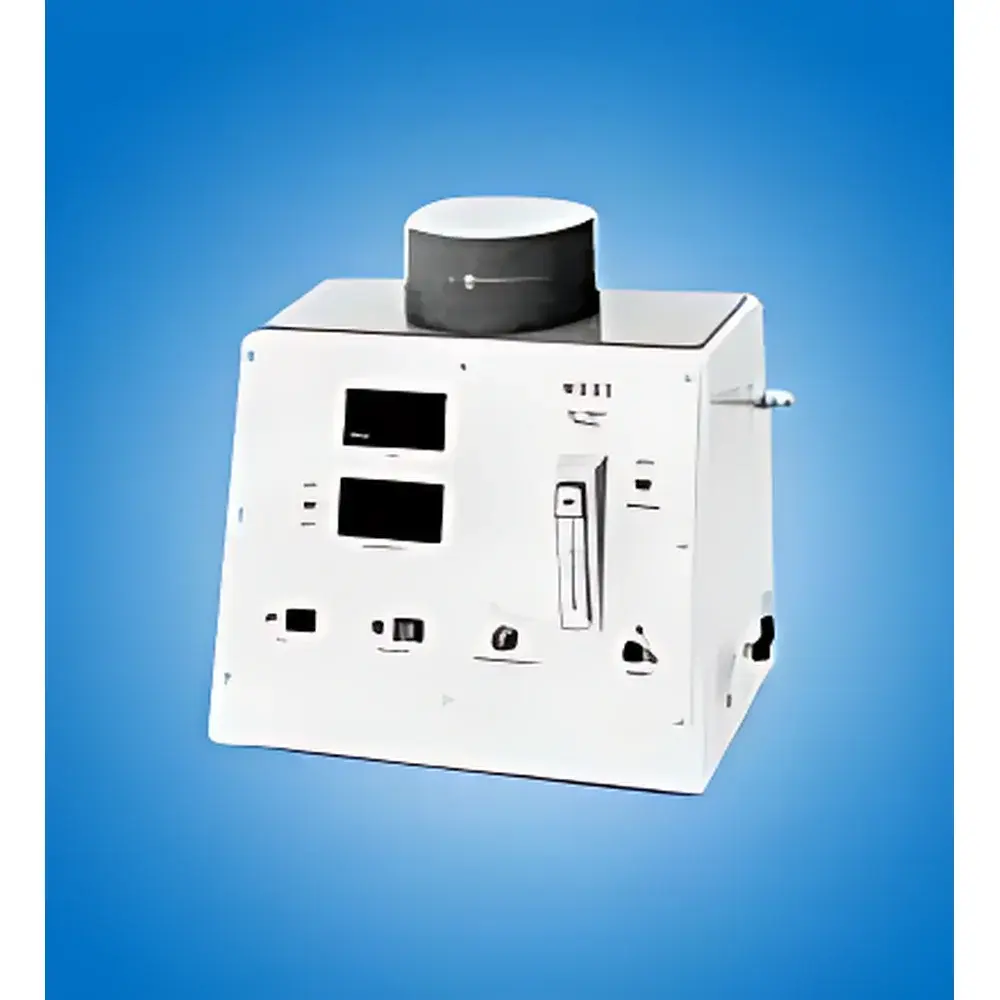
WDDG Water Vapor Transmission Rate (WVTR) Tester
| Origin | Germany |
|---|---|
| Manufacturer Type | Authorized Distributor |
| Origin Category | Imported Instrument |
| Model | WDDG |
| Pricing | Available Upon Request |
| Power Supply | 220 V AC, ~50 W |
| Carrier Gas | High-Purity Nitrogen, 5–10 L/h at ~0.5 bar inlet pressure |
| Measurement Range | 0–10 g/m²·day |
| Output | Direct digital readout across full scale (2.5-digit resolution) |
| Connected Meter | Triple-range analog meter (0–0.1 / 0–1.0 / 0–10 g/m²·day), 100 mV full-scale output |
| Accuracy | ±2% of reading or ±0.005 g/m²·day (whichever is greater) |
| Test Duration | 1–3 hours (sample-dependent) |
| Sample Diameter | 108 mm |
| Temperature Range | –20 °C to +60 °C |
| RH Gradient Generation | Compliant with DIN 53122 Part 2 |
| Dimensions (W×D×H) | 45 × 33 × 45 cm |
| Weight | 23 kg |
Overview
The WDDG Water Vapor Transmission Rate (WVTR) Tester is a precision gravimetric–electrolytic hybrid instrument engineered for the quantitative determination of water vapor permeation through flexible packaging materials under controlled temperature and relative humidity (RH) gradient conditions. Unlike purely gravimetric or infrared-based systems, the WDDG employs a validated electrolytic detection principle: water vapor permeating through the test specimen is swept by ultra-dry nitrogen carrier gas into a dual-electrode measurement cell. Inside the cell, P2O5-coated spiral mesh electrodes quantitatively decompose absorbed H2O via electrolysis (2H2O → 2H2 + O2) under a stable 70 V DC bias. The resulting current—linearly proportional to the molar flux of water—is measured with microampere-level resolution, enabling trace-level WVTR quantification down to 0.005 g/m²·day. Designed in accordance with DIN 53122 Part 2, the system supports standardized RH gradient generation using saturated salt solutions or calibrated humidity chambers, ensuring metrological traceability for regulatory submissions and interlaboratory comparisons.
Key Features
- Electrolytic P2O5 sensor architecture delivering high sensitivity and long-term baseline stability without consumable desiccants or optical recalibration.
- Full-temperature operational range from –20 °C to +60 °C, enabling low-temperature barrier assessment for frozen-food packaging and accelerated aging studies.
- Triple-range analog output interface (0–0.1 / 0–1.0 / 0–10 g/m²·day) with 100 mV full-scale signal, compatible with legacy data loggers and modern SCADA systems.
- Modular sample holder accommodating circular specimens up to 108 mm diameter—optimized for ASTM F1249, ISO 15106-3, and GB/T 21528 compliant testing.
- Low-power design (~50 W) and compact footprint (45 × 33 × 45 cm) suitable for regulated QC laboratories with limited bench space and strict energy management protocols.
- Carrier gas delivery system integrated with pressure-regulated nitrogen inlet (0.5 bar) and mass flow monitoring—ensuring consistent purge velocity and minimizing boundary layer effects.
Sample Compatibility & Compliance
The WDDG accepts a broad spectrum of planar barrier materials including polymeric films (e.g., PET, PE, PP, EVOH laminates), metallized substrates, coated papers, waxed board, and thermoformed trays. Its sealed test chamber and defined diffusion area (π × (54 mm)²) ensure compliance with ISO 15106-3 (infrared detection reference method), ASTM F1249 (electrolytic sensor method), and DIN 53122-2 (standardized RH gradient specification). All hardware and procedural documentation are structured to support GLP-compliant operation, including audit-ready calibration logs, sensor validation records, and environmental parameter traceability (temperature, RH, gas flow). While not inherently 21 CFR Part 11 compliant, the analog output enables integration with validated LIMS or ELN platforms that enforce electronic signature, audit trail, and data integrity controls.
Software & Data Management
The WDDG operates as a stand-alone analog instrument, requiring no embedded firmware or proprietary software. Its 100 mV analog output allows seamless connection to third-party data acquisition systems (e.g., National Instruments DAQ, Keysight BenchVue, or LabVIEW-based QC suites) configured for time-synchronized logging, real-time curve fitting, and automated pass/fail reporting against predefined WVTR limits. Raw current signals are linearly converted to g/m²·day using NIST-traceable calibration factors stored in the host system. For laboratories maintaining paper-based SOPs, printed strip-chart recordings (via optional analog chart recorder) provide permanent, tamper-evident records satisfying basic GMP documentation requirements.
Applications
- Barrier validation of pharmaceutical blister lidding foils and cold-form foil laminates per USP and Ph. Eur. 5.3.
- Accelerated shelf-life modeling of snack food, coffee, and dried dairy packaging under sub-zero storage conditions.
- Comparative evaluation of nanocomposite film formulations for moisture-sensitive electronics encapsulation.
- Quality control release testing of medical device pouches per ISO 11607-1 Annex B and AAMI ST77.
- Development support for active packaging systems incorporating desiccant layers or moisture-scavenging polymers.
FAQ
What carrier gas is required, and why must it be nitrogen?
High-purity nitrogen (>99.999%) is mandatory to prevent interference from oxygen or ambient moisture in the carrier stream; residual O2 could oxidize electrode surfaces, while H2O impurities would elevate baseline current and compromise detection limit.
Can the WDDG measure at 0% RH on the dry side?
Yes—the system achieves effective 0% RH on the detection side via continuous nitrogen purging and P2O5’s strong affinity for water, creating a thermodynamic sink that maintains a near-zero partial pressure gradient across the sensor chamber.
Is calibration traceable to national standards?
Calibration is performed using certified reference films with gravimetrically determined WVTR values (e.g., NIST SRM 1941b-equivalent standards); calibration certificates include uncertainty budgets per ISO/IEC 17025 guidelines.
How frequently must the P2O5 electrodes be regenerated?
Under normal use (≤5 tests/day), electrode regeneration is required every 6–12 months; regeneration involves baking the glass cell at 120 °C under vacuum to remove adsorbed contaminants and restore stoichiometric P2O5 surface coverage.
Does the instrument comply with FDA requirements for pharmaceutical packaging testing?
While the WDDG itself is not FDA-certified, its measurement methodology aligns with FDA-recognized consensus standards (ASTM F1249, ISO 15106-3), and its analog output architecture supports integration into Part 11–compliant data ecosystems when paired with validated acquisition software and procedural controls.






