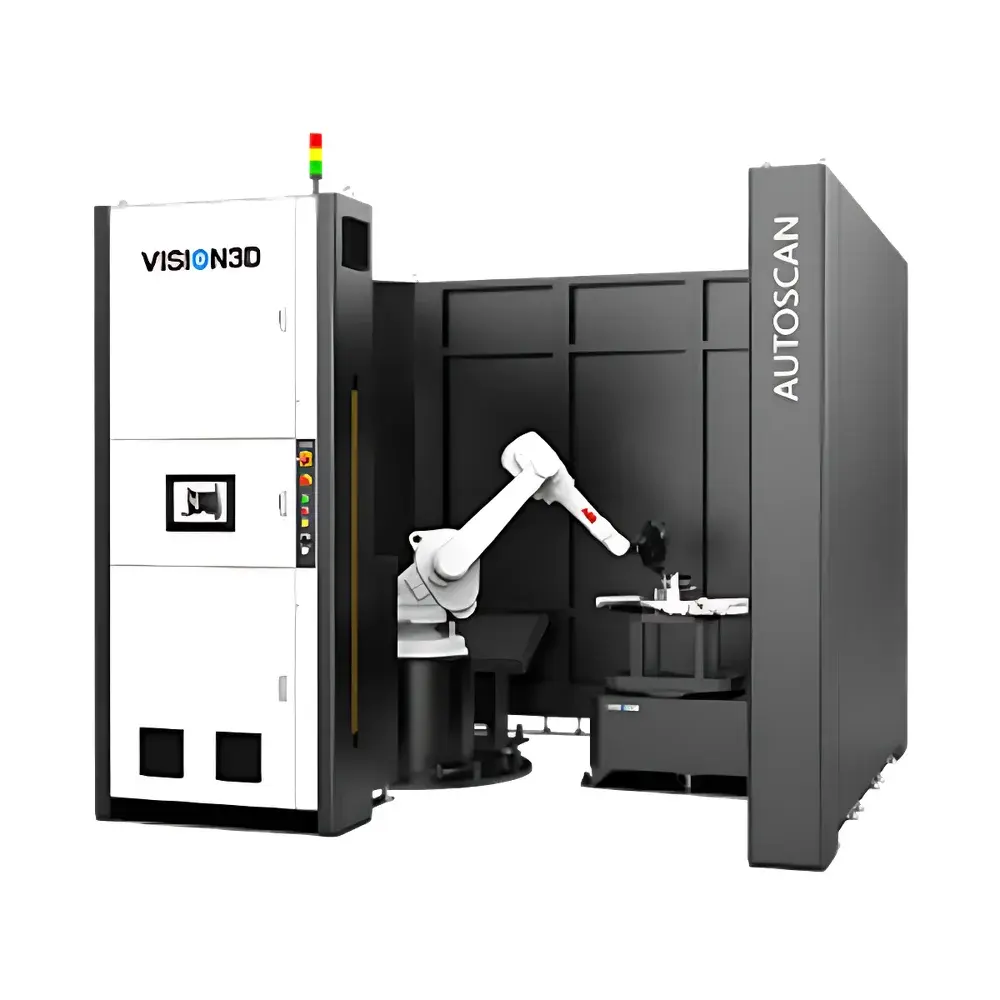
Weijing 3D AutoScan™ 1000 Series Automated Structured-Light 3D Scanner
| Brand | Weijing 3D |
|---|---|
| Model | AutoScan™ 1000 |
| Measurement Principle | Fringe Projection Profilometry (Structured Light) |
| Max. Measurable Volume | Ø1000 mm × H1000 mm |
| Host Weight | 4 kg |
| Origin | Hubei, China |
| Instrument Type | Industrial Automated 3D Coordinate Measurement System |
Overview
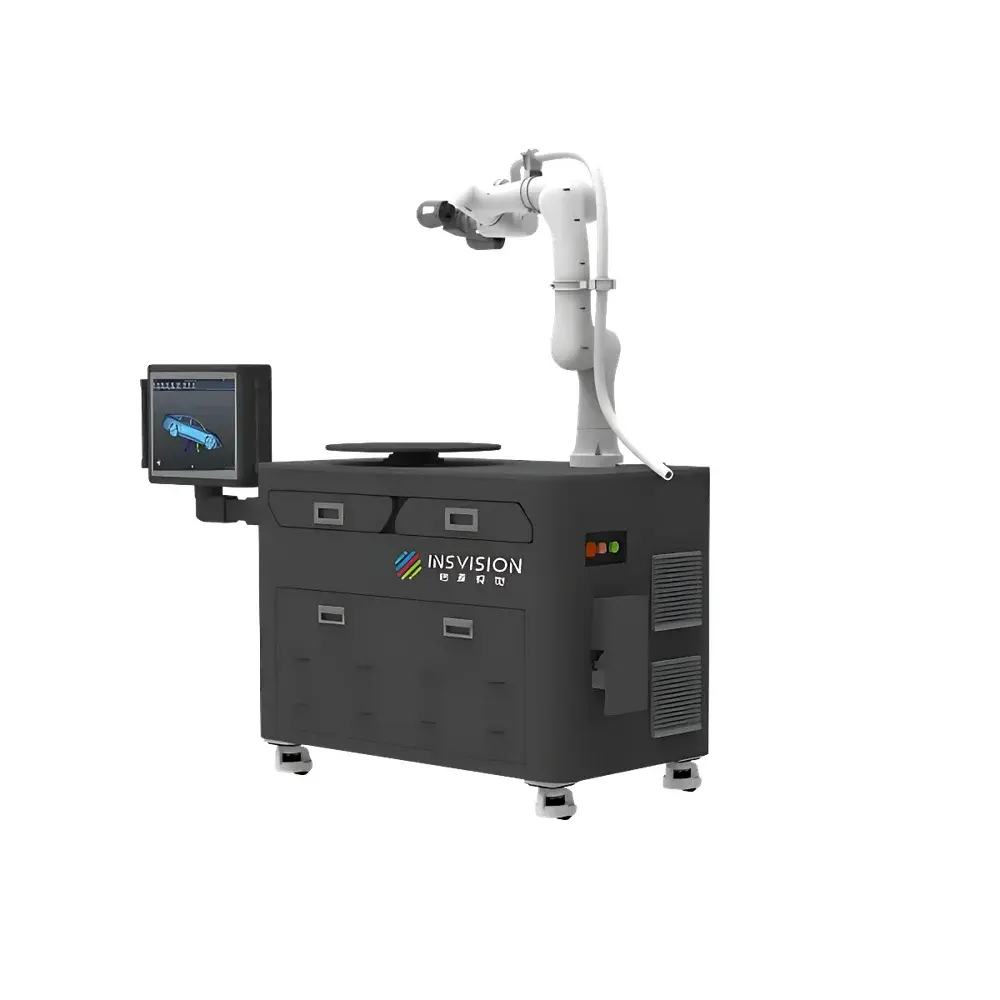
The Weijing 3D AutoScan™ 1000 Series Automated Structured-Light 3D Scanner is an industrial-grade coordinate measurement system engineered for high-accuracy, non-contact geometric metrology in production and quality assurance environments. It integrates high-resolution fringe projection profilometry with programmable robotic motion control to deliver fully automated, repeatable 3D digitization of medium-to-large components—up to Ø1000 mm × H1000 mm in volume. Unlike handheld or fixed-position scanners, the AutoScan™ 1000 employs synchronized multi-axis positioning (e.g., rotary table + linear stage or robot-mounted head) to enable full-surface coverage without manual repositioning, minimizing operator dependency and measurement uncertainty introduced by human intervention. The system operates on the principle of phase-shifted sinusoidal fringe projection: calibrated light patterns are projected onto the object surface, and sub-pixel displacement of deformed fringes—captured by high-dynamic-range CMOS stereo cameras—is triangulated to reconstruct dense point clouds with micron-level lateral resolution and sub-10 µm Z-axis repeatability under controlled environmental conditions (20 ± 1 °C, <50% RH). Designed for integration into factory-floor metrology workflows, it supports traceable dimensional verification per ISO 10360-8 and complies with fundamental requirements of ISO/IEC 17025 for accredited calibration laboratories.
Key Features
- Automated multi-angle acquisition via integrated robotic positioning system—eliminates manual part reorientation and ensures consistent pose registration
- High-fidelity structured-light engine with dual-band LED illumination (450 nm & 530 nm) optimized for reflective, matte, and dark-surface materials without spray coating
- Real-time mesh generation and adaptive point cloud densification based on local curvature and feature saliency
- Ruggedized aluminum-magnesium alloy housing (IP52 rated) and shock-absorbing mounting interface for stable operation on shop-floor vibration platforms
- Modular hardware architecture: scanner head, motion controller, and computing unit are decoupled for field-upgradable firmware and sensor calibration
- Built-in thermal drift compensation algorithm using embedded PT100 sensors and ambient temperature feedback loops
Sample Compatibility & Compliance
The AutoScan™ 1000 accommodates a broad spectrum of industrial parts—including machined castings, injection-molded housings, sheet metal assemblies, composite tooling, and additive-manufactured prototypes—without requiring surface preparation for most engineering polymers, anodized aluminum, stainless steel, and painted surfaces. It meets mechanical safety requirements per ISO 13857 and electromagnetic compatibility standards EN 61326-1:2013. While not certified as a Class I medical device, its measurement uncertainty budget has been validated against NIST-traceable step gauges and sphere artifacts per VDI/VDE 2634 Part 2 guidelines. Data output formats (STL, ASCII XYZ, PLY, and metrology-ready QIF v2.0) support downstream use in GD&T analysis software compliant with ASME Y14.5–2018 and ISO 1101:2017.
Software & Data Management
Bundled ScanMaster™ Control Suite (v4.2+) provides a deterministic, audit-ready workflow environment. All scan sessions generate immutable metadata logs—including timestamp, environmental readings, calibration ID, operator login, and motion path coordinates—enabling full traceability required under GLP and GMP frameworks. The software supports role-based access control (RBAC), electronic signatures per FDA 21 CFR Part 11 Annex 11, and encrypted SQLite database storage with optional integration into Siemens Teamcenter or PTC Windchill PLM systems via RESTful API. Raw point clouds undergo automatic outlier filtering, noise suppression via bilateral kernel convolution, and NURBS surface fitting with user-defined tolerance envelopes (±0.02 mm to ±0.5 mm). Exported inspection reports include color-mapped deviation maps, cross-sectional profiles, and statistical process control (SPC) charts aligned to CPK/Cpk indices.
Applications
- First-article inspection (FAI) and PPAP submission for Tier-1 automotive suppliers
- Digital twin creation for casting die wear monitoring and mold cavity deformation tracking
- Reverse engineering of legacy components lacking CAD documentation
- In-process validation of large-format additive manufacturing builds (e.g., aerospace ducting, turbine housings)
- Tooling verification prior to mass production ramp-up
- Dimensional stability assessment of thermally cycled composites and carbon-fiber structures
FAQ
Is the AutoScan™ 1000 compatible with existing CMM fixtures and granite tables?
Yes—the system features M6 and 1/4″-20 threaded mounting interfaces and supports custom kinematic coupling plates for rigid integration with standard CMM bases and modular fixturing systems.
Does it require external calibration artifacts for routine verification?
No—integrated self-calibration routines execute automatically during startup using internal reference gratings and photogrammetric alignment targets; optional annual verification with certified sphere arrays is recommended per ISO 10360-8 Clause 7.3.
Can measurement data be exported directly to PolyWorks or Geomagic Control X?
Yes—native .PIF and .WRP export modules are included, preserving GD&T annotations, datum definitions, and nominal/actual comparison hierarchies without loss of metrological context.
What environmental conditions affect measurement stability?
Ambient temperature fluctuations >±1.5 °C/hour or relative humidity >70% may induce refractive index drift in the optical path; climate-controlled metrology labs (ISO 554 Class 2) are recommended for certification-grade measurements.
Is robotic motion programming handled through proprietary software or industry-standard languages?
Motion sequences are defined in ScanMaster™ using graphical path planning; however, exported trajectories comply with ISO 9283 and can be imported into ROS 2 (Foxy+) or KUKA KRL environments via CSV-based waypoint interpolation.