
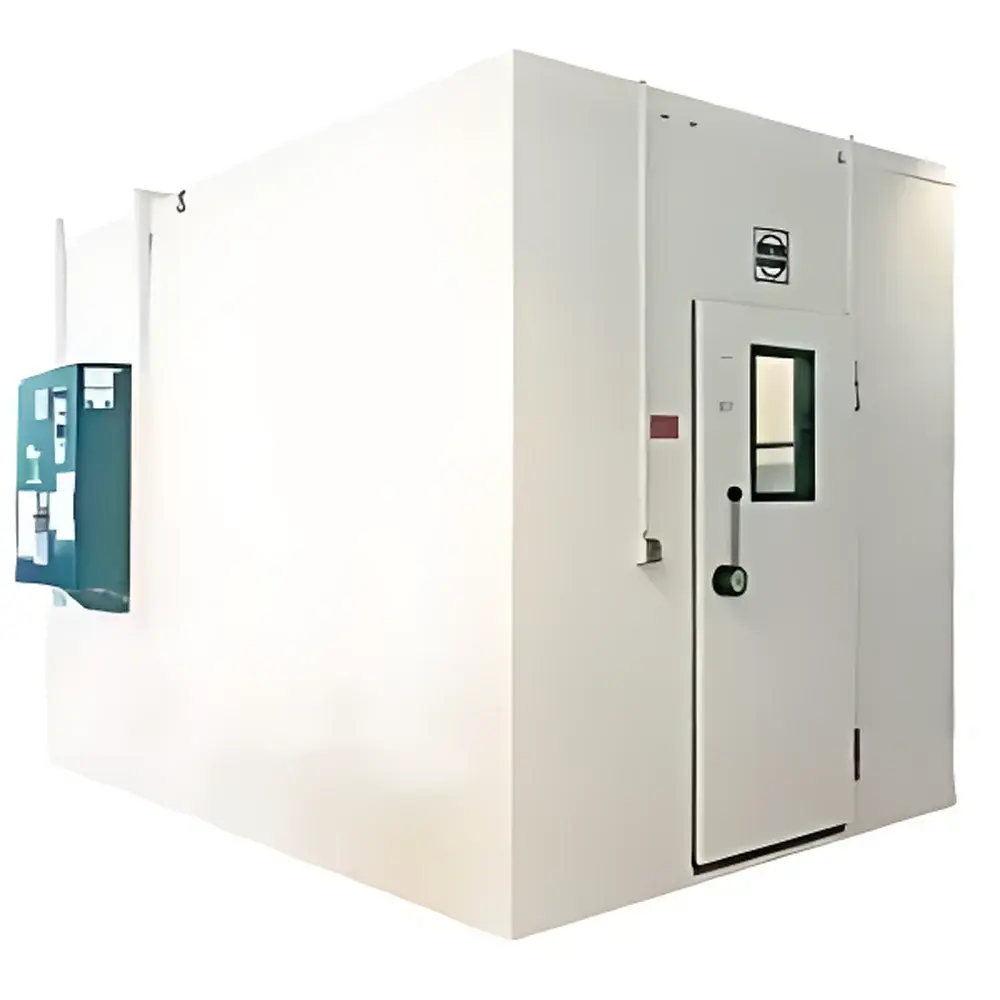
WEISS Walk-in Environmental Test Chamber WK-Series
| Brand | WEISS |
|---|---|
| Origin | Germany |
| Model | WK-Series |
| Chamber Volume Options | 4 m³, 10 m³, 15 m³, 25 m³, 32 m³, 41 m³ |
| Temperature Range | +20 °C to +45 °C |
| Temperature Uniformity | ≤ ±1 °C |
| Humidity Range | 20 % r.H. to 80 % r.H. |
| Humidity Stability (over time) | ≤ ±3 % r.H. |
| Insulation | CFC-free polyurethane (PU) foam |
| Control System | Microprocessor-based, compliant with GAMP 5 and FDA 21 CFR Part 11 |
| Humidification | Ultrasonic |
| Dehumidification | Refrigerant-based |
| Safety Features | Dual independent temperature safety cut-offs, sample temperature monitoring, emergency door release mechanism |
Overview
The WEISS WK-Series Walk-in Environmental Test Chamber is an engineered solution for long-term, high-fidelity stability testing under precisely controlled temperature and humidity conditions. Designed and manufactured in Germany by Weiss Umwelttechnik GmbH — a globally recognized leader in environmental simulation technology — this chamber operates on the principle of forced-air convection combined with precision refrigeration, ultrasonic humidification, and active dehumidification. It delivers stable, reproducible climatic conditions essential for pharmaceutical stability studies (ICH Q1–Q5), accelerated aging of medical devices, validation of packaging integrity, and compliance-driven quality assurance protocols across regulated industries. Its robust construction, validated thermal-hygric performance, and adherence to international regulatory frameworks make it suitable for GLP- and GMP-compliant laboratories conducting stability trials per ICH guidelines, USP , and ISO 14644-3.
Key Features
- CFC-free polyurethane (PU) insulation providing superior thermal resistance and long-term energy efficiency without ozone-depleting substances.
- Microprocessor-based control system with dual PID loops for independent temperature and humidity regulation, ensuring high repeatability and traceability.
- Ultrasonic humidification system delivering fine mist distribution with minimal mineral residue and no water-heating energy penalty.
- Refrigerant-based dehumidification integrated into the main cooling circuit, enabling precise low-humidity setpoints without desiccant consumables or regeneration cycles.
- Dual-stage temperature safety protection: primary controller limit plus independent mechanical overtemperature cut-off, both certified to EN 61000-6-2/6-4 EMC standards.
- Emergency external door release mechanism compliant with EN 179 and EN 1125, ensuring personnel safety during power failure or system lockout.
- Electropolished stainless-steel interior surfaces and seamless floor coving for cleanroom-compatible cleaning and microbial control.
- Double-coated metal door latch system with anti-corrosion plating and tactile feedback engagement verification.
Sample Compatibility & Compliance
The WK-Series accommodates diverse sample configurations — including stacked pallets, open shelving racks, and custom trolleys — within its fully accessible walk-in footprint. Internal dimensions are optimized for airflow uniformity, validated per ASTM E2875-23 (Standard Practice for Performance Verification of Environmental Chambers). All models meet ICH Q5C requirements for temperature uniformity (≤ ±1 °C) and humidity stability (≤ ±3 % r.H. over 24 h), with optional IQ/OQ/PQ documentation packages available. The system supports full audit trail functionality, electronic signatures, and role-based user access control aligned with FDA 21 CFR Part 11 and EU Annex 11 requirements. Calibration certificates traceable to DAkkS-accredited national standards are provided upon installation.
Software & Data Management
The integrated Weiss Climatix® control software enables real-time monitoring, remote alarm notification via SMTP/SMS, and automated report generation in PDF or CSV format. Data logging occurs at user-defined intervals (1 s to 60 min), with storage redundancy across internal flash memory and optional network-attached storage (NAS). All changes to setpoints, alarms, or user permissions are recorded with timestamp, operator ID, and reason-for-change fields — satisfying ALCOA+ data integrity principles. Exported datasets comply with CDISC SDTM standards for regulatory submission. Optional integration with LIMS and MES platforms is supported via OPC UA or Modbus TCP protocols.
Applications
- Pharmaceutical stability testing per ICH Q1A(R3), Q5C, and WHO TRS 1010 Annex 9.
- Accelerated aging studies for sterile barrier systems (ISO 11607-1/2) and combination products.
- Long-term storage condition validation for biologics, vaccines, and mRNA therapeutics.
- Environmental stress screening of automotive electronics (AEC-Q200), aerospace components (SAE ARP4754A), and industrial sensors.
- Reference chamber qualification in metrology labs performing ISO/IEC 17025-accredited calibration services.
- Climate resilience testing of sustainable building materials under cyclic RH/temperature profiles (ISO 15148).
FAQ
What volume options are available for the WK-Series chambers?
Standard configurations include 4 m³, 10 m³, 15 m³, 25 m³, 32 m³, and 41 m³ internal volumes. Custom footprints and height adjustments are available upon engineering review.
Is the chamber suitable for GMP-regulated stability studies?
Yes — all WK-Series units are supplied with FAT/SAT documentation, 3Q protocols, and optional 21 CFR Part 11-compliant software configuration for use in FDA- and EMA-inspected facilities.
How is humidity controlled without condensation or drift?
Ultrasonic humidification ensures rapid vapor dispersion with zero standing water, while the integrated refrigerant dehumidifier maintains dynamic equilibrium across the full 20–80 % r.H. range, minimizing hysteresis and overshoot.
Can the chamber be integrated into an existing laboratory infrastructure?
Yes — standard Ethernet (RJ45), RS485, and dry-contact alarm outputs enable seamless connection to BMS, SCADA, or centralized monitoring platforms.
What maintenance is required for the sensors and control system?
Temperature and humidity sensors are factory-calibrated and require no field recalibration; annual verification against NIST-traceable references is recommended per ISO/IEC 17025.



