
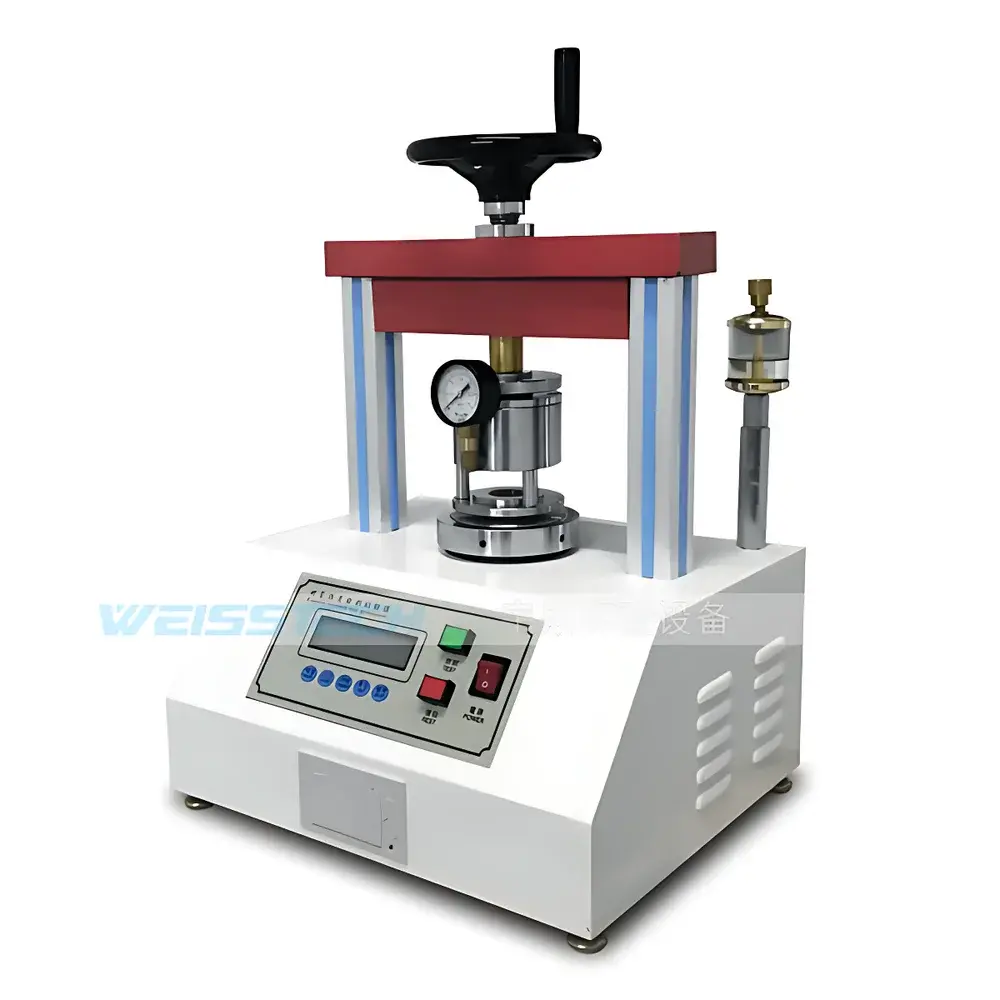
Weisstech WSPL-M Semi-Automatic Burst Strength Tester
| Brand | WEISSTECH |
|---|---|
| Origin | Guangdong, China |
| Manufacturer Type | Direct Manufacturer |
| Country of Origin | China |
| Model | WSPL-M |
| Price | ¥19,900 |
| Test Method | Semi-Automatic |
| Measurement Range | 200–5600 kPa |
| Unit Options | kPa, psi (lbf/in²), kgf/cm² |
| Accuracy | ±0.5% FS |
| Clamping Ring Diameter | Upper & Lower Rings: 31.5 mm |
| Hydraulic Oil Speed | 170 ± 15 mL/min |
| Display | LED Digital Display |
| Hydraulic Medium | Imported Silicone Oil |
| Power Supply | 220 V, 50 Hz |
| Safety Protection | Automatic pressure relief upon overpressure detection |
Overview
The Weisstech WSPL-M Semi-Automatic Burst Strength Tester is an engineered solution for standardized determination of the bursting strength of corrugated fiberboard, linerboard, and other rigid paper-based packaging materials. It operates on the principle of hydraulic pressure application through a calibrated diaphragm (rubber membrane) constrained by concentric clamping rings, in strict accordance with ISO 2758, TAPPI T403, ASTM D774, and GB/T 6545—international standards governing burst resistance testing for paper and board. Unlike fully manual or purely mechanical testers, the WSPL-M integrates electromechanical actuation with closed-loop pressure control, enabling consistent force ramping, precise peak detection, and repeatable sample failure characterization without operator-dependent loading variability.
Key Features
- Semi-automated test cycle: Initiated with a single press of the “Test” button—automatically engages hydraulic pressure, detects burst point, relieves load, and finalizes data output.
- Dual-ring clamping system: Precision-machined upper and lower clamping rings (Ø31.5 mm) ensure uniform sample confinement and minimize edge effects during pressurization.
- High-fidelity pressure transduction: Digitally calibrated sensor with ±0.5% full-scale accuracy enables traceable measurement across the 200–5600 kPa range.
- Multi-unit display capability: Real-time switching between kPa, psi (lbf/in²), and kgf/cm² supports global reporting requirements and lab interoperability.
- Imported silicone oil hydraulic system: Provides stable viscosity over ambient temperature fluctuations (15–30°C), ensuring reproducible flow dynamics and long-term seal integrity.
- Integrated safety interlock: Monitors real-time pressure trajectory; triggers immediate hydraulic release if exceeding preset thresholds—preventing membrane rupture and eliminating routine replacement downtime.
- LED digital interface: High-contrast, backlit display delivers clear readouts under varied lighting conditions and requires no external software for basic operation.
Sample Compatibility & Compliance
The WSPL-M accommodates standard test specimens measuring 140 mm × 140 mm (per ISO 2758) or 6.5 in × 6.5 in (per TAPPI T403), suitable for single-wall, double-wall, and triple-wall corrugated boards, solid bleached sulfate (SBS), chipboard, and recycled linerboard. Its clamping geometry and pressure ramp rate (170 ± 15 mL/min) comply with the hydraulic displacement requirements specified in ASTM D774 Annex A1 for burst testing consistency. The instrument’s mechanical design conforms to CE-relevant safety directives (2006/42/EC) and meets electromagnetic compatibility (EMC) Class B limits per EN 61326-1. Calibration traceability aligns with ISO/IEC 17025–accredited practices when used with NIST-traceable pressure standards.
Software & Data Management
While the WSPL-M operates as a standalone unit with local LED readout and thermal printout functionality, its analog pressure signal output (0–10 V or 4–20 mA, optional) supports integration into centralized QC data acquisition systems. When paired with third-party LabVIEW or SCADA platforms, test records—including burst value, time-to-failure, and pressure curve metadata—can be archived with timestamp, operator ID, and instrument serial number. Audit trails comply with GLP and GMP documentation expectations where electronic records are subject to 21 CFR Part 11 controls (when implemented via validated external software). No proprietary cloud service or vendor-hosted platform is required or embedded.
Applications
- Quality assurance laboratories in corrugated box manufacturing facilities verifying batch conformity to customer-specified burst strength minima.
- R&D departments evaluating pulp furnish composition, wet-end additives, or calendering parameters’ impact on board structural integrity.
- Third-party testing agencies performing accredited conformance testing against ISO, ASTM, or GB standards for export certification.
- Packaging engineers correlating burst strength with edge crush test (ECT) and compression performance in stack-load modeling.
- Supplier qualification programs requiring documented repeatability (RSD < 2.5% across n=10 replicates on homogeneous board).
FAQ
What standards does the WSPL-M support out of the box?
It is configured to meet ISO 2758, TAPPI T403, ASTM D774, and GB/T 6545 without hardware modification.
Is calibration certificate included with shipment?
A factory calibration report (non-accredited) is supplied; users must perform periodic verification using certified deadweight testers or pressure calibrators per ISO 6508-1.
Can the instrument test non-corrugated materials such as kraft paper or cardboard?
Yes—provided specimens meet minimum thickness (≥0.15 mm) and dimensional stability requirements under hydraulic loading; results remain valid only if clamping does not induce premature slippage or wrinkling.
What maintenance intervals are recommended?
Silicone oil should be replaced every 12 months or after 5,000 test cycles; rubber diaphragms require inspection every 500 cycles and replacement if microcracking or permanent deformation is observed.
Does the WSPL-M support network connectivity or USB data export?
No native USB or Ethernet port is integrated; data export relies on thermal printout or optional analog signal interfacing to external DAQ hardware.





