
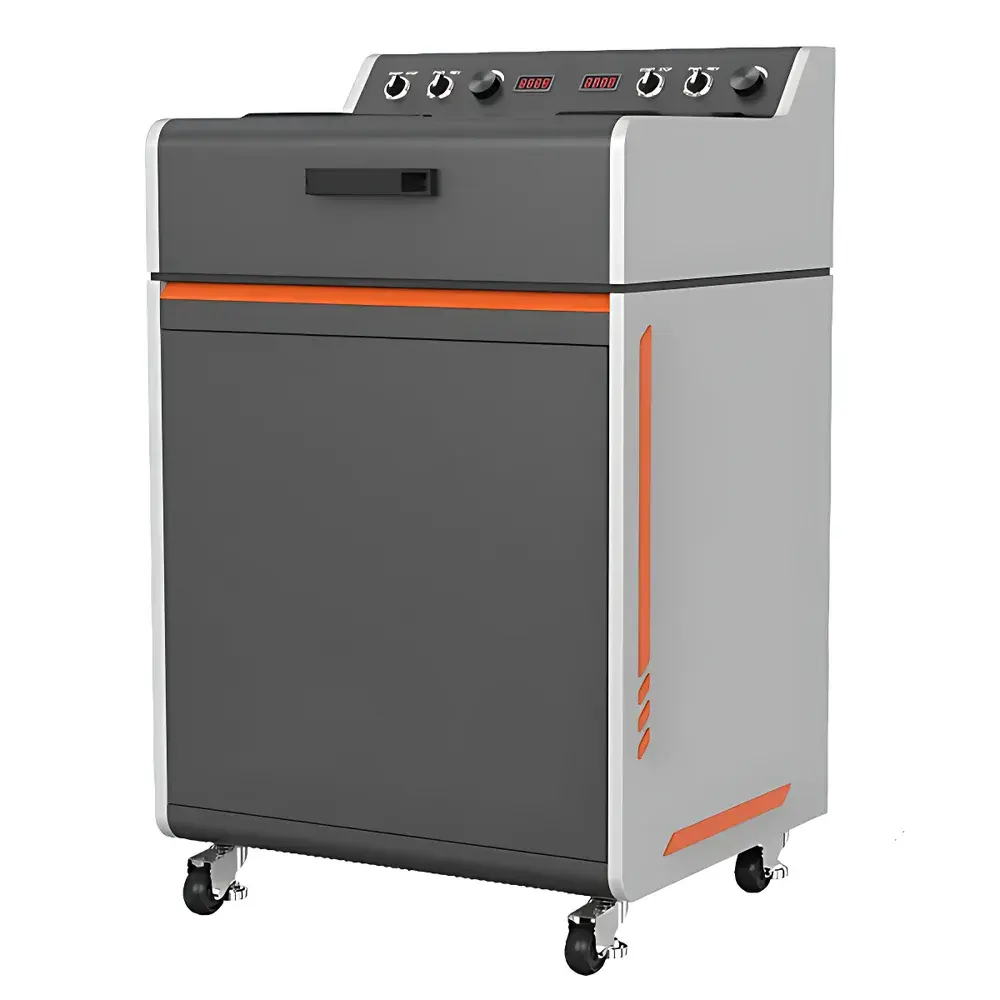
WEIYEE SDJ-2 Dual-Band Belt Grinding and Polishing Machine
| Brand | WEIYEE |
|---|---|
| Origin | Guangdong, China |
| Manufacturer Type | Authorized Distributor |
| Country of Origin | China |
| Model | SDJ-2 |
| Speed Range | 50–1500 rpm (infinitely variable) |
| Number of Grinding Belts | 2 |
| Belt Dimensions | 100 × 920 mm |
| Rotation | Bidirectional (forward/reverse) |
| Power Supply | 220 V AC |
Overview
The WEIYEE SDJ-2 Dual-Band Belt Grinding and Polishing Machine is an industrial-grade sample preparation system engineered for consistent, reproducible surface conditioning of metallic, ceramic, polymer, and composite specimens prior to metallurgical analysis, microstructural evaluation, or mechanical testing. Unlike single-belt grinders, the SDJ-2 integrates two independently driven abrasive belts operating in parallel—enabling sequential coarse grinding and fine polishing within a single setup without manual repositioning. Its operation is based on controlled tangential belt motion across a precision-machined platen, where specimen flatness, edge retention, and minimal subsurface deformation are maintained through regulated contact pressure, speed synchronization, and bidirectional belt rotation. Designed for integration into ISO/IEC 17025-accredited laboratories and QC/QA workflows compliant with ASTM E3, ISO 1463, and EN 10365, the SDJ-2 supports standardized metallographic preparation protocols while minimizing operator-induced variability.
Key Features
- Two synchronized abrasive belts (100 × 920 mm each), allowing simultaneous coarse grinding and fine finishing—reducing process steps and cross-contamination risk.
- Infinitely variable speed control (50–1500 rpm) with digital tachometric feedback, enabling precise adaptation to material hardness, abrasiveness, and desired removal rate.
- Bidirectional belt rotation (forward/reverse) mitigates asymmetric wear, extends belt service life, and improves planarity during extended runs on large or irregular samples.
- Robust cast-iron frame with vibration-damped base ensures mechanical stability under load, critical for maintaining dimensional fidelity during high-pressure grinding.
- Adjustable specimen holder with calibrated tilt and lateral lock accommodates specimens from 10 mm to 120 mm in width and up to 50 mm in thickness.
- Integrated dust extraction port (Ø60 mm) compatible with standard laboratory vacuum systems, supporting OSHA-compliant particulate containment and filter longevity.
Sample Compatibility & Compliance
The SDJ-2 accommodates flat, cylindrical, and prismatic specimens across a broad materials spectrum—including ferrous and non-ferrous alloys (e.g., stainless steels, aluminum 6061, titanium Ti-6Al-4V), sintered carbides, oxide ceramics (Al₂O₃, ZrO₂), thermoset composites, and geological thin sections. It complies with mechanical safety requirements per IEC 61000-6-2 (EMC immunity) and IEC 61000-6-4 (EMC emission), and its electrical design conforms to GB/T 19001–2016 (equivalent to ISO 9001). When operated with certified abrasive media and documented SOPs, the system supports GLP-aligned traceability for metallurgical reporting under ASTM E407 and ISO 643.
Software & Data Management
The SDJ-2 operates via an embedded microcontroller interface with tactile push-button controls and LED status indicators—no external PC or proprietary software required. All operational parameters (speed setpoint, runtime, direction mode) are retained in non-volatile memory after power cycling. While the unit does not feature network connectivity or audit-trail logging, its deterministic mechanical behavior and repeatable speed calibration enable full integration into LIMS environments via external PLC-triggered start/stop signals and analog 4–20 mA speed monitoring outputs (optional add-on). For FDA-regulated labs, optional validation documentation packages—including IQ/OQ protocols aligned with 21 CFR Part 11 data integrity principles—are available upon request.
Applications
- Preparation of cross-sectional specimens for SEM-EDS, EPMA, and microhardness mapping (e.g., weld zones, coating interfaces, heat-affected regions).
- Routine flattening and chamfering of as-cast or forged coupons prior to tensile bar machining per ASTM E8/E8M.
- Edge preservation grinding of brittle materials (e.g., silicon wafers, dental zirconia) where wheel-based systems induce microcracking.
- Standardized surface roughness reduction for adhesion testing substrates (ASTM D4541) and corrosion coupon exposure studies (ASTM G1).
- High-throughput sample conditioning in failure analysis labs handling >50 specimens/day, particularly in aerospace OEM supplier QA departments.
FAQ
Is the SDJ-2 suitable for automated integration into a robotic sample prep line?
Yes—the machine features dry-contact relay outputs for cycle completion signaling and accepts 24 V DC trigger inputs for remote start/stop, facilitating synchronization with gantry loaders or conveyor-based staging systems.
Can custom belt widths or grit configurations be supplied?
WEIYEE offers OEM belt mounting kits compatible with industry-standard 100 mm width belts; non-standard lengths (e.g., 1200 mm) and coated abrasive types (alumina, silicon carbide, diamond-impregnated) are available under minimum order quantities.
Does the unit include CE or UL certification?
The SDJ-2 carries CCC (China Compulsory Certification) and meets EMC and low-voltage directive requirements equivalent to CE; UL 61010-1 listing is available for North American deployment upon request and additional factory testing.
What maintenance intervals are recommended for long-term reliability?
Belt tension rollers require lubrication every 500 operating hours; drive belts and motor brushes should be inspected at 2,000-hour intervals; full calibration verification (speed accuracy ±1.5% FS) is advised annually or after 10,000 cycles.
Is technical support available outside mainland China?
WEIYEE provides remote diagnostics and English-language service manuals globally; certified field engineers operate in Southeast Asia, the Middle East, and select EU markets under distributor partnership agreements.



