
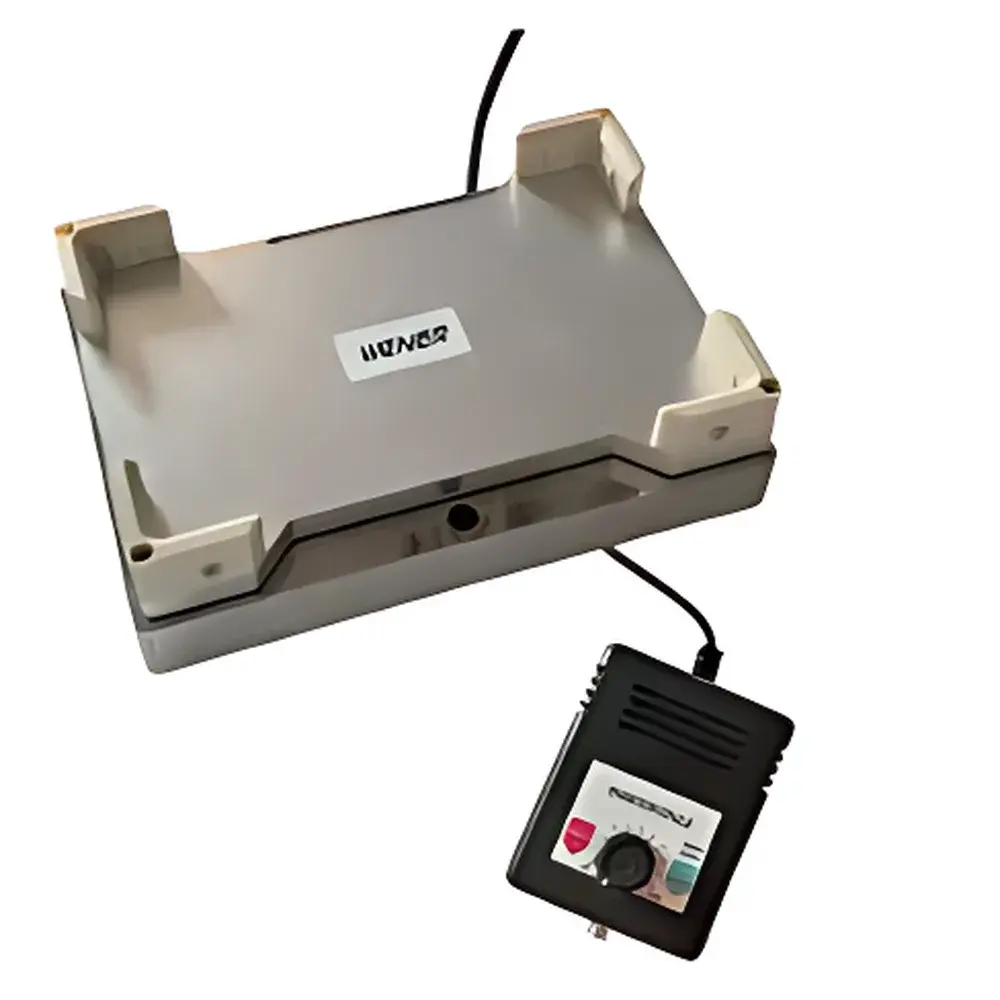
Wener SparkShake Magnetic Microplate Shaker
| Brand | Wener |
|---|---|
| Model | SparkShake |
| Type | Magnetic Microplate Shaker |
| Dimensions (L×W×H) | 146 × 103 × 42 mm |
| Weight | 2000 g |
| Speed Range | 100–2000 rpm |
| Amplitude | 2 mm |
| Positioning Accuracy | ±0.1 mm |
| Oscillation Modes | Orbital or Linear |
| Plate Compatibility | SBS-standard microplates (6-, 12-, 24-, 48-, 96-, 384-well plates and reservoirs) |
| Max Load | 500 g |
| Temp. Range | 5–80 °C |
| RH Limit | ≤85% non-condensing |
| Interface | RS232 |
| Control | Physical button panel |
| Origin | Shanghai, China |
| Manufacturer | Wener Nanotech |
Overview
The Wener SparkShake Magnetic Microplate Shaker is an engineered solution for precise, low-profile orbital or linear agitation of SBS-standard microplates in life science laboratories and integrated automation environments. Unlike conventional mechanical shakers, the SparkShake employs a contactless magnetic drive system—eliminating belt wear, mechanical backlash, and maintenance-intensive components—while delivering high reproducibility across speed ranges from 100 to 2000 rpm. Its compact footprint (146 × 103 × 42 mm) and thin-profile architecture enable seamless integration into robotic workcells, stackable incubator modules, or benchtop workflows where spatial constraints and thermal management are critical. Designed for consistent mixing of low-volume samples—including ELISA assays, cell-based assays, enzymatic reactions, and nucleic acid hybridization—the device ensures uniform kinetic energy transfer without splashing, even at high speeds, via programmable soft-start ramping and real-time positional stabilization.
Key Features
- Compact, low-profile design optimized for automation integration—fits beneath standard deck rails and within confined instrument footprints.
- Contactless magnetic drive mechanism ensures long-term operational stability, zero mechanical wear, and silent operation (<45 dB(A) at 1500 rpm).
- Dual oscillation modes: selectable orbital (circular) or linear motion—configurable per protocol requirements to optimize mixing efficiency for viscous, foaming, or sediment-prone samples.
- Adjustable plate clamping force accommodates diverse plate types—from thin-wall PCR plates to reinforced 384-well assay plates—without deformation or slippage.
- Auto-homing function returns the platform to its calibrated origin position with ±0.1 mm repeatability after each run, ensuring positional consistency for downstream robotic arm pickup.
- Physical button interface with intuitive LED status indicators supports standalone operation; no software installation required for basic timing and speed control.
Sample Compatibility & Compliance
The SparkShake is validated for use with all SBS-compliant microplates and reservoirs, including 6-, 12-, 24-, 48-, 96-, and 384-well formats. Its vibration profile maintains sample integrity across common life science applications: enzyme kinetics, immunoassays, bacterial culture resuspension, and binding assays requiring homogeneous suspension. The unit operates reliably under ambient conditions ranging from 5 °C to 80 °C with relative humidity up to 85% (non-condensing), making it suitable for use inside temperature-controlled enclosures or adjacent to incubators. While not certified as a medical device, its construction complies with IEC 61010-1 safety standards for laboratory equipment. All electrical interfaces meet CE and RoHS directives. For GLP/GMP environments, the RS232 interface supports external logging of run parameters (speed, duration, mode), enabling traceability when paired with compliant LIMS or ELN systems.
Software & Data Management
The SparkShake operates natively via front-panel controls but includes an open RS232 serial interface for external command integration. Communication follows ASCII-based protocol documentation available upon request—enabling direct control from LabVIEW, Python (pySerial), or third-party scheduling software. Supported commands include speed setpoint, run time, oscillation mode selection, start/stop, and status query. No proprietary drivers or middleware are required. For audit-trail compliance, users may log timestamps, executed commands, and error codes externally. Though the device lacks on-board data storage or cloud connectivity, its deterministic response and hardware-level auto-homing support repeatable, protocol-driven operation essential for regulated workflows aligned with FDA 21 CFR Part 11 principles when implemented with appropriate procedural controls.
Applications
- ELISA and multiplex immunoassay plate washing and reagent mixing prior to detection.
- Cell suspension homogenization in viability assays and transfection protocols.
- Hybridization steps in DNA/RNA probe-based assays requiring gentle yet thorough agitation.
- Pre-incubation mixing for high-throughput screening (HTS) libraries prior to plate reader analysis.
- Integration into automated liquid handling platforms (e.g., Hamilton STAR, Tecan Fluent) as a dedicated shaking module between dispensing and reading steps.
- Temperature-stable agitation during kinetic assays conducted inside heated enclosures or environmental chambers.
FAQ
Does the SparkShake support programmable multi-step protocols (e.g., ramp-up, hold, ramp-down)?
No—it supports single-step timed runs with fixed speed and mode. Multi-segment profiles require external controller coordination via RS232.
Can it be used inside a CO₂ incubator?
Yes, provided internal temperature remains within 5–80 °C and humidity stays below 85% non-condensing; verify compatibility with incubator manufacturer regarding electromagnetic interference.
Is calibration documentation available for ISO/IEC 17025 labs?
Factory calibration reports (position accuracy, speed linearity, amplitude verification) are supplied with each unit; user-performed periodic verification using NIST-traceable tachometers or laser displacement sensors is recommended.
What is the maximum allowable plate height for full travel clearance?
Plates up to 22 mm tall (including lid) are fully accommodated without interference; taller accessories require mechanical clearance verification.
Does the RS232 interface support handshaking or flow control?
Yes—hardware RTS/CTS flow control is implemented; default settings: 9600 baud, 8N1, no parity.





