
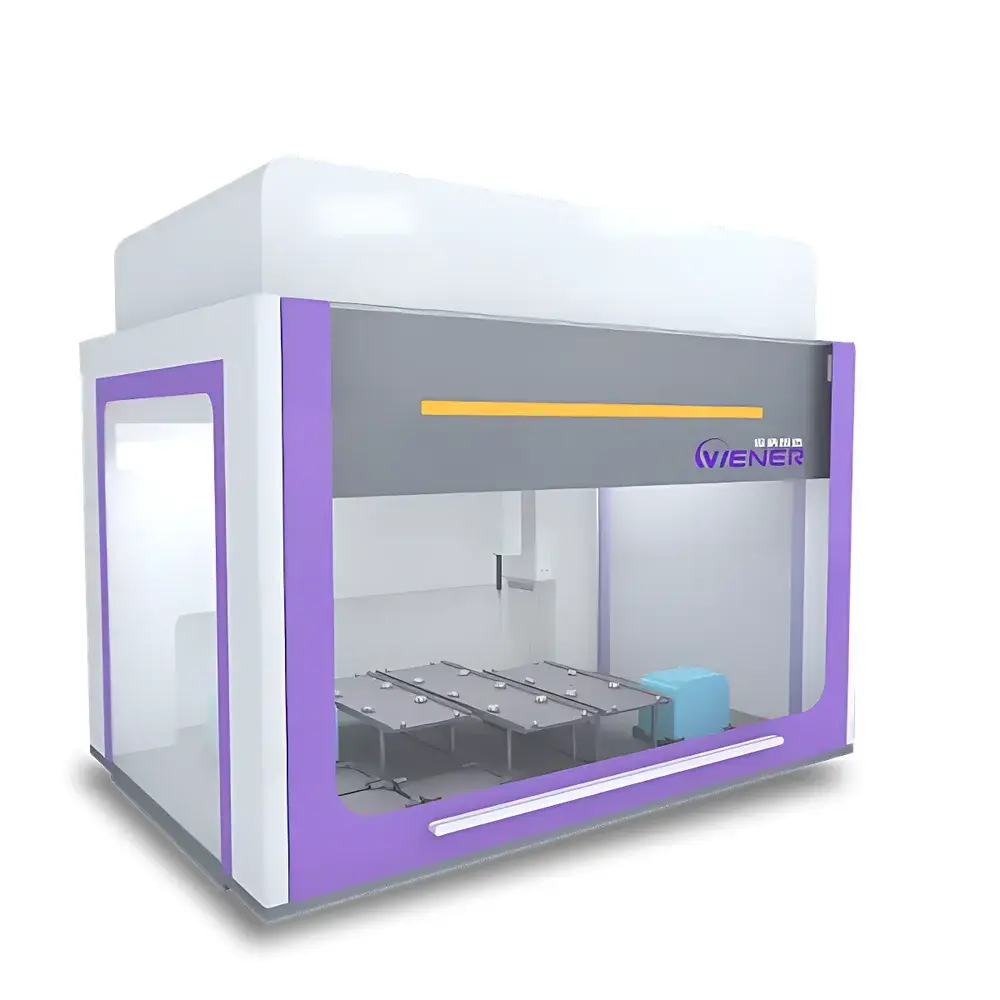
WenerLab V20 Medium-Throughput Liquid Handling Workstation
| Brand | Wener |
|---|---|
| Origin | Shanghai, China |
| Manufacturer Type | Original Equipment Manufacturer (OEM) |
| Country of Origin | China |
| Model | WenerLab V20 |
| Quotation | Upon Request |
| Deck Positions | 20 |
| Pipetting Accuracy | ≤5% at 1 μL |
| Pipetting Range | 0.5–1000 μL |
| Throughput Configurations | Single-channel, 8-channel, 16-channel |
| Dimensions (W×D×H) | 990 × 708 × 865 mm |
Overview
The WenerLab V20 Medium-Throughput Liquid Handling Workstation is an engineered platform for precise, reproducible, and scalable liquid manipulation in regulated and research-intensive laboratory environments. Built upon a modular, open-architecture design, it implements positive-displacement and air-displacement pipetting principles—optimized for volumetric accuracy across a broad dynamic range (0.5–1000 μL). Its core functionality centers on automated aspiration, dispensing, serial dilution, reagent addition, plate replication, and multi-step mixing protocols, with mechanical repeatability validated under ISO 8655-6 (volumetric performance of piston-operated pipettes) and aligned with CLSI EP10-A3 guidelines for method comparison and bias estimation. The workstation’s rigid aluminum-alloy frame, temperature-stable linear motion system, and closed-loop stepper motor control ensure positional fidelity and long-term operational consistency—critical for assay development, sample preparation prior to LC-MS or NGS workflows, and QC/QA batch processing.
Key Features
- 20-position deck layout supporting standard SBS-format microplates (96-well, 384-well), tube racks (1.5/2.0 mL, PCR strips), and custom labware via programmable coordinate mapping
- Interchangeable pipetting modules: single-channel, 8-channel, and 16-channel heads—each calibrated per ISO 8655-2 and traceable to NIM (National Institute of Metrology, China) standards
- Onboard precision: ≤5% CV at 1 μL; ≤1% CV at 50 μL; ≤0.5% CV at 500 μL (tested with aqueous glycerol solutions at 22 °C, RH 45–60%)
- Integrated anti-contamination safeguards: tip ejection force optimization, UV-LED sterilization zone (optional), and real-time tip presence detection via capacitive sensing
- Modular expansion interface compliant with ANSI/SLAS 4–2004 footprint specifications—enabling seamless integration of thermal control units (4–45 °C), orbital shakers (200–1200 rpm), and 2D barcode readers (ISO/IEC 15415 certified)
Sample Compatibility & Compliance
The WenerLab V20 handles low-viscosity aqueous buffers, serum, cell lysates, ethanol-based reagents, and diluted organic solvents (e.g., acetonitrile <30% v/v). It supports ANSI/SLAS-compliant consumables—including filtered and non-filtered tips (10–1000 μL), skirted and unskirted plates, and low-binding tubes. All firmware and motion control logic are designed to meet GLP/GMP documentation requirements: audit trail logging (user ID, timestamp, protocol name, parameter changes), electronic signature support (per FDA 21 CFR Part 11 Annex 11 readiness), and configurable data retention policies. Device calibration records, maintenance logs, and performance verification reports (PV-1, PV-2) are exportable in CSV/PDF formats for internal QA review or regulatory submission.
Software & Data Management
Controlled via WenerSoft v3.2—a Windows-based application featuring drag-and-drop protocol builder, real-time execution monitoring, and integrated error recovery logic (e.g., tip clog detection, volume mismatch alert, deck collision avoidance). Protocols are stored in encrypted SQLite databases with version control and rollback capability. Raw log files include timestamped event streams (motor step counts, pressure sensor outputs, tip ejection cycles) for root-cause analysis. Data export supports direct linkage to LIMS platforms via RESTful API (JSON/XML payloads) and instrument-interfacing standards including ASTM E1384 and HL7 v2.x. Software validation packages (IQ/OQ/PQ documentation) are provided for GxP-regulated users.
Applications
- High-fidelity sample normalization for qPCR and digital PCR template preparation
- Automated ELISA and immunoassay plate setup—including standard curve generation and conjugate addition
- Library preparation for next-generation sequencing (NGS), including fragmentation, end-repair, A-tailing, and adapter ligation steps
- Compound dilution series generation for IC₅₀/EC₅₀ screening in early-stage drug discovery
- Cell culture media exchange and reagent dosing in 3D spheroid and organoid assays
- QC release testing of biologics—buffer exchange, formulation dilution, and stability time-point sampling
FAQ
Is the WenerLab V20 compatible with third-party tip brands?
Yes—mechanical tip fit follows ISO 8655-3 dimensional tolerances; compatibility verified with major global suppliers (e.g., Eppendorf, Gilson, BRAND, Thermo Fisher). Tip adhesion force testing performed per DIN EN ISO 8655-6 Annex B.
Does the system support remote monitoring and troubleshooting?
Yes—via optional Ethernet/Wi-Fi module enabling secure SSH access, live camera feed (integrated 5 MP overhead imager), and diagnostic telemetry (motor current draw, ambient temperature/humidity, vacuum level).
Can protocols be exported for use on other WenerLab platforms?
Protocol files (.wlp) are forward-compatible across WenerLab V-series instruments (V10, V20, V30); backward compatibility requires firmware update to v3.1 or later.
What validation documentation is included with shipment?
Factory-issued Certificate of Conformance (CoC), IQ/OQ test reports, and metrological calibration certificates (traceable to NIM) are delivered digitally and on USB drive.
Is robotic arm collision detection enabled by default?
Yes—dual-mode safety: hardware-based limit switches + software-defined virtual boundaries (configurable per deck zone) prevent unintended contact during high-speed movement.



