
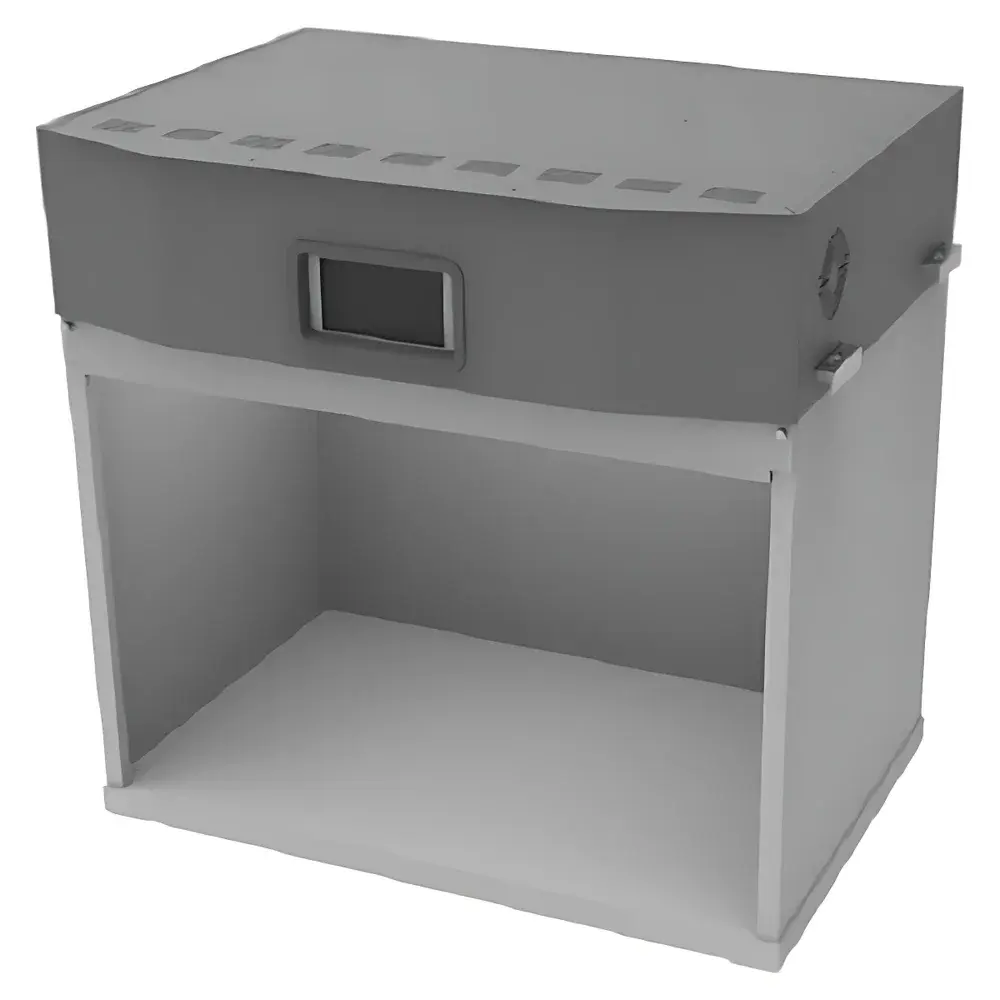
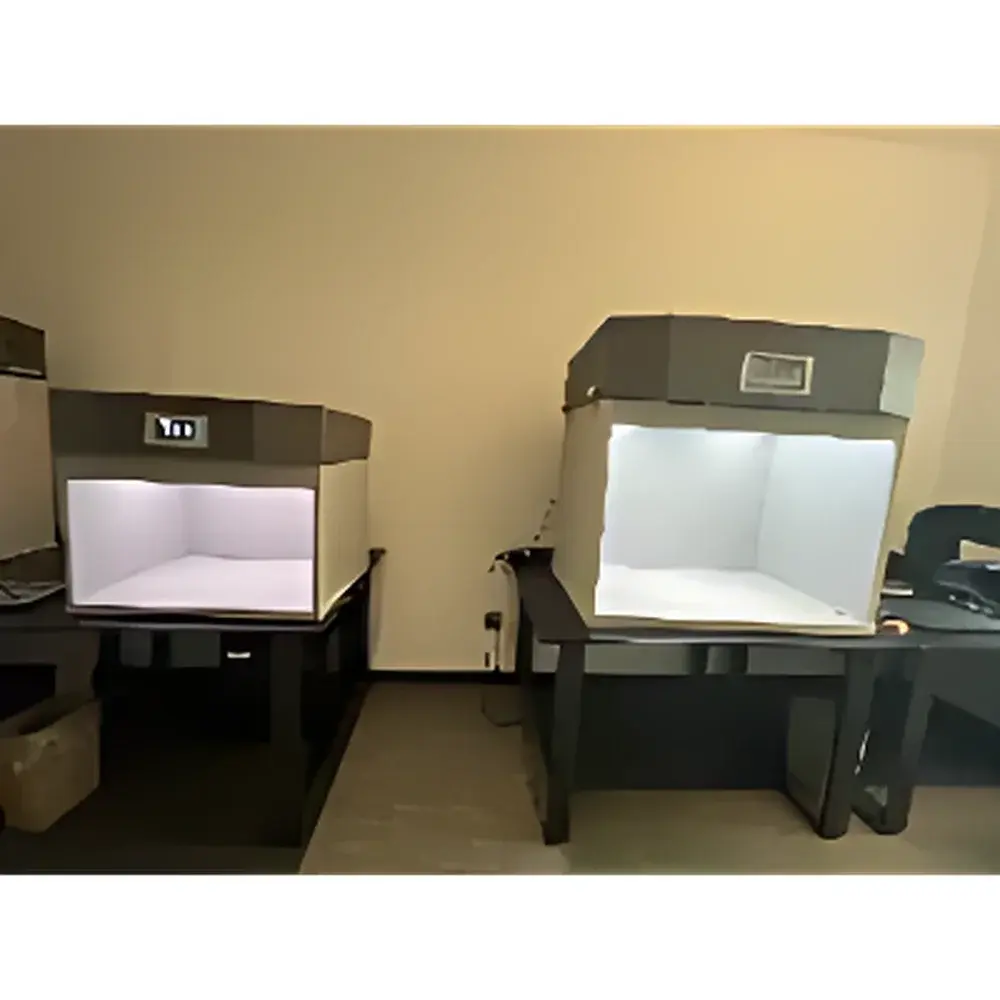
WeSpectra SpectraLED Pro Multi-Channel LED Standard Light Source Color Cabinet
| Brand | WeSpectra |
|---|---|
| Origin | Shanghai, China |
| Model | SpectraLED Pro |
| LED Channels | 21 |
| Spectral Range | 360–780 nm |
| CCT Tuning Range | 2000–20000 K (±1% accuracy) |
| CIE Ra | ≥99 |
| Flicker Frequency | 1–1000 Hz (1 Hz step) |
| Dimming Resolution | 12-bit per channel (4000 levels) |
| Uniformity | ≥80% |
| Max Illuminance | ≥2000 lx (D-series), Low-Light Mode: 0.1–50 lx |
| Preheat Time | 0 s |
| LED Lifetime | ≥10,000 h |
| Storage | 80 user-editable presets (hardware), unlimited via software |
| Dimensions (L×H×W) | 990×930×685 mm |
| Viewing Chamber (L×H×W) | 890×585×620 mm |
| Cabinet Color | Munsell N7 |
| Weight | ~40 kg |
| Power Input | 110–240 V AC, max 500 W |
| Operating Temperature | 0–40 °C |
| Compliance | ISO 23603, ISO 3664, ASTM D1729 |
| Software Integration | SDK with API support for automated calibration and third-party instrument synchronization (e.g., Konica Minolta CL-500A, JETI Specbos 2501/2501uv) |
Overview
The WeSpectra SpectraLED Pro Multi-Channel LED Standard Light Source Color Cabinet is an engineered optical reference platform designed for high-fidelity spectral reproduction in color-critical environments. Unlike conventional fluorescent or halogen-based light booths, the SpectraLED Pro employs 21 independently controlled, narrowband LED emitters spanning 360–780 nm—covering ultraviolet, visible, and near-infrared regions—to synthesize programmable spectral power distributions (SPDs) with metrological traceability. Its core architecture implements amplitude-modulated, 12-bit per-channel digital driving, eliminating flicker entirely while enabling precise intensity control across four decades of irradiance (0.1–2000 lx). The system reproduces standardized illuminants—including CIE D50, D65, A, and specialized medical, horticultural, and circadian lighting spectra—with CIE Ra ≥99 and Metamerism Index (MI) Class A compliance. It serves as both a static reference for visual color assessment and a dynamic stimulus generator for photobiological, sensor, and display evaluation under controlled, repeatable, and auditable conditions.
Key Features
- 21-channel spectral engine with individually calibrated LEDs (360–780 nm), supporting UV-enhanced and directional illumination modes
- Real-time SPD synthesis: Reconstruct any measured or imported spectrum—including CIE S026:2019 LED reference spectra—without physical lamp replacement
- CCT tunability from 2000 K to 20000 K at ±1% accuracy, validated against NIST-traceable spectroradiometric standards
- Flicker-free operation via 12-bit amplitude modulation; optional 1–1000 Hz sinusoidal or square-wave modulation for legacy source emulation
- Zero preheat time and thermal stabilization latency—full spectral output stability achieved within 100 ms of activation
- Integrated 7-inch capacitive touchscreen with on-device preset management (up to 80 named configurations); USB-host interface for firmware updates and data export
- Automated closed-loop feedback: Compatible with Konica Minolta CL-500A and JETI Specbos 2501/2501uv spectroradiometers for real-time SPD verification and auto-re-calibration
- Modular mechanical design: Supports ceiling suspension, floor-standing pedestal, and custom optical bench integration
Sample Compatibility & Compliance
The SpectraLED Pro accommodates samples up to 890 × 585 × 620 mm (L×H×W) within its Munsell N7 matte-black viewing chamber, minimizing stray reflections and ensuring spatial uniformity ≥80% (measured per ISO 23603 Annex B). It supports rigid, flexible, translucent, and retroreflective specimens—including OLED/LCD panels, textile swatches, painted automotive parts, pharmaceutical tablets, and horticultural canopies—without requiring sample repositioning between illuminant changes. The system conforms to ISO 3664:2009 (graphic technology), ISO 23603:2022 (colorimetric viewing conditions), and ASTM D1729-21 (standard practice for color matching). For regulated environments, it supports audit-ready operation under GLP/GMP frameworks: all calibration events, SPD parameter sets, and user actions are timestamped and logged via the SDK; full traceability aligns with FDA 21 CFR Part 11 requirements when deployed with validated software.
Software & Data Management
The bundled SpectraControl software provides intuitive GUI-based SPD configuration, preset library management, and dynamic sequence programming (e.g., timed transitions between D65 → A → UV → directional D65). All spectral data—including raw SPDs, chromaticity coordinates (CIE 1931 xy, u’v’), CCT, Duv, and CRI/Rf values—are exportable in CSV, XML, and CIE S 026-compliant .spd formats. The included Software Development Kit (SDK) delivers documented RESTful and DLL-based APIs for integration into LIMS, MES, or custom QA workflows. Supported functions include remote SPD loading, real-time intensity readback, synchronized trigger output for high-speed imaging systems, and bidirectional communication with external spectroradiometers for drift-compensated operation. Calibration certificates are digitally signed and embed instrument serial number, date, and uncertainty budgets per ISO/IEC 17025.
Applications
- Visual color assessment in printing, packaging, paint, and textile industries per ISO 3664
- Camera and image sensor spectral responsivity characterization under variable illuminants
- Display quality evaluation (e.g., viewing angle dependency, HDR tone mapping) using dynamic SPD sequences
- Non-visual photobiological research: melanopic EDI quantification, circadian stimulus modeling per CIE S 026
- Medical lighting validation for surgical and diagnostic environments (IES RP-29, IEC 62471)
- Agricultural lighting R&D: photosynthetic photon flux density (PPFD) and phytochrome photoequilibrium tuning
- Material whiteness and fluorescence evaluation under UV-augmented D65
- Metamerism detection and tolerance specification in multi-source supply chains
FAQ
Does the SpectraLED Pro require periodic lamp replacement?
No. All 21 LED channels are rated for ≥10,000 hours at nominal drive current. Output degradation is compensated via software-based recalibration—not hardware replacement.
Can I import my own measured SPD into the system?
Yes. The SpectraControl software accepts ASCII-formatted SPD data (wavelength/nm, irradiance/W·m⁻²·nm⁻¹) and automatically maps it to the 21-channel LED model for best-fit synthesis.
Is the system suitable for ISO/IEC 17025-accredited laboratories?
Yes. With proper documentation of calibration procedures, uncertainty budgets, and version-controlled software deployment, it meets metrological requirements for accredited color measurement labs.
What third-party instruments does the SDK support for closed-loop control?
Officially validated integrations include Konica Minolta CL-500A, JETI Specbos 2501 and 2501uv, and PR-788 spectroradiometers. Custom drivers can be developed for other IEEE 1451.2 or USBTMC-compliant devices.
How is uniformity verified and maintained over time?
Uniformity is measured during factory calibration using a 100-point grid scan per ISO 23603. Field verification is supported via the SDK’s built-in uniformity test mode, which outputs deviation heatmaps relative to center-point readings.




