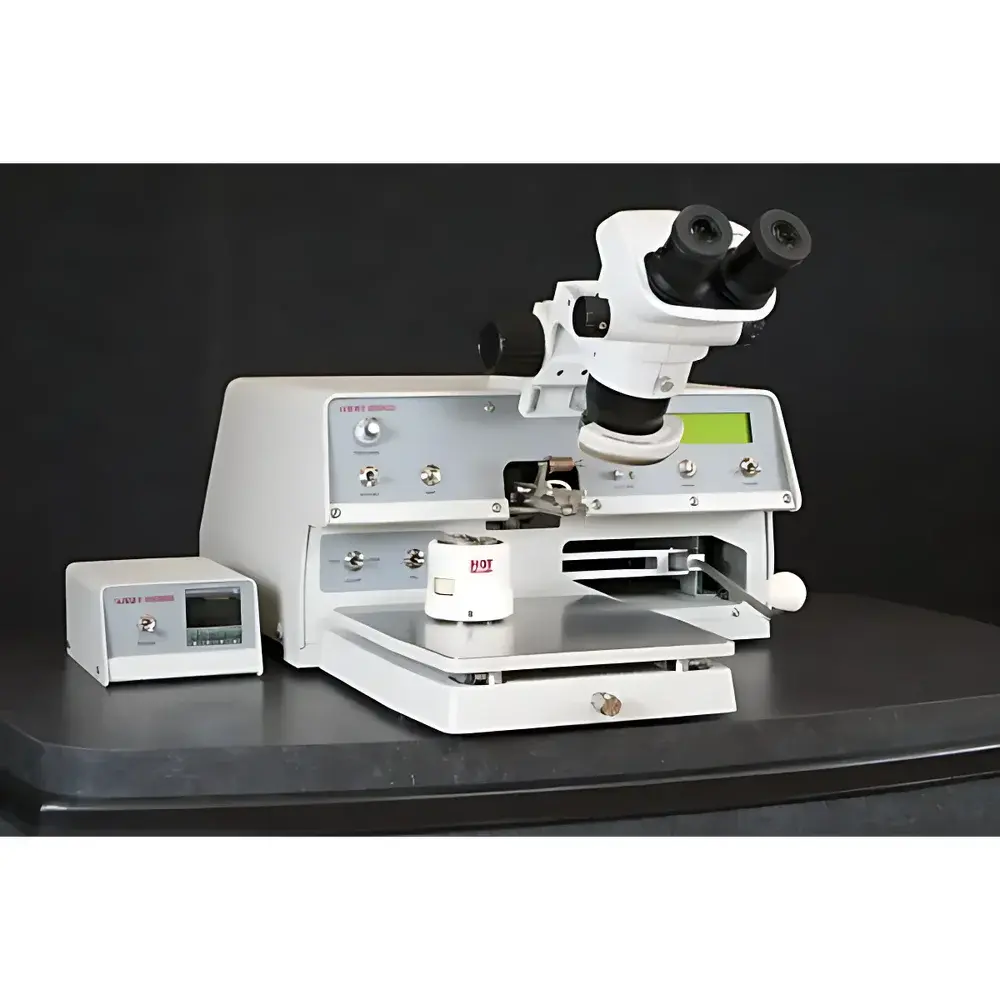
Westech 7476D Precision Wedge Bonding System
| Brand | Westech |
|---|---|
| Origin | USA |
| Model | 7476D |
| Bonding Angle Options | 45° & 90° (deep cavity) |
| Wire Diameter Range | 18–100 µm |
| Ribbon Dimensions | 0.0005 × 0.010 in or 0.001 × 0.010 in |
| Ultrasonic Power Output | 4 W |
| Bonding Force Control | Dual-range, programmable |
| Heating | Resistive tool heating |
| Motion Control | Direct-drive motor with programmable tail control |
| Platform | Adjustable height (0.625 in), 12 × 12 in |
| Display | LCD interface |
| ESD Protection | Standard |
| Deep Cavity Capability | ≥13 mm (1 in optional) |
| Software | Multi-device recipe storage |
| Compliance | ESD-safe architecture, designed for Class 100/ISO 5 cleanroom integration |
Overview
The Westech 7476D Precision Wedge Bonding System is a microprocessor-controlled, high-reproducibility bonding platform engineered for semiconductor assembly and hybrid microcircuit packaging. It employs thermosonic, ultrasonic, and thermal wedge bonding methodologies—leveraging controlled mechanical force, localized resistive heating of the bonding tool, and calibrated ultrasonic energy (4 W nominal output) to form reliable metallurgical interconnections between fine wires or ribbons and substrate bond pads. Unlike capillary-based ball bonding systems, the 7476D utilizes a wedge-shaped bonding tool that remains in continuous contact with the wire during bonding, enabling precise control over bond geometry, loop profile, and tail formation—critical for low-profile, high-density, and deep-cavity applications such as GaAs MMICs, RF modules, MEMS sensors, and hermetically sealed optoelectronic packages.
Key Features
- Programmable dual-range bonding force system optimized for fragile substrates including GaAs, LiNbO₃, and thin-film ceramic carriers
- Standard 45° wedge bonding configuration with optional 90° deep-cavity tooling supporting cavities ≥13 mm (1-inch depth available)
- Resistively heated bonding tool with closed-loop temperature regulation for thermosonic and thermal wedge processes
- Direct-drive servo motor for precise, repeatable wire tail positioning and loop shaping—fully programmable per bond site
- ESD-safe design compliant with ANSI/ESD S20.20 requirements; grounded chassis, shielded signal paths, and static-dissipative work surface
- LCD-based human-machine interface with intuitive menu navigation and real-time parameter monitoring
- Adjustable Z-axis platform (0.625 in travel range) and 12 × 12 inch bonding area accommodating large-format hybrid substrates and multi-die arrays
- Integrated automatic wire feed mechanism with tension control for consistent wire presentation across 18–100 µm diameters (Au, Al, Cu)
- Support for ribbon bonding using 0.0005 × 0.010 in or 0.001 × 0.010 in gold ribbon—enabling high-current interconnects and TAB-style attachment
Sample Compatibility & Compliance
The 7476D accommodates a broad spectrum of substrate types—including alumina, LTCC, HTCC, silicon, quartz, and sapphire—and supports both die-attach and second-level interconnect configurations. It is routinely deployed in production environments meeting ISO 9001, IATF 16949, and MIL-STD-883H requirements. The system’s mechanical stability, thermal management, and ESD protection align with IPC-7095B guidelines for flip-chip and fine-pitch wedge bonding. While not FDA-certified (as it is not a medical device), its cleanroom-compatible construction (Class 100/ISO 5 compatible) and traceable parameter logging support GLP/GMP-aligned process documentation when integrated into validated manufacturing workflows.
Software & Data Management
The embedded microcontroller enables storage of multiple device-specific bonding recipes—including force profiles, ultrasonic burst durations, heat soak times, loop heights, and tail lengths—each assignable to discrete program IDs. Parameter changes are logged with timestamp and operator ID (where external authentication is integrated). Though the base system does not include network connectivity or FDA 21 CFR Part 11-compliant electronic signatures, optional RS-232 or Ethernet interfaces allow integration with factory MES systems for audit-trail generation and SPC data export. All recipes are retained through power cycles and support rapid requalification after maintenance.
Applications
- Thermosonic wedge bonding of Au, Al, and Cu wires in RF power amplifiers and microwave ICs
- Deep-cavity wedge bonding for TO-can and metal-can optoelectronic packages (e.g., VCSELs, photodiodes)
- Hybrid circuit assembly involving thick-film and thin-film substrates with mixed-material bond pads
- Ribbon bonding for high-current sensor interfaces and power module interconnects
- Low-k dielectric and ultra-thin (<100 µm) silicon die bonding where capillary impact is prohibitive
- Research and development of novel intermetallic bond systems under controlled inert atmosphere (when paired with glovebox integration)
FAQ
Does the 7476D support copper wire bonding?
Yes—it is fully compatible with bare and palladium-coated copper wire in the 18–100 µm diameter range, provided appropriate oxidation mitigation (e.g., forming gas ambient or pre-bond plasma cleaning) is implemented externally.
Is the system qualified for aerospace-grade bonding per MIL-STD-883?
While the 7476D itself is not pre-qualified, its mechanical repeatability, force calibration traceability, and thermal stability meet the foundational equipment criteria outlined in Method 2011.9 (Wire Bond Pull Test) and 2012.7 (Bond Strength). End-user qualification per MIL-PRF-38534 is required.
Can the 7476D be integrated into an automated handling line?
Yes—via optional I/O expansion modules supporting TTL-level start/stop signals, vacuum status feedback, and end-of-cycle acknowledgments compatible with standard SECS/GEM protocols.
What is the recalibration interval for bonding force sensors?
Westech recommends annual force transducer verification using NIST-traceable deadweight standards; field verification kits are available for daily operational checks.
Is ribbon bonding capability included by default?
Ribbon bonding functionality requires the optional ribbon feed module and custom wedge tooling—both available as factory-installed accessories at time of order.