
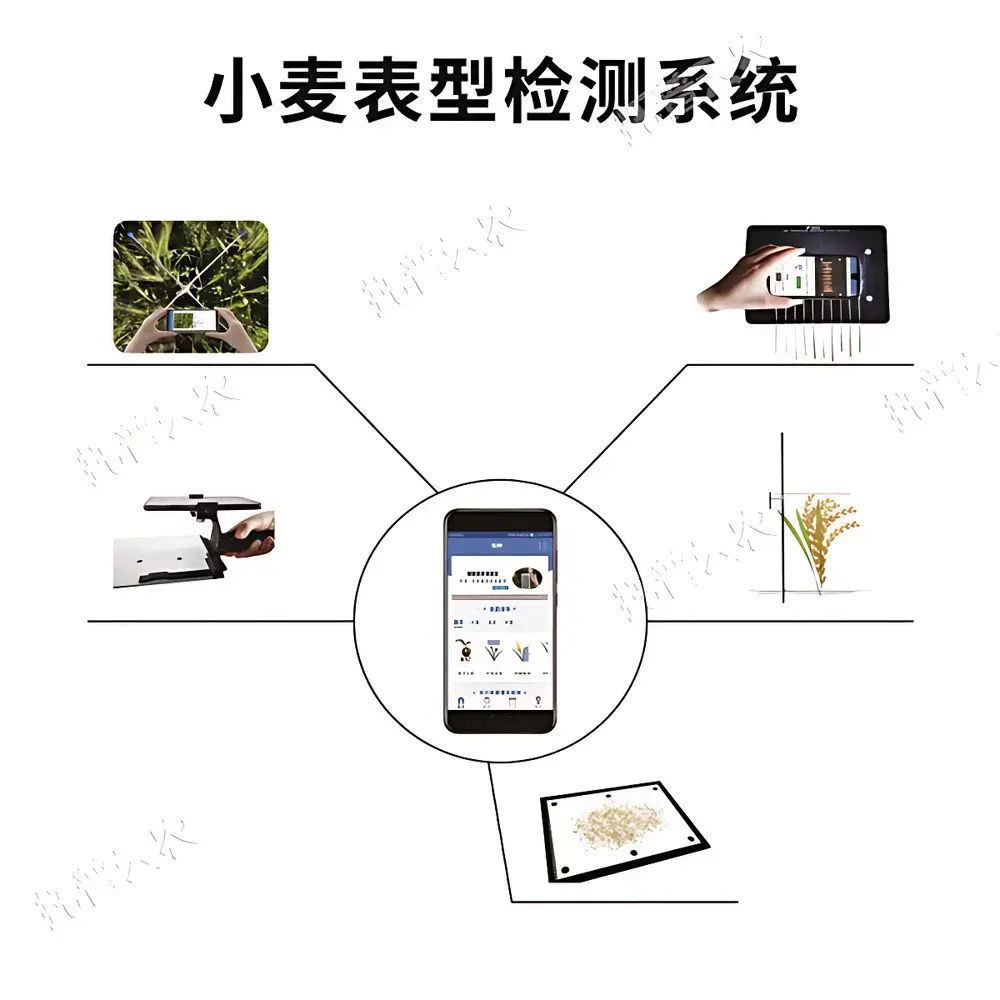
Wheat Phenotyping System TPM-BX-1 by Top Cloud-agri
| Brand | Top Cloud-agri |
|---|---|
| Model | TPM-BX-1 |
| Origin | Zhejiang, China |
| Manufacturer Type | Direct Manufacturer |
| Country of Origin | China |
| Pricing | Upon Request |
Overview
The Wheat Phenotyping System TPM-BX-1 is a field-deployable, image-based phenotyping platform engineered for high-throughput, non-destructive quantification of morphological and architectural traits in wheat (Triticum aestivum). It integrates computer vision algorithms with convolutional neural networks (CNNs) trained on large-scale, manually annotated wheat image datasets to deliver reproducible, operator-independent measurements. The system operates on the principle of 2D digital image analysis—leveraging calibrated spatial references, perspective correction, and pixel-to-metric conversion—to extract biologically meaningful phenotypic descriptors. Designed specifically for breeding programs, physiological studies, and agronomic trials, it supports longitudinal monitoring across key developmental stages—from tillering and jointing through heading, anthesis, grain filling, and maturity—enabling robust genotype–phenotype association mapping under real-world field or controlled-environment conditions.
Key Features
- Multi-modal calibration: Dual-area reference standards—0.25 m² cross-shaped and 0.5 m² square calibrators—enable cross-validated counting of tillers and spikes per unit area, accommodating both low-density and high-density planting configurations.
- Augmented reality (AR)-assisted imaging: Integrated AR glasses paired with Bluetooth-enabled extendable selfie sticks allow real-time framing and stable capture of canopy-level images—even at heights exceeding 1.5 m—minimizing occlusion and perspective distortion.
- Batch processing capability: Simultaneous analysis of up to 60 geotagged or timestamped field images for spike density estimation, with automated averaging and statistical summary output.
- Dynamic compensation engine: Adjustable occlusion rate thresholding, boundary area masking, and sensitivity scaling ensure consistent accuracy across phenological phases—including flowering, milk, dough, and early ripening stages—with measurement uncertainty maintained within ±5% for spike counts.
- High-precision spike morphometrics: Single-image analysis yields length (5–20 cm range), spikelet count (±3 spikelets tolerance), and mean values across up to 10 individual spikes per frame.
- Dedicated hardware ergonomics: Black matte acrylic spike-holding trough prevents lodging due to awn-induced instability; integrated hinge-and-press arm secures stems during angular measurement, mitigating wind-induced motion artifacts.
- Automated sequence indexing: Left-to-right ordinal tagging of spikes ensures unambiguous linkage between visual objects and metadata (e.g., cultivar ID, plot number, growth stage).
- Real-time grain counting & weight conversion: Sub-second enumeration of 10–8,000 kernels per image; input of sample mass enables automatic calculation of thousand-kernel weight (TKW) with ±0.2% relative error.
- Perspective-invariant imaging: Automatic lens distortion correction and scale normalization accommodate variable smartphone camera models and shooting angles—eliminating manual alignment or fixed-rig requirements.
- Touch-enabled refinement: On-screen annotation tools permit manual correction of segmentation boundaries, spike delineation, or grain grouping—achieving 100% user-verified accuracy where needed.
Sample Compatibility & Compliance
The TPM-BX-1 is validated for use with common hexaploid wheat cultivars grown in temperate agroecosystems. It complies with standard experimental protocols aligned with FAO Crop Ontology definitions for wheat phenotypic descriptors and supports traceable data collection in accordance with GLP principles. While not certified to ISO/IEC 17025, its measurement repeatability meets internal validation benchmarks required for QTL mapping and genomic selection workflows. All image-derived metrics—including spike density (spikes/m²), spike length (cm), spikelet number, TKW (g), plant height (cm), and stem angle (°)—are recorded with timestamps, GPS coordinates (if enabled), and device-specific metadata to support audit-ready documentation per institutional data management policies.
Software & Data Management
The system runs on the proprietary ZhiZhong mobile application (iOS/Android), a lightweight, offline-capable platform optimized for rural connectivity. Image acquisition, preprocessing, inference, and result visualization occur locally on the embedded color-display smartphone—ensuring data sovereignty and minimizing cloud dependency. All outputs are stored in structured JSON format with embedded version-controlled schema definitions. Export functionality supports CSV and Excel (.xlsx) formats, including full audit trails of manual corrections. Data sharing via encrypted QR codes or direct export to WeChat, QQ, or DingTalk enables seamless integration into multi-stakeholder trial management systems. Account-level dynamic authentication (SMS/OTP) enforces concurrent session control without compromising cross-device accessibility.
Applications
- Accelerated varietal screening: Rapid comparison of spike architecture and canopy architecture across hundreds of entries in yield trials.
- Phenotypic stability assessment: Longitudinal tracking of tiller dynamics, spike emergence timing, and grain filling progression across environments.
- Functional genomics support: High-resolution trait mapping for loci influencing spike compactness, rachis fragility, or awn development.
- Climate-resilience phenotyping: Quantifying morphological plasticity—such as stem angle adjustment or spikelet abortion patterns—under drought or heat stress.
- Seed quality assurance: Standardized TKW determination in post-harvest seed lots, compliant with ISTA Rule 5.4 guidelines for cereal seed testing.
- Educational deployment: Hands-on training in digital phenotyping workflows for graduate students and extension personnel.
FAQ
What growth stages are supported for spike density measurement?
Spike density can be reliably estimated from heading through early grain filling—specifically during anthesis, milk, and dough stages.
Can the system operate without internet connectivity?
Yes. All image processing, model inference, and data storage occur locally on the onboard smartphone; internet is only required for optional software updates or cloud backup.
Is third-party software integration possible?
The system exports standardized CSV/Excel files compatible with R, Python (Pandas), and commercial statistical packages (e.g., JMP, SAS); API access is available under enterprise licensing agreements.
How is measurement traceability ensured?
Each analysis log includes embedded EXIF metadata (device model, timestamp, GPS if active), calibration identifier, user ID, and revision history of any manual edits—supporting full ALCOA+ compliance for research data integrity.
What is the recommended lighting condition for optimal image capture?
Diffuse daylight (e.g., overcast conditions or early morning/late afternoon) is preferred; the integrated ultra-thin LED light panel provides uniform illumination for indoor or low-light scenarios.
Related Products




