
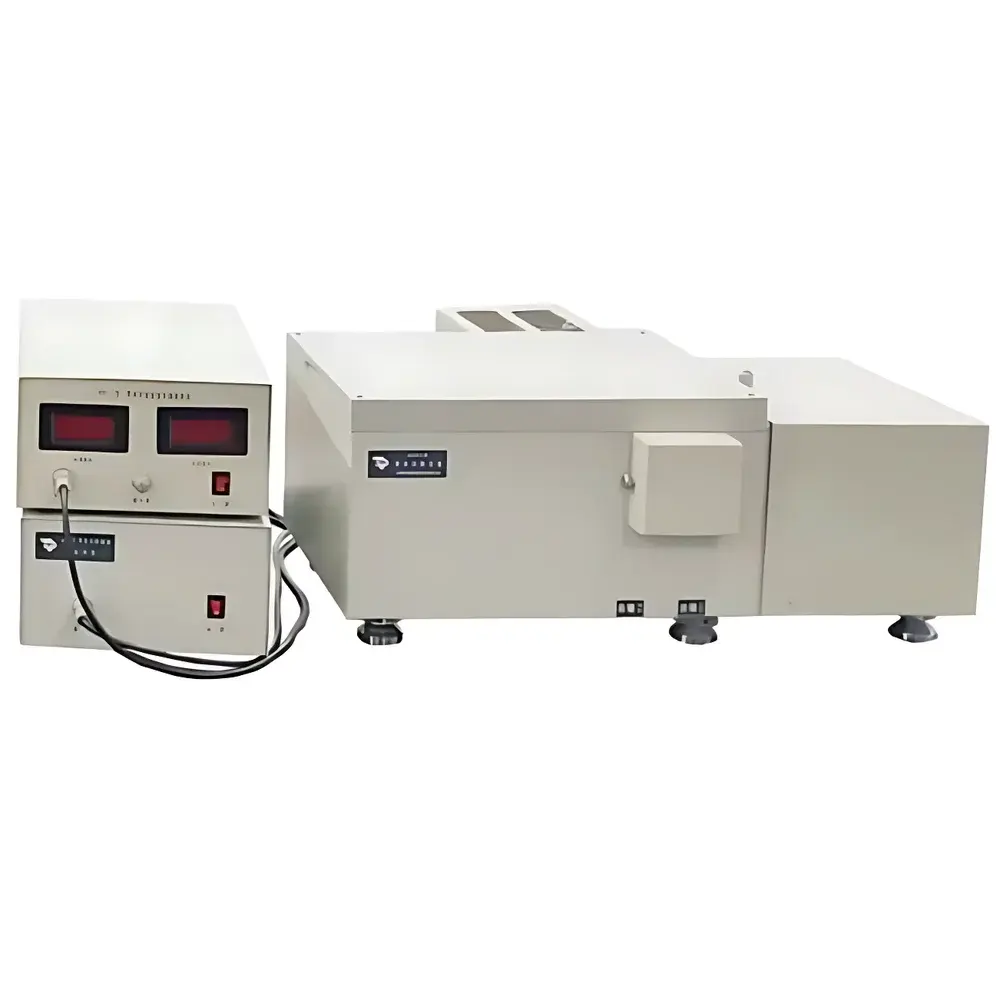
WHS-1 Blackbody Radiation Experiment System by TOP (Tianjin Top Optoelectronics Co., Ltd.)
| Brand | TOP |
|---|---|
| Origin | Tianjin, China |
| Manufacturer Type | Original Equipment Manufacturer (OEM) |
| Country of Origin | China |
| Model | WHS-1 |
| Price | Upon Request |
| Wavelength Range | 800–2500 nm |
| Relative Aperture | D/F = 1/7 |
| Grating Density | 300 lines/mm |
| Focal Length | 300 mm |
| System Composition | f = 300 mm Czerny–Turner monochromator, photodetector unit (InGaAs-based), variable-color-temperature tungsten-halogen lamp source, Windows-based control software on USB-delivered installation media, integrated electronic control module |
| Interface | USB 2.0 |
Overview
The WHS-1 Blackbody Radiation Experiment System is a pedagogical and research-grade optical measurement platform engineered to quantitatively characterize thermal radiation spectra in accordance with Planck’s law, Wien’s displacement law, and the Stefan–Boltzmann law. Designed for university physics laboratories and metrology training environments, the system implements a calibrated spectral radiometry architecture based on grating monochromation and thermally stabilized photodetection. It employs a Czerny–Turner monochromator (f = 300 mm, 300 lines/mm ruled grating, D/F = 1/7) coupled to an InGaAs photodetector optimized for the near- to short-wave infrared (NIR–SWIR) range (800–2500 nm). A precisely regulated tungsten-halogen lamp serves as a programmable quasi-blackbody source, with color temperature continuously adjustable from 1500 K to 3200 K—enabling empirical verification of spectral emittance variation with source temperature under controlled electrical input and thermal equilibrium conditions.
Key Features
- Integrated spectral acquisition architecture: Monochromator, detector, source, and control electronics are co-aligned and factory-aligned for minimal stray light and reproducible optical throughput.
- Automated spectral response correction: Software implements component-wise transfer function deconvolution—including grating efficiency, detector responsivity, and lamp spectral irradiance—to yield absolute spectral radiance data traceable to NIST-traceable calibration references.
- Windows-native GUI application: Full-featured, menu-driven interface supporting real-time spectrum plotting, multi-curve overlay, manual/auto wavelength scanning, integration time adjustment (10 ms–5 s), and baseline drift compensation.
- USB 2.0 plug-and-play connectivity: No external power adapters or proprietary interface cards required; compatible with Windows 10/11 (64-bit) without driver installation beyond standard WinUSB stack.
- Educational design focus: Includes preloaded lab protocols aligned with ISO/IEC 17025-compliant teaching modules, annotated spectral analysis routines, and export-ready data formats (CSV, TXT, XML) for post-processing in MATLAB, Python (NumPy/Pandas), or OriginLab.
Sample Compatibility & Compliance
The WHS-1 is configured exclusively for controlled thermal radiation source characterization—not for material emissivity measurement or remote sensing. It complies with educational instrumentation safety standards IEC 61010-1 (Edition 3.0) for laboratory electrical equipment. All optical components meet RoHS 2011/65/EU directives. While not certified to ISO/IEC 17025 as a calibration laboratory, the system supports GLP-aligned experimental documentation through its audit-log-enabled software, recording operator ID, timestamp, lamp voltage/current, ambient temperature/humidity (via optional sensor input), and raw spectral file checksums—facilitating traceability in undergraduate and graduate coursework assessments.
Software & Data Management
The bundled Windows application provides full instrument control, real-time visualization, and structured data persistence. Each acquired spectrum is saved with embedded metadata: acquisition date/time, lamp filament voltage and current, monochromator slit width, integration time, detector gain setting, and user-defined experiment ID. The software enforces version-controlled configuration files (.cfg) and supports batch processing of multiple temperature sweeps. Export functions generate tab-delimited ASCII files compliant with ASTM E1335-22 Annex A1 (spectral radiometric data exchange format). Audit trail logs record all parameter changes and file operations, satisfying basic requirements for FAIR (Findable, Accessible, Interoperable, Reusable) data principles in academic settings.
Applications
- Undergraduate physics labs: Direct validation of Planck’s spectral distribution law across ≥5 discrete filament temperatures.
- Graduate thermal metrology courses: Quantitative evaluation of emissivity deviation from ideal blackbody behavior using tungsten’s published spectral emissivity tables (e.g., NPL TRA 2017-01).
- Instrumentation engineering practicums: Hands-on study of monochromator resolution limits, detector linearity ranges, and signal-to-noise optimization in IR radiometry.
- Curriculum development: Basis for advanced experiments including Kirchhoff’s law verification, spectral filter characterization, and comparative analysis of radiation models (Rayleigh–Jeans vs. Wien’s approximation).
FAQ
Is the WHS-1 suitable for measuring emissivity of solid materials?
No—the system is designed exclusively for characterizing the spectral radiance of high-temperature thermal sources. Emissivity measurement requires a reference blackbody cavity, bidirectional reflectance geometry, and background-subtracted measurements, which are outside this system’s scope.
Does the software support automated temperature ramping of the tungsten lamp?
Yes—via programmable voltage ramp profiles with configurable dwell times and step resolution (0.1 V increments); temperature estimation uses the lamp’s published resistance–temperature curve and real-time current monitoring.
Can spectral data be imported into third-party analysis tools?
Yes—all exported CSV files contain wavelength (nm) and spectral radiance (µW·cm⁻²·sr⁻¹·nm⁻¹) columns with header metadata, fully compatible with Python (SciPy), MATLAB, and commercial spectroscopy platforms.
What calibration documentation is provided?
A factory spectral responsivity certificate is included, referencing NIST-traceable tungsten lamp standards (SRM 2252a) and grating efficiency maps measured at 1000 nm, 1500 nm, and 2200 nm.
Is remote operation supported over LAN or Ethernet?
No—control is limited to direct USB connection. Networked operation would require additional hardware abstraction layers and is not part of the current OEM specification.




