
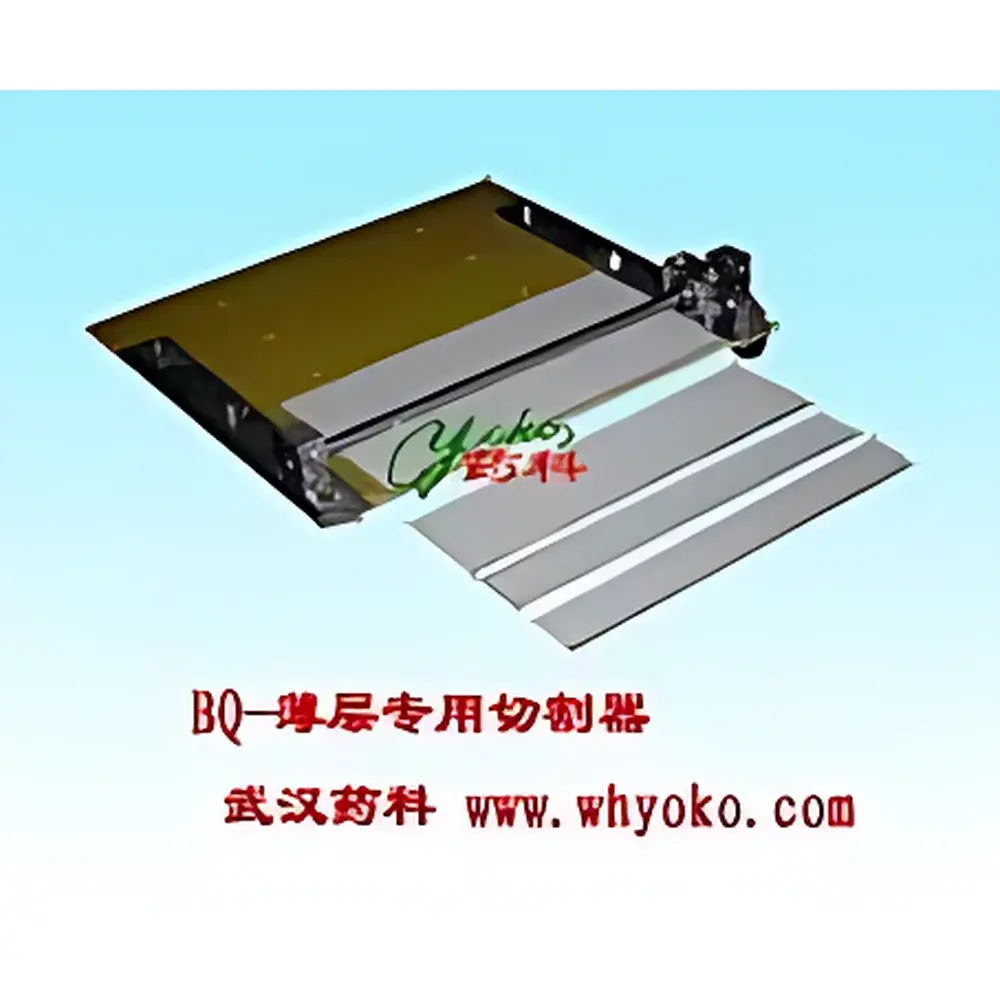
whYOKO BQ Thin-Layer Chromatography (TLC) Plate Cutter
| Brand | whYOKO |
|---|---|
| Origin | Hubei, China |
| Manufacturer Type | Authorized Distributor |
| Product Origin | Domestic (China) |
| Model | BQ |
| Price | Upon Request |
| Dimensions | 300 × 250 × 50 mm |
| Weight | 1 kg |
| Max. Plate Thickness | 3 mm |
| Included Accessories | 1 × cutter unit, 10 × pre-coated glass TLC plates (100 × 200 mm) |
Overview
The whYOKO BQ Thin-Layer Chromatography (TLC) Plate Cutter is a precision mechanical cutting tool engineered specifically for the preparation of standardized silica gel or alumina-coated glass or aluminum-backed TLC plates. It operates on a guided linear scoring-and-break principle—utilizing a hardened steel scribing wheel and calibrated pressure bar—to generate clean, straight, chip-free edges without delamination or surface abrasion of the adsorbent layer. Unlike manual scoring with handheld glass cutters or abrasive tools, the BQ cutter ensures consistent kerf width and reproducible fracture propagation across heterogeneous plate substrates, minimizing analytical variability in Rf determination, spot resolution, and quantitative densitometry. Its design addresses a critical but often overlooked pre-analytical step: plate dimensional uniformity directly impacts solvent front migration kinetics, edge effects, and inter-plate comparability—particularly in method development, stability-indicating assays, and regulatory-compliant QC workflows.
Key Features
- Calibrated dual-scale ruler (metric and imperial) integrated into the base plate, enabling direct dimension readout from 10 mm to 200 mm in 1 mm increments.
- Adjustable stop block with fine-tuning screw for repeatable batch cutting of identical plate sizes—essential for high-throughput screening and parallel development studies.
- Low-profile scribing arm with spring-loaded, self-aligning tungsten-carbide wheel (diameter: 3 mm), optimized for controlled micro-fracture initiation on brittle glass (≥1.1 mm thickness) and flexible aluminum sheets.
- Non-slip rubberized base and ergonomic handle provide stable operation without clamping fixtures—reducing operator-induced torsional stress that causes coating cracking.
- Tool-free blade replacement system compliant with ISO 8502-3 for surface cleanliness verification; no lubricants or solvents required during operation.
Sample Compatibility & Compliance
The BQ cutter accommodates standard commercial TLC substrates including 1.0–3.0 mm thick glass plates (e.g., Merck Silica Gel 60 F254, Sigma-Aldrich Aluminum-backed silica), as well as polymer-backed cellulose and RP-18 plates. It is validated for use with both pre-coated and hand-cast layers, provided binder integrity (e.g., calcium sulfate, polyvinyl alcohol) remains intact post-cutting. While not an analytical instrument per se, its output directly supports compliance with ICH Q2(R2) guidelines on analytical procedure validation—specifically specificity and robustness—by eliminating plate-edge artifacts that distort baseline resolution. The device itself requires no electrical certification; however, its consistent output contributes to GLP-aligned documentation when paired with traceable calibration logs and plate lot tracking.
Software & Data Management
The BQ cutter is a purely mechanical device with no embedded electronics, firmware, or connectivity interfaces. As such, it generates no digital data streams and does not require software installation, cybersecurity protocols, or audit trail functionality. This analog architecture eliminates validation overhead associated with computerized systems under FDA 21 CFR Part 11 or EU Annex 11. Users maintain full control over procedural documentation: cutting parameters (plate type, dimensions, batch ID) are recorded manually in laboratory notebooks or LIMS-integrated forms. Optional integration includes scanning cut-plate barcodes (applied post-cutting) into ELN platforms for metadata linkage to subsequent chromatographic runs.
Applications
- Method development labs requiring rapid iteration of plate geometry (e.g., narrow strips for gradient elution testing or miniature formats for microscale reaction monitoring).
- Quality control environments performing identity testing per USP or Ph. Eur. 2.2.27, where plate uniformity affects limit test sensitivity.
- Academic teaching laboratories emphasizing hands-on technique training in planar chromatography fundamentals—edge quality directly correlates with student success in visualization and interpretation.
- Contract research organizations (CROs) optimizing cost-per-analysis by repurposing surplus full-size plates into assay-specific formats, reducing waste of high-value pre-coated media.
- Stability studies requiring identical plate batches across multiple timepoints—dimensional consistency ensures equivalent capillary action and solvent penetration profiles.
FAQ
Can the BQ cutter be used with plastic-backed TLC plates?
Yes—provided the backing thickness does not exceed 3 mm and exhibits sufficient rigidity to resist buckling during scoring. Polyethylene terephthalate (PET) and polyester substrates are compatible; flexible PVC or polyolefin films may require auxiliary support.
Does the cutter require periodic calibration?
No formal calibration is mandated, but users should verify ruler alignment annually against NIST-traceable steel rule and inspect scribing wheel wear using 10× magnification—replacement recommended after ≥500 cuts on glass substrates.
Is the included 10 × 20 cm glass plate set suitable for HPTLC applications?
The supplied plates meet standard TLC specifications (not HPTLC-grade); for high-performance work, users must source certified HPTLC plates separately—the cutter itself imposes no resolution limitations on downstream analysis.
How does the BQ cutter compare to automated CNC-based plate cutters?
While CNC systems offer programmable multi-axis cuts, they introduce thermal stress, vibration artifacts, and higher capital/operational costs. The BQ provides superior edge finish for straight-line segmentation at <5% of the price point, with zero maintenance downtime.



