
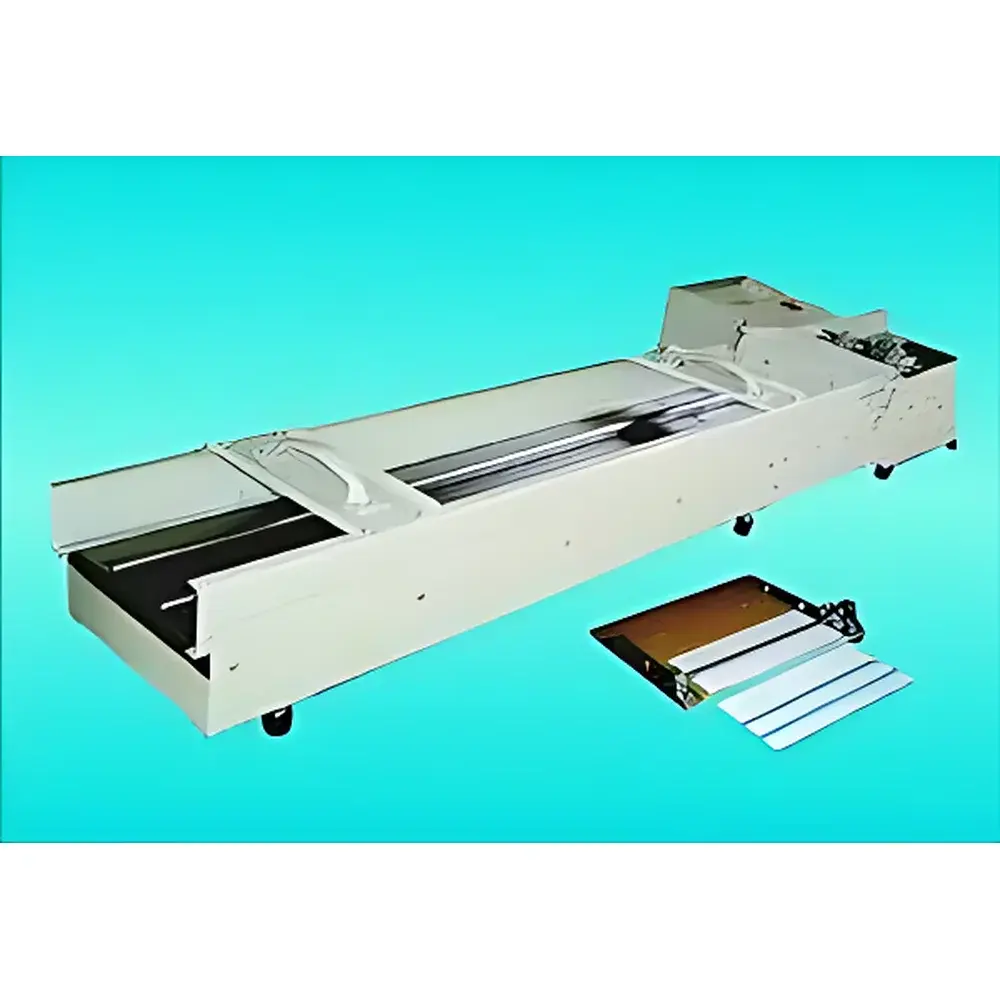
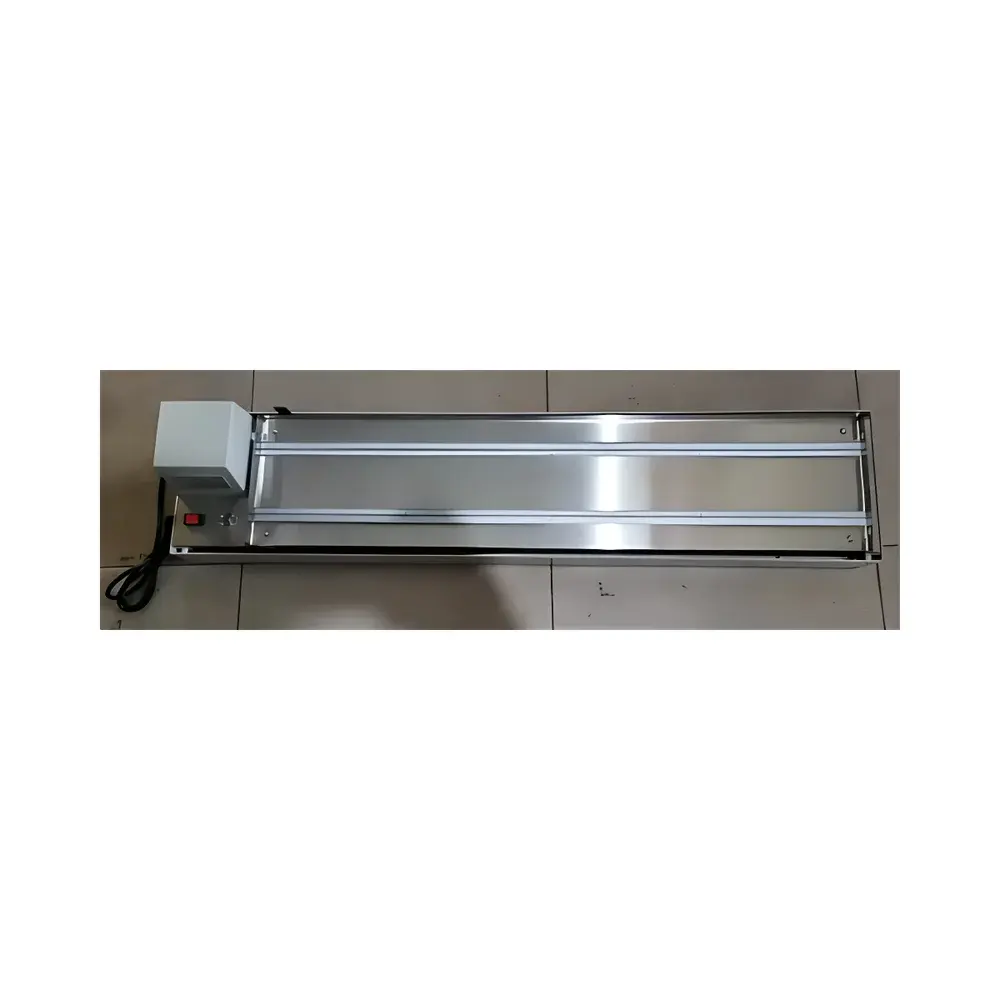
whYOKO yoko-BF-111 Electric Thin-Layer Coater
| Brand | whYOKO |
|---|---|
| Origin | Hubei, China |
| Model | yoko-BF-111 |
| Type | TLC Plate Coating Device |
| Operation Mode | Motorized (non-manual hand-crank) |
| Coating Width Options | 100 mm or 200 mm |
| Adjustable Coating Thickness | 0.05–2.0 mm |
| Thickness Uniformity (Non-Parallelism) | ≤ 0.04 mm |
| Throughput | Up to 210 pcs of 200 × 200 mm plates per 10 minutes (BF-I/BF-II mode) |
| Motorized Traverse Speed | 4.2 m/min |
| Power Consumption | 90 W (BF-I/BF-II), 40 W (BF-III variant) |
| Dimensions (L×W×H) | 340 × 130 × 190 mm |
| Frame Material | Anodized Aluminum with Epoxy Coating |
| Compliance | Designed for GLP-compliant thin-layer chromatography (TLC) plate preparation in regulated and research laboratories |
Overview
The whYOKO yoko-BF-111 Electric Thin-Layer Coater is a precision-engineered laboratory instrument designed specifically for the reproducible, uniform deposition of adsorbent slurries onto glass, aluminum, or plastic backing substrates used in thin-layer chromatography (TLC). Unlike manual spreaders or low-repeatability semi-automatic devices, the yoko-BF-111 implements motor-driven linear translation combined with a mechanically adjustable coating gap to deliver consistent layer thickness across full-format plates — a critical requirement for quantitative densitometric analysis, method validation, and preparative-scale separations. Its operational principle relies on controlled volumetric delivery via gravity-fed slurry flow through a precisely gapped applicator bar (also known as a doctor blade), synchronized with constant-speed substrate movement. This Couette-type coating mechanism ensures minimal shear-induced particle segregation and avoids edge bead formation — both essential for high-resolution Rf reproducibility and spot shape fidelity.
Key Features
- Motorized traverse system with calibrated speed control (4.2 m/min nominal), enabling repeatable dwell time and slurry distribution kinetics.
- Adjustable coating gap (0.05–2.0 mm) via micrometer-actuated aluminum frame, supporting analytical (0.1–0.5 mm), semi-preparative (0.6–1.0 mm), and preparative (1.0–2.0 mm) layer formats.
- Integrated spirit level and leveling feet ensure mechanical horizontal alignment — critical for minimizing thickness gradient across 200 × 200 mm plates.
- Anodized aluminum coater frame with epoxy finish resists solvent corrosion and facilitates cleaning between organic and aqueous phase applications.
- Two operational configurations: continuous-feed mode (BF-I/BF-II) for high-throughput standardized plates; discrete-batch mode (BF-III variant) optimized for small-batch R&D or custom sizing (e.g., 100 × 50 mm, 200 × 100 mm).
- Low-maintenance brushless DC motor (BF-I/BF-II) or industrial-grade synchronous motor (BF-III), rated for unattended operation up to 24 hours under ambient lab conditions.
Sample Compatibility & Compliance
The yoko-BF-111 accommodates standard commercial TLC substrates including silica gel 60 F254, alumina, cellulose, and reversed-phase C18 plates — whether rigid (glass), flexible (aluminum foil), or disposable (plastic). It supports slurries formulated with common binders (e.g., calcium sulfate hemihydrate, polyvinyl alcohol) and solvents (chloroform/methanol, ethyl acetate/hexane, water/acetonitrile). The device conforms to foundational principles outlined in USP , EP 2.2.27, and ISO 17025 Annex A for traceable, documented plate preparation. While not a regulated medical device, its design enables full auditability when integrated into GLP or GMP workflows — particularly when paired with calibrated thickness gauges, environmental monitoring logs, and operator training records.
Software & Data Management
The yoko-BF-111 operates as a stand-alone electromechanical instrument without embedded firmware or digital interface. All process parameters — coating speed, gap setting, substrate dimensions, slurry viscosity (indirectly via flow rate calibration), and ambient temperature/humidity — are recorded manually or within laboratory notebook systems. For regulatory traceability, users are advised to document each coating run using standardized SOP templates aligned with FDA 21 CFR Part 11 requirements (e.g., electronic signatures, version-controlled procedures, retention of raw parameter logs). Optional integration with third-party LIMS platforms is supported via external data capture from calibrated thickness measurement tools (e.g., digital micrometers, optical profilometers).
Applications
- Routine production of analytical TLC plates for pharmaceutical impurity profiling per ICH Q5A and Q5C guidelines.
- Preparative TLC plate fabrication for compound isolation in natural product chemistry and synthetic route scouting.
- Method development support for HPTLC-based assays requiring strict layer homogeneity (e.g., pesticide residue screening per AOAC 2007.01).
- Academic teaching labs where reproducibility, safety (reduced solvent exposure vs. manual spreading), and student operability are prioritized.
- Quality control environments requiring ≥99.5% first-pass yield for certified reference material qualification.
FAQ
What substrates are compatible with the yoko-BF-111?
Standard glass, aluminum, and polyester-backed sheets up to 200 mm width and 200 mm length. Custom frame inserts may be fabricated for non-standard dimensions.
Does the device require calibration before use?
Yes — mechanical leveling must be verified using the included spirit level prior to each session. Coating gap should be confirmed with a certified thickness gauge (e.g., Mitutoyo 293-831-30) at three points across the applicator bar.
Can it be used with high-viscosity slurries (e.g., >1000 mPa·s)?
Slurry viscosity must remain below 800 mPa·s at application temperature to ensure laminar flow and avoid channeling. Pre-filtration through 5 µm mesh is recommended for silica-based suspensions.
Is technical support available for international customers?
whYOKO provides remote troubleshooting, English-language operating manuals, and video-guided maintenance protocols. Spare parts (applicator bars, drive belts, leveling feet) are stocked in EU and US distribution hubs.
How does it compare to CAMAG’s ATS 4 system?
The yoko-BF-111 matches CAMAG ATS 4 in coating uniformity (≤0.04 mm non-parallelism) and throughput but differs in architecture: it employs open-loop motor control rather than closed-loop optical position feedback, making it suitable for cost-sensitive labs where absolute positional repeatability is secondary to batch consistency.
Related Products





