
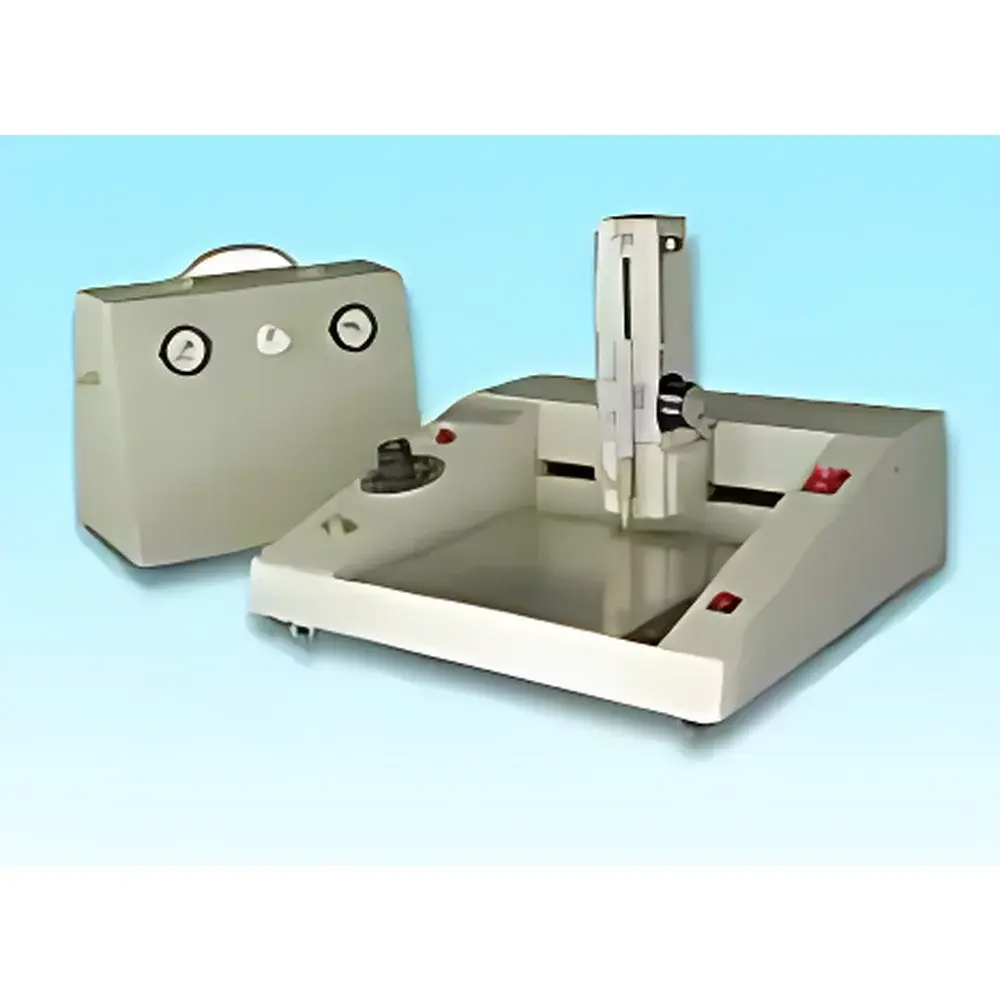
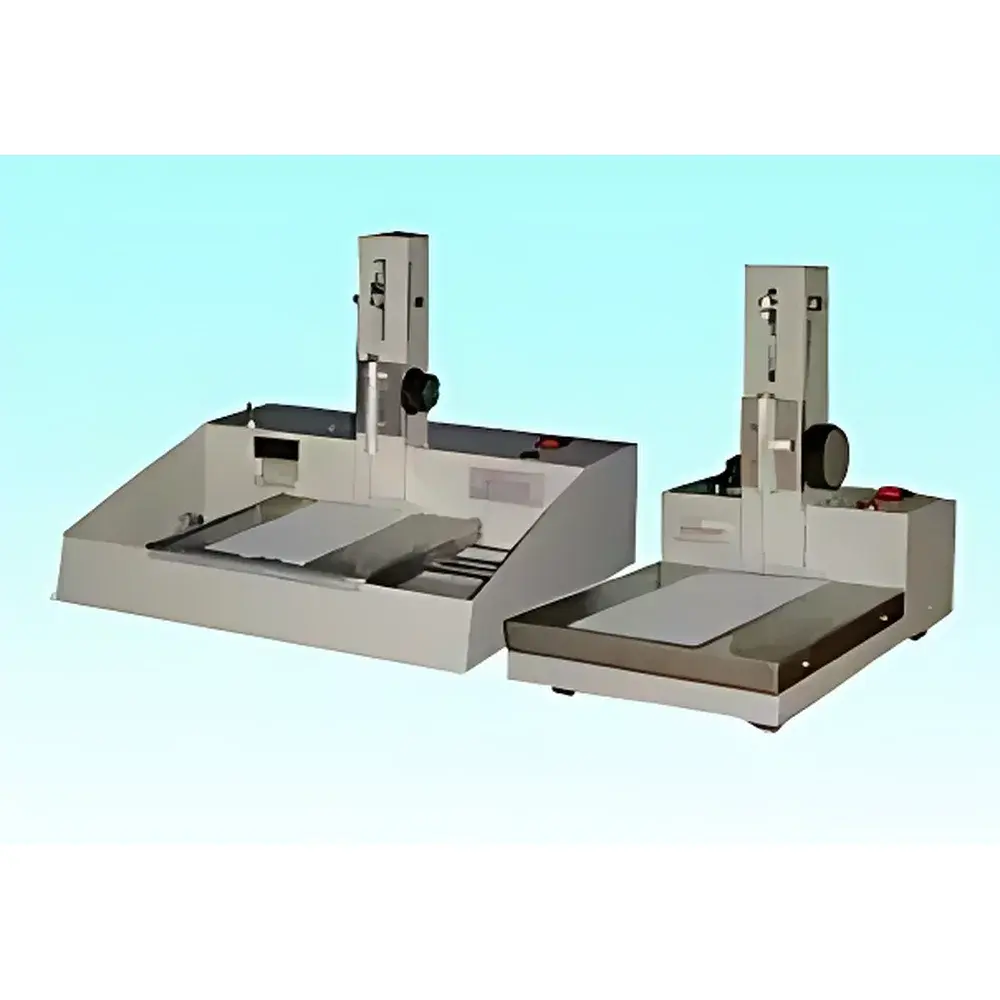
whYOKO YOKO-TD Automated Strip Sample Applicator for Thin-Layer Chromatography
| Brand | whYOKO |
|---|---|
| Origin | Hubei, China |
| Manufacturer Type | Authorized Distributor |
| Country of Manufacture | China |
| Model | YOKO-TD |
| Instrument Category | Thin-Layer Sample Applicator |
| Operation Mode | Fully Automatic |
| Wavelength Accuracy | < ±1.0% |
| Wavelength Repeatability | < ±1.5% |
| Sample Platform Dimensions | 200 × 200 mm TLC Plate |
| Heating Range | 35–200 °C |
| Heating Power | 600 W |
| Strip Length Range | 0–180 mm |
| Air Pressure Control | 0–0.12 MPa |
| Gas Flow Rate | 0.1–2.0 L/min |
| Power Supply | 220 V ±10%, 50–60 Hz, 630 W |
| Dimensions (L×W×H) | 450 × 390 × 290 mm |
| Weight | 16 kg |
| Included Syringes | 10 µL & 50 µL stainless-steel flat-tipped microsyringes |
| Optional Syringes | 25 µL, 100 µL |
| Sample Delivery Method | Non-contact pneumatic spray dispensing |
| Spot/Strip Precision | < ±1.0% (accuracy), < ±1.5% (repeatability) |
Overview
The whYOKO YOKO-TD Automated Strip Sample Applicator is a precision-engineered instrument designed specifically for reproducible, high-resolution sample application in thin-layer chromatography (TLC) workflows. Unlike conventional manual or contact-based applicators, the YOKO-TD employs a non-contact pneumatic spray deposition mechanism—based on controlled aerosol generation—to deliver analytes uniformly across silica or alumina-coated plates without mechanical contact. This eliminates physical stress on the stationary phase, preventing surface deformation, crater formation, or layer disruption that commonly compromise Rf reproducibility and resolution. The system supports both discrete spot application and continuous strip deposition (0–180 mm), enabling flexible method development for analytical screening, semi-preparative isolation, and gradient elution optimization. Integrated PID-controlled heated platform (35–200 °C) ensures consistent solvent evaporation kinetics and uniform film formation—critical for achieving high plate efficiency and inter-run comparability in regulated environments.
Key Features
- Non-contact pneumatic spray dispensing head with adjustable pressure (0–0.12 MPa) and flow rate (0.1–2.0 L/min), minimizing cross-contamination and preserving stationary-phase integrity.
- Motor-driven XYZ positioning system with synchronous stepper motors for precise lateral (±0.1 mm) and vertical (auto-lift/lower) control of the applicator head.
- Uniformly heated aluminum platform (200 × 200 mm max capacity) with digital temperature regulation (±1 °C stability over full range), enhancing solvent volatility control and band sharpness.
- Dual-mode operation: programmable single-spot, multi-spot, linear strip, reverse-direction, and repeat-overlay deposition—fully configurable via front-panel interface.
- Self-locking foot-switch and tactile keypad for hands-free, ergonomically optimized workflow integration; supports both intermittent and continuous dispensing modes.
- Modular syringe compatibility: standard 10 µL and 50 µL flat-tip stainless-steel syringes included; optional 25 µL and 100 µL variants support semi-preparative scale-up.
Sample Compatibility & Compliance
The YOKO-TD accommodates standard commercial TLC plates (glass or aluminum-backed, 0.1–2.0 mm thickness) and custom-coated substrates up to 200 × 200 mm. Its non-contact delivery mechanism is compatible with volatile solvents (e.g., chloroform, ethyl acetate, methanol), viscous solutions (up to 20 cP), and suspensions containing sub-5 µm particles—provided appropriate filtration and air pressure tuning are applied. While not certified to ISO/IEC 17025 or FDA 21 CFR Part 11 out-of-the-box, the instrument’s deterministic motion control, thermal stability, and documented repeatability (< ±1.5%) support GLP-compliant method validation when operated within defined SOPs. Traceable calibration records for temperature, pressure, and volume delivery can be maintained per internal quality protocols.
Software & Data Management
The YOKO-TD operates via embedded firmware with no external PC dependency. All operational parameters—including strip length, number of passes, dwell time per position, heating setpoint, and air pressure—are stored in non-volatile memory with up to 99 user-defined methods. Real-time status indicators (temperature, pressure, motor position) and error logging (e.g., syringe blockage, platform overheat, end-stop trigger) aid troubleshooting and audit readiness. For laboratories requiring electronic record retention, exported method files (CSV-formatted) and manual logbook entries may be integrated into LIMS or ELN platforms following ALCOA+ principles.
Applications
- Routine qualitative and semi-quantitative analysis of pharmaceutical actives, excipients, and degradation products per USP and EP 2.2.27 guidelines.
- Semi-preparative TLC fractionation with 180 mm strip capability for compound isolation prior to NMR or MS characterization.
- Development and optimization of multi-solvent gradient systems where uniform sample geometry directly impacts front-line homogeneity.
- Stability-indicating assays requiring high inter-day reproducibility of Rf values and spot morphology under accelerated storage conditions.
- Academic teaching labs requiring robust, low-maintenance instrumentation for student-led TLC methodology training.
FAQ
What types of TLC plates are compatible with the YOKO-TD?
Standard silica gel 60 F254, aluminum oxide, and cellulose plates—both pre-coated and self-poured—on glass, plastic, or aluminum backing, up to 200 × 200 mm and 2.0 mm thick.
Can the instrument apply samples in overlapping strips for concentration gradient studies?
Yes. The programmable overlay function allows sequential deposition of identical or differing samples along the same axis with user-defined spacing and repetition count.
Is the heated platform suitable for moisture-sensitive layers such as ammonium sulfate-modified silica?
Yes—the PID-controlled heating avoids thermal overshoot and permits stable operation at low setpoints (e.g., 40 °C), minimizing dehydration-induced cracking or delamination.
How is calibration verified for volumetric accuracy?
Gravimetric verification using certified reference weights and solvent density correction is recommended per ASTM E2877-22; typical deviation remains within ±1.0% when using factory-calibrated syringes and maintained air filters.
Does the system support integration with third-party image analysis software?
While the YOKO-TD does not include built-in imaging, its consistent spot/strip geometry and dimensional repeatability enable reliable post-run densitometric quantification using commercial tools (e.g., ImageJ with TLC Analyser plugin, CAMAG WinCATS).







