
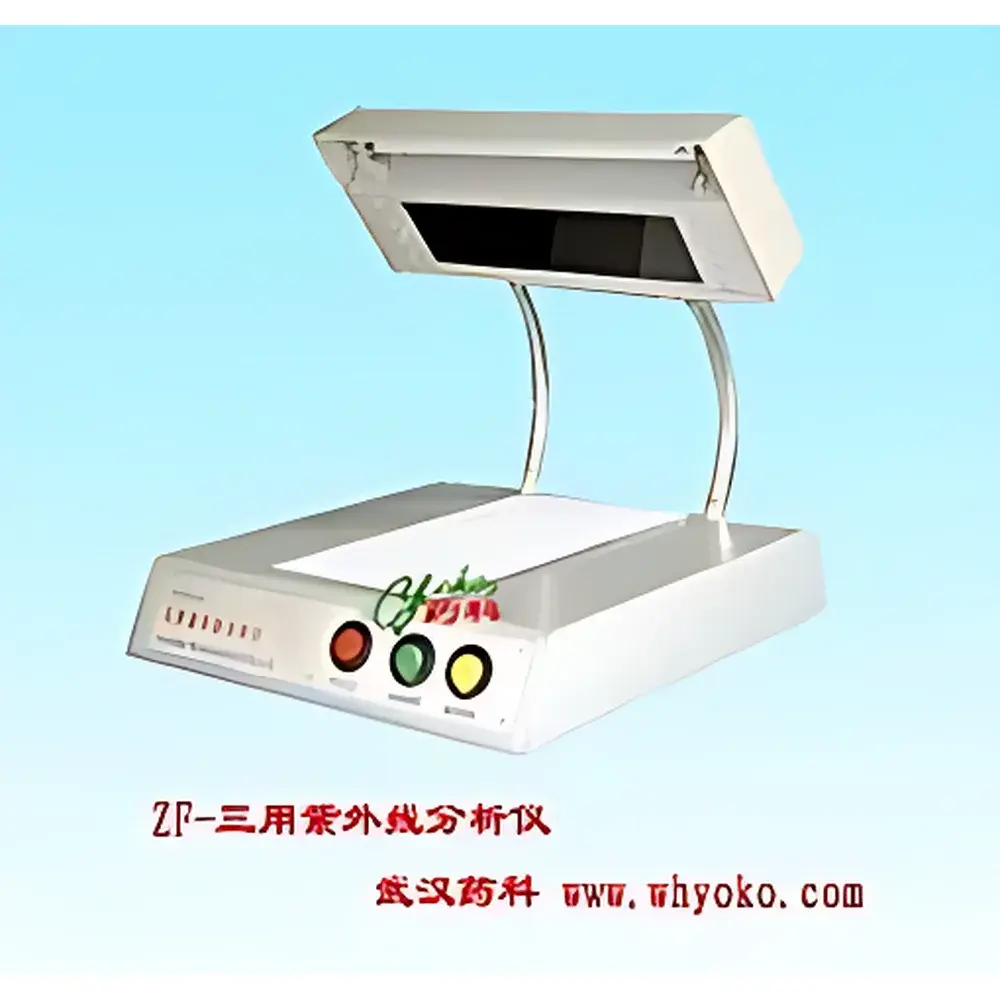
whYOKO YOKO-ZF Triple-Wavelength UV Transilluminator for Thin-Layer Chromatography Analysis
| Key | Brand: whYOKO |
|---|---|
| Origin | Hebei, China |
| Manufacturer Type | Authorized Distributor |
| Instrument Category | Domestic |
| Model | YOKO-ZF |
| Operation Mode | Manual |
| UV Wavelengths | 254 nm (1 lamp), 365 nm (1 lamp) |
| Visible Light | Integrated daylight lamp (400–700 nm) |
| UV Filter Dimensions | 50 × 200 mm |
| UV Transmission | ≥68% at 254 nm, ≥86% at 365 nm |
| Power Supply | 220 V, 50–60 Hz |
| Rated Power | 25 W |
| Overall Dimensions | 250 × 255 × 220 mm |
| Compliance | CE-marked design principles, compatible with ISO/IEC 17025 laboratory environment requirements |
| Accessories | Host unit, two 1A fuses, instruction manual, certificate of conformity, warranty card |
Overview
The whYOKO YOKO-ZF Triple-Wavelength UV Transilluminator is a purpose-engineered analytical support instrument designed specifically for visualization and documentation of fluorescent compounds in thin-layer chromatography (TLC), paper chromatography, and nucleic acid or protein gel electrophoresis. Unlike general-purpose UV lamps, this transilluminator integrates three distinct optical output modes—254 nm (high-energy short-wave UV), 365 nm (long-wave UV), and visible white light—within a single compact chassis. Its operational principle relies on fluorescence excitation: analytes containing conjugated aromatic systems or derivatized fluorophores absorb UV photons and re-emit at longer wavelengths, enabling high-contrast detection against dark backgrounds. The device is not a standalone quantitative analyzer but serves as a critical qualitative visualization platform in QC laboratories, academic research settings, and pharmaceutical stability testing workflows where rapid spot identification and Rf value determination are required.
Key Features
- Triple-mode optical configuration: Independent 254 nm and 365 nm UV lamps plus integrated daylight lamp for sample spotting, alignment, and post-UV documentation under ambient illumination.
- High-transmission UV filter assembly: Precision-cut 50 × 200 mm quartz-based filter with ≥68% transmission at 254 nm and ≥86% at 365 nm—exceeding typical industry benchmarks (20–30% transmission in conventional filters) and delivering up to 2× higher effective irradiance per watt consumed.
- Low-thermal-load architecture: Optimized lamp geometry and thermally stable electronic ballast minimize radiant heat emission, reducing risk of sample degradation during prolonged exposure—critical for thermolabile compounds such as certain alkaloids or labile glycosides.
- Energy-efficient solid-state ballast: Instant-start electronic driver eliminates warm-up delay; operates at stable frequency without flicker, ensuring consistent excitation intensity across repeated use cycles.
- Compact benchtop footprint (250 × 255 × 220 mm): Designed for integration into standard fume hoods or laminar flow cabinets without compromising workspace ergonomics.
Sample Compatibility & Compliance
The YOKO-ZF supports standard TLC plates (silica gel 60 F254, aluminum-backed or glass-backed), cellulose and polyamide sheets, agarose and polyacrylamide gels stained with ethidium bromide, SYBR® Safe, or fluorescein derivatives, and paper chromatography strips. It complies with foundational optical safety guidelines per IEC 62471 (Photobiological Safety of Lamps) for UV-A and UV-C spectral bands. While not certified for GLP/GMP production environments, its consistent output profile and documented transmission characteristics make it suitable for method development, reference standard verification, and non-regulated routine analysis under ISO/IEC 17025-accredited quality systems. All electrical components meet CE-conformity requirements for low-voltage directive compliance.
Software & Data Management
This is a hardware-only transilluminator with no embedded microcontroller or digital interface. No proprietary software, firmware, or data logging capability is included. Users integrate the device into existing imaging workflows using third-party CCD or DSLR cameras mounted above the viewing surface. For regulated environments requiring audit trails, external image capture systems compliant with FDA 21 CFR Part 11 (e.g., LabChart™ or ImageLab™ with electronic signature modules) may be employed. Documentation integrity is maintained through manual logbook entries referencing batch numbers, plate IDs, exposure duration, and observed fluorescence patterns—consistent with standard operating procedures for chromatographic recordkeeping.
Applications
- Pharmaceutical QC: Rapid identification of active pharmaceutical ingredients (APIs) and degradation products on silica TLC plates using 254 nm UV quenching or 365 nm fluorescence enhancement.
- Natural product isolation: Visualization of flavonoids, coumarins, and terpenoids in plant extract fractions following solvent-based separation.
- Biochemical assay support: Detection of DNA/RNA bands in agarose gels pre-stained with intercalating dyes; validation of restriction digest completeness.
- Forensic chemistry: Screening of illicit substances (e.g., amphetamines, benzodiazepines) via characteristic fluorescence under dual-wavelength excitation.
- Educational laboratories: Pedagogical tool for teaching chromatographic theory, Rf calculation, and fluorescence phenomena in undergraduate analytical chemistry curricula.
FAQ
Is the YOKO-ZF suitable for quantitative densitometry?
No. It provides uniform illumination for qualitative spot detection only. Quantitative analysis requires a calibrated scanning densitometer with linear response calibration and background subtraction algorithms.
Can the 254 nm lamp be used for UV sterilization?
No. The lamp’s low power (≤8 W per tube) and non-collimated emission profile do not meet germicidal irradiance thresholds defined in ISO 15858 for surface decontamination.
What safety precautions are recommended during operation?
Always wear UV-blocking safety goggles (OD ≥3 at 254 nm) and nitrile gloves. Avoid direct eye or skin exposure—especially to 254 nm radiation, which poses acute photokeratitis and erythema risks.
Is the filter replaceable, and where can spare parts be sourced?
Yes. The 50 × 200 mm UV filter is field-replaceable. Genuine whYOKO replacement filters (P/N: YOKO-F254/365-50200) are available through authorized distributors with traceable lot documentation.
Does the instrument include a timer or exposure control?
No. Exposure duration is manually controlled by user-initiated lamp activation. For reproducible results, users should establish standardized timing protocols documented in their SOPs.
Related Products





