Wiley SmartSpectra Raman Spectral Database
| Brand | Wiley |
|---|---|
| Origin | USA |
| Distributor Type | Authorized Distributor |
| Import Status | Imported |
| Model | SmartSpectra Raman Spectral Database |
| Price Range | USD 4,200 – 7,000 |
Overview
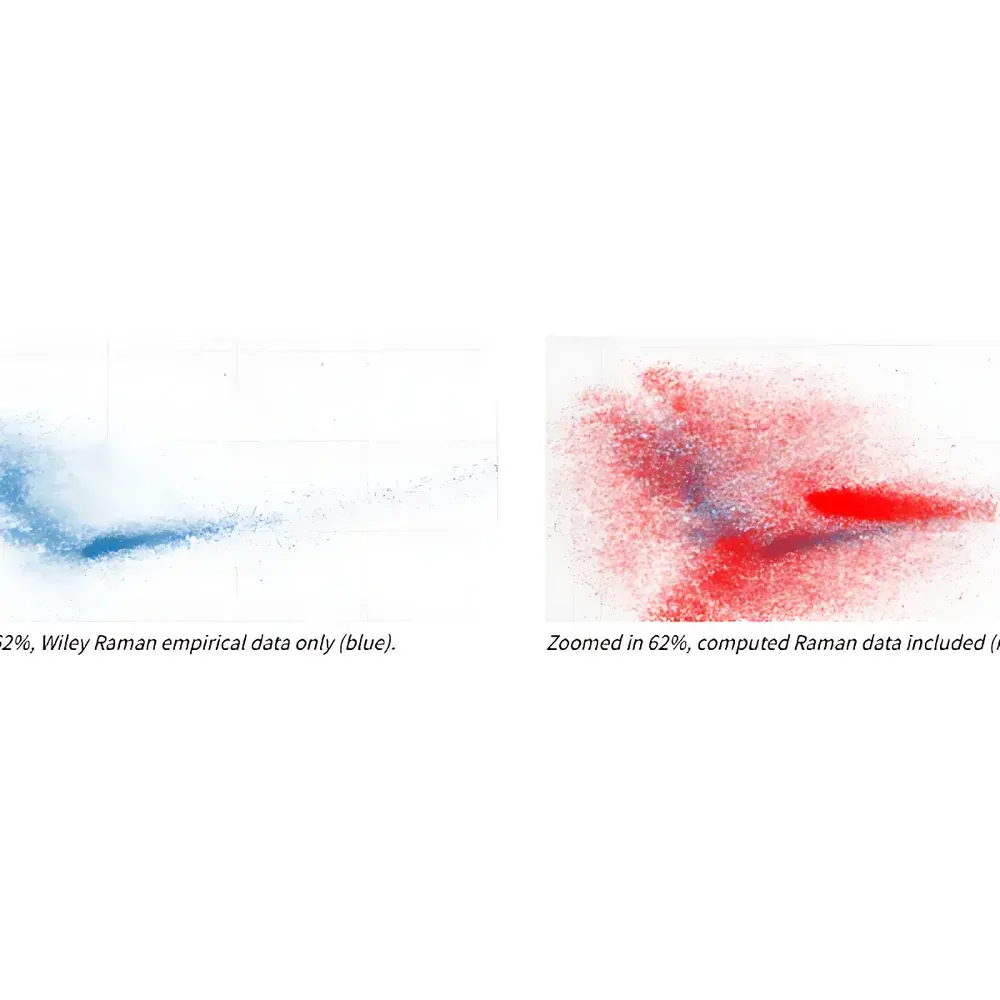
The Wiley SmartSpectra Raman Spectral Database is a rigorously curated, cheminformatics-enabled reference resource engineered to extend the compound identification capability of Raman spectroscopy beyond conventional empirical libraries. Built upon the foundational Sadtler spectral archives and augmented with algorithmically enriched spectral representations, it applies validated computational methods—including vibrational mode simulation, functional group–driven spectral clustering, and chemical space mapping—to generate high-fidelity synthetic spectra for compounds lacking experimentally acquired Raman data. This approach does not replace measured spectra but strategically complements them by populating underrepresented regions of chemical space—particularly for rigid, symmetric, or low-symmetry molecules where experimental acquisition is challenging due to weak scattering cross-sections or sample instability. The database contains 33,163 high-confidence spectral entries, each linked to authoritative structural, physical, and thermodynamic metadata, enabling context-aware spectral matching in unknown identification workflows.
Key Features
- 33,163 high-quality Raman spectral entries, including both experimentally acquired (Sadtler-derived) and computationally validated synthetic spectra
- Chemical space expansion via spectral interpolation: fills gaps between empirically measured compounds using quantum-chemically informed vibrational prediction models
- Integrated metadata schema: includes IUPAC name, SMILES, InChI, molecular weight, melting/boiling points, solubility class, and functional group annotations
- Fully compatible with Wiley KnowItAll® software platform (v10.5+), supporting spectral search, library merging, hierarchical classification, and similarity-based ranking (Cosine, Euclidean, and Pearson correlation metrics)
- SME-validated curation workflow: all synthetic spectra undergo review by spectroscopists and computational chemists to ensure adherence to selection rules, band intensity realism, and peak width consistency
- Compliance-ready architecture: supports audit trails, user access logging, and version-controlled database updates—aligned with GLP documentation requirements for regulated laboratories
Sample Compatibility & Compliance
The SmartSpectra Raman Database imposes no hardware constraints; it operates independently of instrument vendor or detector type, provided spectral data are imported in standard formats (JCAMP-DX, .spc, .csv with wavenumber-intensity columns). It is routinely deployed in QC labs performing raw material verification (per USP <1120>, Ph. Eur. 2.2.48), polymer additive screening, pharmaceutical polymorph differentiation, and forensic trace evidence analysis. All spectral assignments conform to IUPAC-recommended nomenclature and follow ASTM E1421-22 guidelines for vibrational spectral data reporting. The underlying Sadtler collection adheres to ISO/IEC 17025:2017 criteria for reference material traceability, with spectral acquisition performed on NIST-traceable instrumentation under controlled temperature and humidity conditions.
Software & Data Management
Integration occurs exclusively through Wiley KnowItAll® software, which provides native support for SmartSpectra’s extended metadata fields and enables multi-layered search strategies—e.g., simultaneous constraint of spectral similarity (>85% cosine match), molecular weight (±5 Da), and presence/absence of specific functional groups (e.g., carbonyl stretch at 1650–1750 cm⁻¹). Search results include confidence scoring based on spectral uniqueness, database coverage density in the local chemical neighborhood, and SME validation status. Data export complies with FDA 21 CFR Part 11 requirements: electronic signatures, immutable audit logs, and role-based permissions are enforced at the application layer. Version history is maintained per ISO/IEC 17025 Annex A.2, with quarterly update notifications and SHA-256 checksum verification for integrity assurance.
Applications
- Unknown compound identification in pharmaceutical development when empirical matches fall below 90% similarity threshold
- Functional group classification of novel heterocycles and metal–organic frameworks (MOFs) exhibiting limited Raman activity
- Supporting regulatory submissions by documenting spectral rationale for identity assertions (e.g., FDA ANDA filings requiring structural corroboration)
- Accelerating materials qualification in battery R&D—e.g., distinguishing LiNi₀.₈Co₀.₁₅Al₀.₀₅O₂ surface residues from bulk phase via residual spectral decomposition
- Forensic chemistry: narrowing candidate lists for seized substances using combined spectral + physicochemical property filtering
FAQ
Does SmartSpectra replace experimental Raman libraries?
No—it is designed as a complementary extension to empirical collections such as the Wiley Raman Library or Sadtler Raman Collection, not a standalone replacement.
Can SmartSpectra spectra be used for quantitative analysis?
No. The database supports qualitative identification only; intensities are normalized and not calibrated for concentration-dependent response.
Is spectral data export permitted for third-party software integration?
Export is restricted to KnowItAll-compatible formats; raw computational spectral vectors (e.g., DFT output files) are not distributed per Wiley’s intellectual property policy.
How frequently is the database updated?
Biannual updates are released, incorporating newly validated compounds, expanded polymer families, and corrections flagged during SME review cycles.
Does the database support hyphenated techniques (e.g., Raman–TGA or Raman–XRD)?
No. SmartSpectra is optimized for standalone Raman spectral interpretation; co-analytical data must be correlated externally using KnowItAll’s multi-technique workspace.