
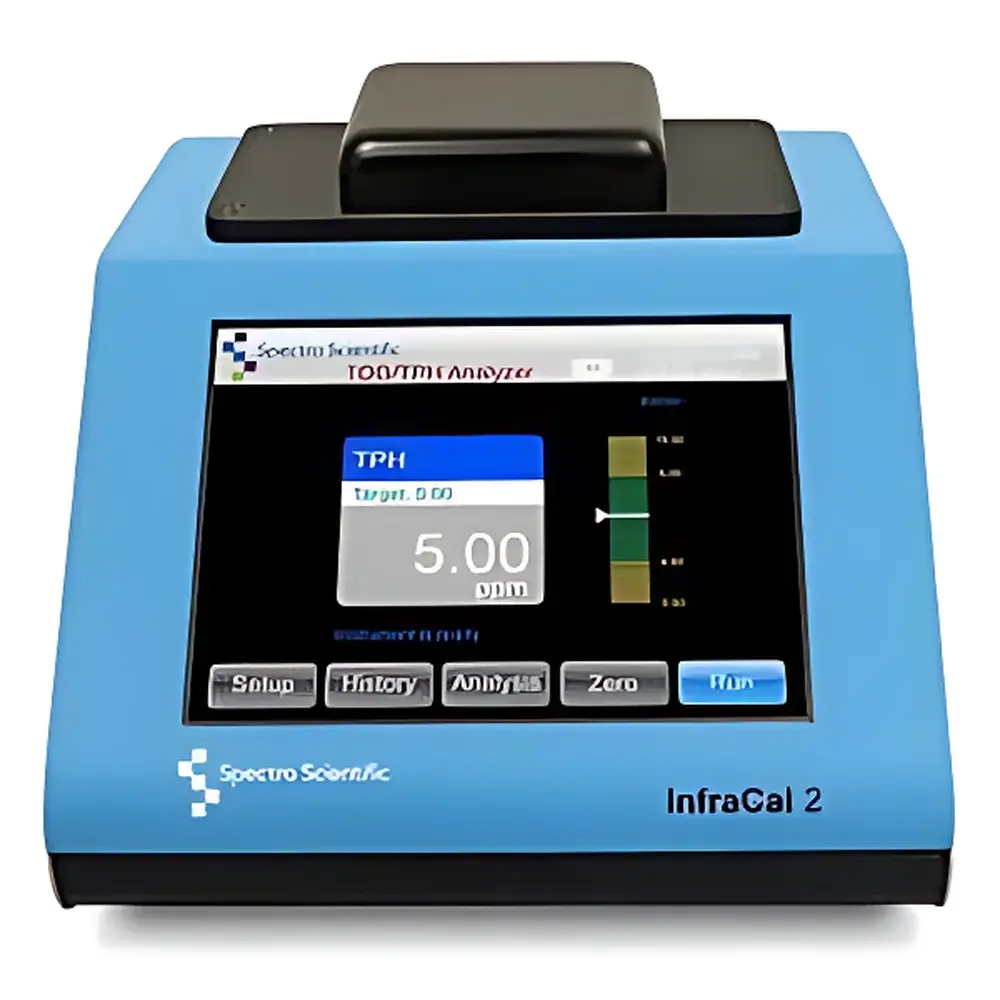
Wilks InfraCal 2 TRANS-SP Oil-in-Water and Total Petroleum Hydrocarbons (TPH) Analyzer
| Brand | Wilks Instrument |
|---|---|
| Origin | USA |
| Model | TRANS-SP |
| Detection Principle | Infrared Absorption at 2930 cm⁻¹ (3.4 µm) |
| Detection Limits | 0.1 ppm (water), 1 ppm (soil) |
| Extractants | Perchloroethylene, S-316, Freon-113, or other IR-transparent solvents |
| Compliance | EPA Method 1664, EPA Methods 413.2 & 418.1, ASTM D7066-04, ISO 9377-2 |
| Sample Cell | 10-mm pathlength fused quartz cuvette with PTFE-sealed cap |
| Power | 18 V DC, 3.3 A (internal Li-ion battery + universal AC/DC adapter) |
| Dimensions | 17 cm × 19.8 cm × 13.2 cm |
| Weight | 2.6 kg (net), 3.2 kg (with battery) |
| Operating Temperature | 5–40 °C |
| Analysis Time | 10–15 min (including extraction) |
| Repeatability | ±0.1 ppm |
| Data Interface | USB, RS-232 |
| Calibration Options | Multi-curve support (low/high concentration, S-316 or PCE-based), password-protected configuration |
Overview
The Wilks InfraCal 2 TRANS-SP is a field-deployable, benchtop infrared analyzer engineered for rapid, quantitative determination of total petroleum hydrocarbons (TPH) in soil and oil-in-water (TOG) or fat, oil, and grease (FOG) in wastewater. It operates on the fundamental principle of mid-infrared absorption spectroscopy at the characteristic C–H stretching band near 2930 cm⁻¹ (3.4 µm), where aliphatic hydrocarbons—predominant in petroleum-derived compounds—exhibit strong, linear absorbance proportional to concentration. Unlike gas chromatographic or gravimetric methods, the TRANS-SP eliminates the need for complex instrumentation, carrier gases, or lengthy sample preparation cycles. Instead, it relies on solvent extraction followed by direct IR measurement in a sealed, 10-mm pathlength fused quartz cuvette—minimizing volatile loss and ensuring analytical integrity across variable environmental conditions. Designed for compliance-driven workflows, the instrument implements measurement protocols aligned with EPA Method 1664 (the regulatory benchmark for oil and grease), EPA Methods 413.2 and 418.1 (for petroleum hydrocarbons in water and soil), ASTM D7066-04 (for FOG quantification), and ISO 9377-2 (for hydrocarbon content in water). Its robust architecture supports continuous operation in demanding settings—including offshore drilling platforms, remediation sites, municipal treatment plants, and environmental field labs—without degradation in optical stability or calibration fidelity over extended service life.
Key Features
- Field-ready design with integrated rechargeable lithium-ion battery (18 V DC, 3.3 A) and universal AC/DC power adapter for uninterrupted operation in remote or mobile laboratories.
- High-stability infrared photometric system optimized for the 2930 cm⁻¹ absorption band, delivering a detection limit of 0.1 ppm in water and 1 ppm in soil matrices.
- Multi-curve calibration capability supporting up to six independent calibration sets—enabling method-specific quantification for petroleum hydrocarbons (S-316 or perchloroethylene-based), FOG (50:50 isooctane/caprylic acid standard), or low-/high-concentration ranges within a single instrument session.
- Password-protected configuration mode ensures data integrity and audit readiness, aligning with GLP/GMP documentation requirements and facilitating user-access control in regulated environments.
- Sealed 10-mm fused quartz cuvettes with PTFE stoppers prevent solvent evaporation during analysis—critical for maintaining stoichiometric accuracy when using volatile extractants such as Freon-113 or AK-225.
- Onboard data storage and bidirectional communication via USB and RS-232 interfaces allow seamless integration with LIMS, automated reporting systems, and FDA 21 CFR Part 11-compliant electronic record workflows.
Sample Compatibility & Compliance
The InfraCal 2 TRANS-SP accommodates heterogeneous environmental matrices without modification to core optics or electronics. For aqueous samples—including produced water, stormwater runoff, cooling tower effluent, and industrial wastewater—the method employs liquid–liquid extraction using IR-transparent solvents (perchloroethylene, S-316, or Freon-113), followed by phase separation and direct cuvette loading. Soil and sediment analyses follow EPA 1664-compliant solid-phase extraction: homogenized samples are spiked with anhydrous sodium sulfate and silica gel, extracted via Soxhlet or ultrasonication, and filtered prior to measurement. The instrument’s dynamic range spans 0.1–1000+ ppm in water and 1–5000+ ppm in soil (dry weight basis), validated against certified reference materials traceable to NIST SRMs. All factory-installed calibration curves—including part numbers 405-2035-41 (S-316 high-range), 405-2035-8041 (S-316 dual-range), and 405-2035-7978 (PCE dual-range)—are generated using CRM-grade standards prepared in accordance with ISO/IEC 17025-accredited laboratory protocols. Full method validation documentation, including linearity (R² ≥ 0.999), precision (RSD < 2.5% at 10 ppm), and recovery studies (85–115% across matrix types), is supplied with each unit.
Software & Data Management
The TRANS-SP runs embedded firmware supporting real-time spectral acquisition, automatic baseline correction, and multi-point curve fitting using least-squares regression. Calibration files are stored internally and may be exported or imported via USB mass storage mode. Software tools include InfraCal Manager—a Windows-based desktop application enabling advanced curve editing, batch report generation (PDF/CSV), audit trail review, and electronic signature capture for Part 11 compliance. All measurements retain timestamped metadata (operator ID, sample ID, solvent lot, calibration ID, ambient temperature), and raw absorbance values are retained alongside concentration outputs. Data export supports hierarchical folder structures synchronized with laboratory naming conventions, and optional encryption ensures secure transmission to centralized QA/QC databases. Firmware updates are delivered via signed binary packages verified through SHA-256 checksums to maintain cryptographic integrity.
Applications
- Regulatory compliance monitoring for NPDES permits, RCRA corrective action programs, and brownfield site assessments requiring EPA 1664 or ISO 9377-2 reporting.
- Rapid screening of drill cuttings, mud tanks, and reserve pits during offshore exploration to verify hydrocarbon contamination thresholds prior to disposal or re-injection.
- Wastewater treatment optimization—tracking FOG accumulation in grease traps, equalization basins, and biological reactors to preempt operational upsets.
- Soil vapor intrusion investigations where TPH fractionation data informs risk-based corrective action levels (RBCLs) under ASTM E2600 guidance.
- Contract laboratory verification of third-party GC-FID results, serving as a cost-effective orthogonal technique for method cross-validation.
- Academic and government research into biodegradation kinetics, where repeated low-concentration TOG measurements (sub-ppm) support time-series modeling of microbial hydrocarbon metabolism.
FAQ
What solvent options are validated for use with the InfraCal 2 TRANS-SP?
Perchloroethylene (PCE), S-316, Freon-113, and AK-225 are all IR-transparent and EPA-approved for TOG/TPH extraction; S-316 is recommended for routine use due to lower toxicity and superior long-term cuvette compatibility.
Can the instrument differentiate between petroleum hydrocarbons and animal/vegetable oils?
No—its 2930 cm⁻¹ band measures total aliphatic C–H content; however, the included FOG-specific calibration (405-2035-40) uses a 50:50 isooctane/caprylic acid standard per ASTM D7066-04 to approximate mixed-source response.
Is method validation support available for ISO 17025 accreditation?
Yes—Wilks provides full validation kits including CRM traceability statements, uncertainty budgets, and IQ/OQ/PQ protocol templates compliant with ISO/IEC 17025:2017 Annex A.3.
How often must the instrument be recalibrated?
Factory calibrations remain stable for ≥12 months under normal use; annual verification with primary standards (e.g., 403-1041 or 403-1078) is recommended per ISO/IEC 17025 clause 7.7.1.
Does the TRANS-SP meet FDA 21 CFR Part 11 requirements for electronic records?
Yes—when used with InfraCal Manager v3.2+, it supports role-based access control, electronic signatures, and immutable audit trails meeting Part 11 Subpart B criteria for closed systems.
Related Products







