
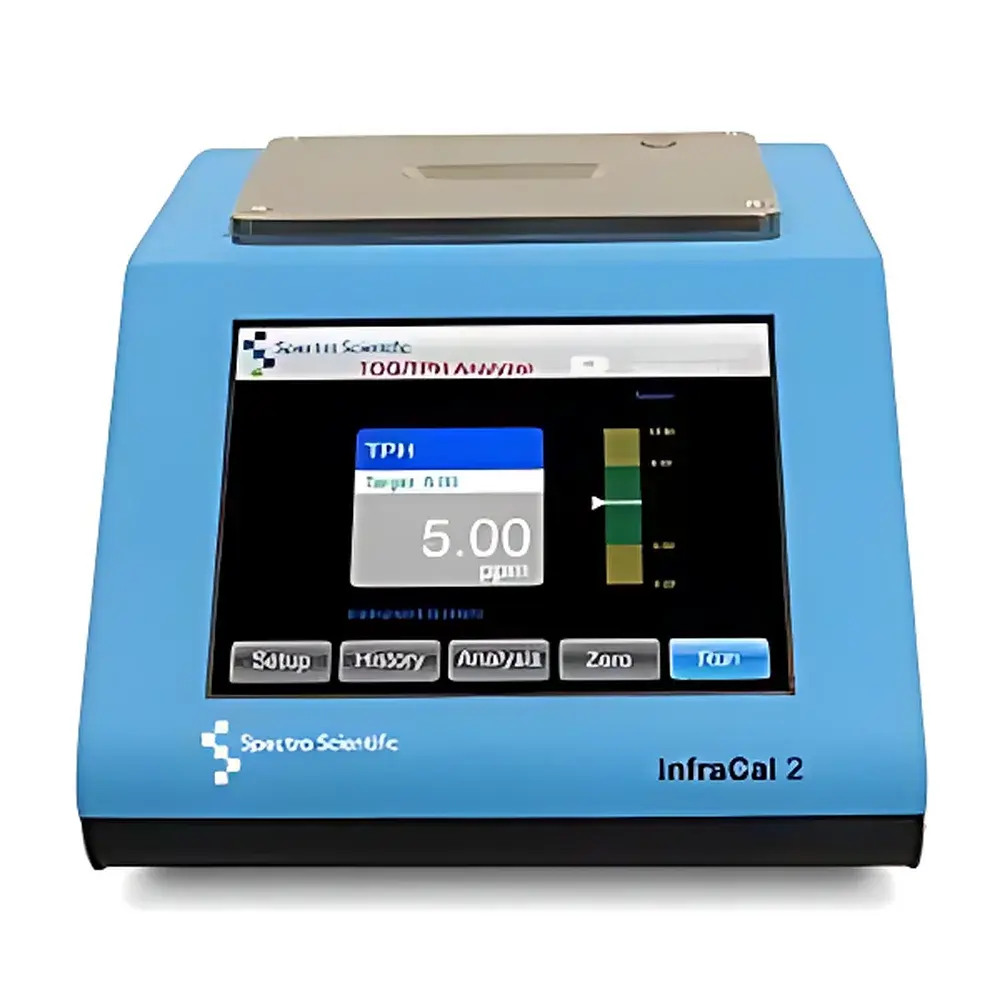
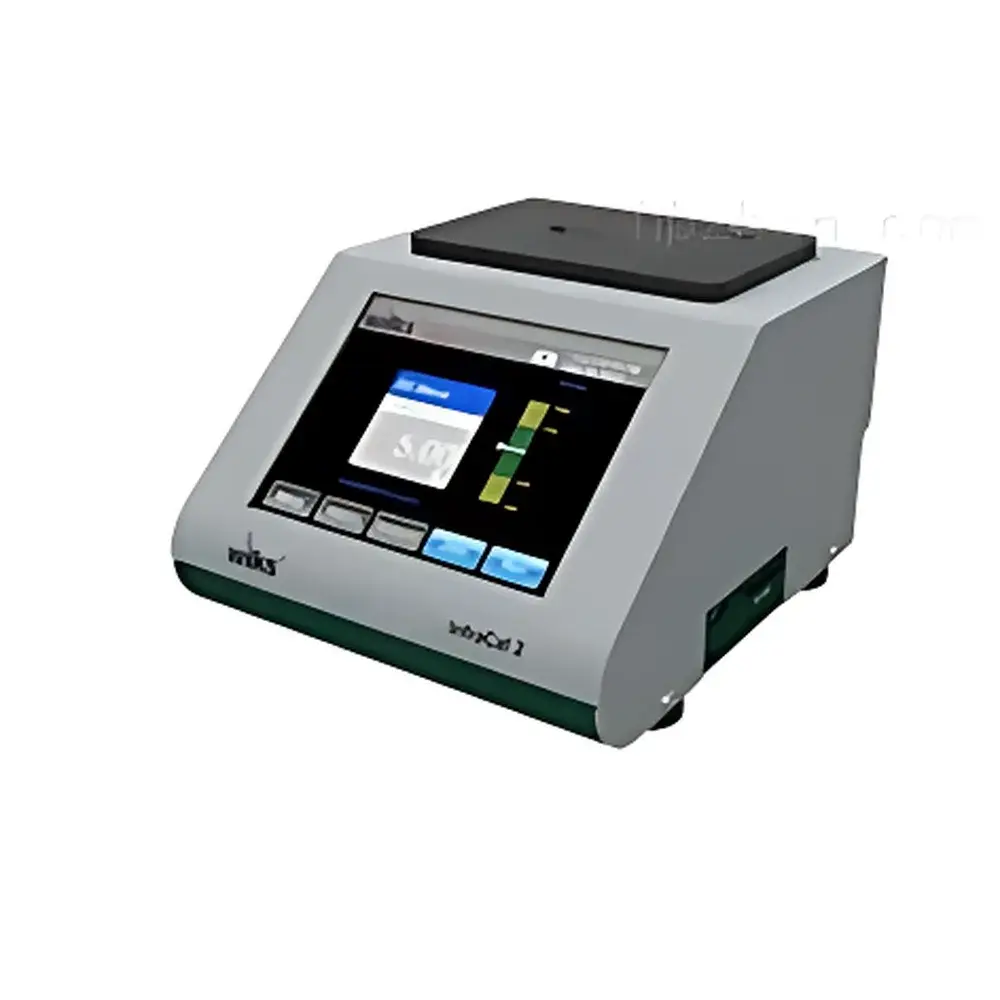
Wilks InfraCal2 Portable Infrared Oil-in-Water and Oil-in-Soil Analyzer
| Brand | Wilks |
|---|---|
| Origin | USA |
| Model | InfraCal2 |
| Instrument Type | Portable |
| Principle | Infrared Spectrophotometry (C–H Stretch Absorption at ~2960 cm⁻¹) |
| Measurement Range | 0.3–1000 ppm (as oil) |
| Detection Limit | 0.3 ppm |
| Accuracy | ±0.3 ppm (at low end, per ASTM D7066) |
| Resolution | 2 ppm |
| Data Storage | Internal memory for ≥500 results |
| Power | Rechargeable Li-ion battery |
| Interface | USB 2.0 for data export |
| Solvent Consumption per Test | 0.2 mL |
| Calibration | Multi-point, user-definable curves for TOG, FOG, TPH |
Overview
The Wilks InfraCal2 Portable Infrared Oil-in-Water and Oil-in-Soil Analyzer is an industry-proven field-deployable instrument engineered for rapid, quantitative determination of total oil and grease (TOG), fats, oils, and greases (FOG), and total petroleum hydrocarbons (TPH) in aqueous and solid matrices. Based on the fundamental principle of infrared absorption spectroscopy—specifically the symmetric and asymmetric C–H stretching vibrations near 2960 cm⁻¹—the InfraCal2 measures hydrocarbon content by quantifying infrared absorbance of solvent-extracted analytes. Unlike GC-based or gravimetric methods, it requires no carrier gas, column maintenance, or complex sample preparation beyond liquid–liquid or solid–liquid extraction using standardized solvents (e.g., Freon-113 substitute, hexane, or S-316). Its optical architecture employs a fixed-wavelength filter-based detector system optimized for robustness under variable environmental conditions—including temperature fluctuations, vibration, and humidity—making it suitable for offshore platforms, remediation sites, and mobile laboratory deployments.
Key Features
- Rapid analysis: Complete measurement cycle—including solvent extraction, phase separation, and infrared quantification—in ≤15 minutes per sample
- Sub-ppm detection capability with verified limit of detection (LOD) of 0.3 ppm and quantitation accuracy of ±0.3 ppm at the lower range, compliant with EPA Method 1664A and ASTM D7066 validation protocols
- Field-rugged design: IP65-rated enclosure, shock-absorbing housing, and wide operating temperature range (0–45°C)
- Integrated data management: Onboard non-volatile memory stores ≥500 test records with timestamp, operator ID, calibration ID, and result units
- Low reagent consumption: Only 0.2 mL of extraction solvent required per analysis—reducing hazardous waste generation and operational cost
- Flexible power options: Rechargeable lithium-ion battery supports ≥8 hours of continuous operation; also compatible with 12 V DC vehicle power or AC adapter
- Multi-curve calibration support: Up to 10 user-defined calibration curves stored internally for TOG, FOG, diesel-range organics (DRO), or site-specific hydrocarbon standards
Sample Compatibility & Compliance
The InfraCal2 accommodates diverse sample types following standardized extraction procedures: process water, produced water, industrial wastewater, soil/sediment (via Soxhlet or ultrasonic-assisted extraction), drill cuttings, spent metal parts, and recovered solvents. It complies with method equivalency requirements of U.S. EPA Methods 1664A (oil and grease), 418.1 (petroleum hydrocarbons), and ASTM D7066 (field-use infrared analyzers). While not a primary compliance instrument for regulatory submission without lab verification, its results are widely accepted for screening, process control, and trend monitoring under ISO/IEC 17025-accredited QA/QC programs. The device meets IEC 61000-4 electromagnetic compatibility standards and carries CE marking for use in EU member states. Its design supports GLP-aligned documentation workflows through traceable calibration logs and audit-ready USB data export.
Software & Data Management
Data export is performed via standard USB 2.0 interface to Windows-compatible PCs. Exported files are generated in CSV format, containing raw absorbance values, calibrated concentration, date/time stamp, calibration curve identifier, and operator code. No proprietary software installation is required—data can be imported directly into LIMS, Excel, or statistical analysis platforms. Firmware updates are delivered via downloadable .bin files and installed using the same USB connection. All calibration events—including zero checks, span verifications, and full multi-point calibrations—are automatically logged with metadata, enabling full traceability for internal audits or regulatory inspections under FDA 21 CFR Part 11 (when used in GMP environments with appropriate procedural controls).
Applications
- Offshore and onshore oil & gas operations: Real-time monitoring of produced water discharge compliance against regulatory limits (e.g., OSPAR, MMS, or national permit thresholds)
- Drilling waste management: Quantitative assessment of hydrocarbon loading in cuttings prior to disposal or thermal treatment
- Environmental remediation: Field screening of TPH in excavated soils and groundwater plumes during site characterization
- Wastewater treatment plants: FOG load tracking in influent, effluent, and grease trap samples per local sewer use ordinances
- Industrial maintenance: Residual oil detection on cleaned machinery surfaces, pipelines, or heat exchangers
- Refinery and petrochemical facilities: Process water recycle loop monitoring and solvent recovery purity verification
- Hydraulic fracturing water analysis: Rapid evaluation of hydrocarbon carryover in flowback and produced water streams
FAQ
What extraction solvents are compatible with the InfraCal2?
Commonly used solvents include S-316 (trichlorotrifluoroethane replacement), hexane, and Freon-113 substitutes meeting EPA Method 1664A specifications. Solvent choice must ensure complete hydrocarbon extraction and minimal infrared interference.
Can the InfraCal2 distinguish between mineral oil and biogenic oils?
No—it measures total C–H bond density and reports as TOG, FOG, or TPH equivalents. Speciation requires complementary techniques such as GC-FID or GC-MS.
Is routine calibration required before each analysis?
A zero check is recommended before each batch; full calibration is required daily or per shift in regulated environments, and after any solvent or hardware change.
Does the instrument require annual factory recalibration?
While not mandatory, Wilks recommends annual performance verification using NIST-traceable standards to maintain measurement confidence and support ISO/IEC 17025 accreditation requirements.
How is method validation documented for regulatory reporting?
Users must establish and retain method-specific validation records—including LOD/LOQ studies, precision/repeatability testing, and matrix spike recoveries—as part of their site-specific SOPs; the InfraCal2 provides the measurement platform, not the full validated method.







