
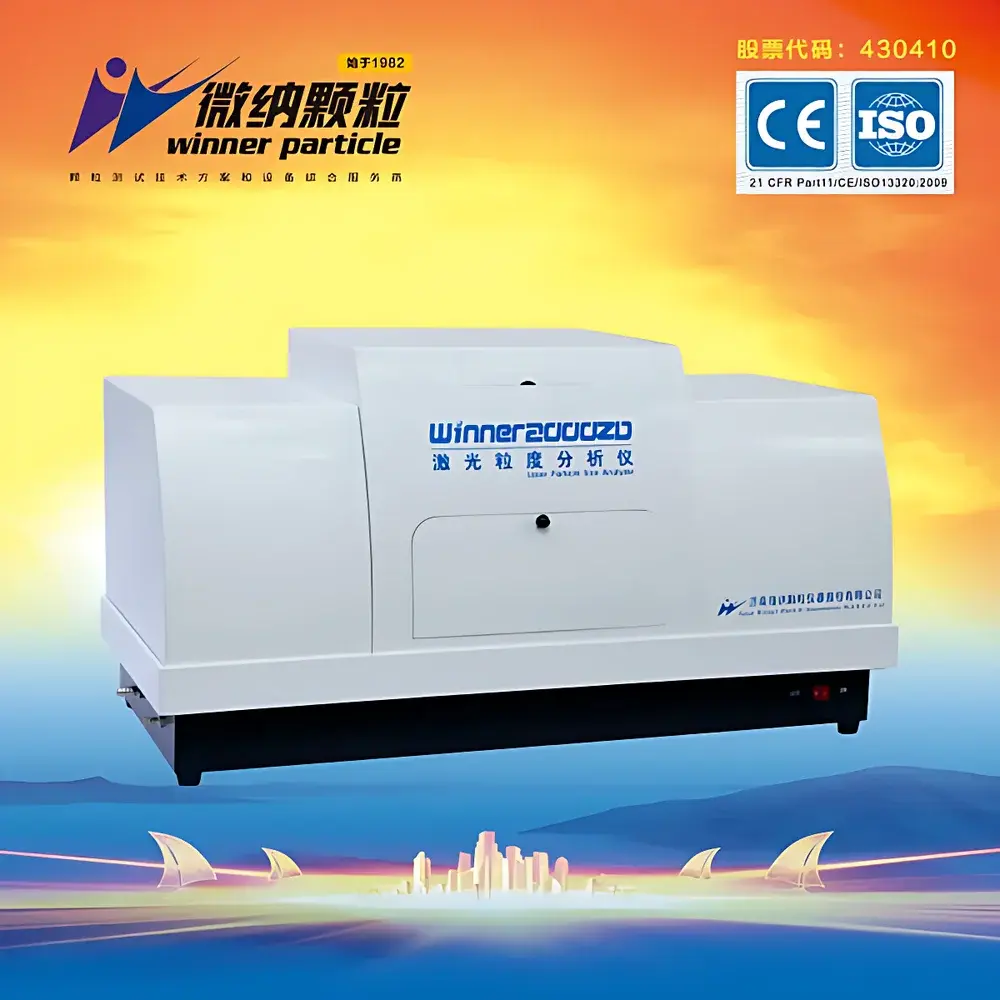
WinNano Winner2000ZD Intelligent Laser Particle Size Analyzer
| Brand | Jinan WinNano |
|---|---|
| Origin | Shandong, China |
| Manufacturer Type | Direct Manufacturer |
| Regional Classification | Domestic (China) |
| Model | 2000ZD |
| Price Range | USD 0–14,500 |
| Dispersion Method | Wet Dispersion |
| Instrument Type | Laboratory Laser Particle Size Analyzer |
| Measurement Range | 0.1–300 µm |
| Repeatability | <0.5% |
| Measurement Time | <2 min per test |
Overview
The WinNano Winner2000ZD Intelligent Laser Particle Size Analyzer is a high-precision laboratory instrument engineered for reliable and reproducible particle size distribution (PSD) analysis of solid powders, suspensions, emulsions, and colloidal dispersions. It operates on the principle of Mie scattering theory combined with Fraunhofer diffraction modeling, optimized via convergent-beam Fourier transform optical architecture. This design eliminates aperture-induced angular truncation, significantly enhancing sensitivity to submicron particles down to 0.1 µm while maintaining full-range coverage up to 300 µm. The system features an automated alignment mechanism driven by a precision four-phase hybrid stepper motor—achieving micron-level positional stability—and a fully integrated wet dispersion unit that ensures consistent sample presentation without secondary sedimentation or aggregation artifacts.
Key Features
- Convergent-beam Fourier transform optical path: Enables extended low-angle detection and improved resolution for particles below 1 µm.
- Ring-type photodetector array with 76–78 independent channels: Provides high angular resolution scattering data for robust inverse algorithm execution.
- Automatic optical alignment system: Maintains beam centering accuracy within ±1 µm over time and thermal drift, eliminating manual recalibration.
- Patented integrated wet dispersion module (CN ZL.2010 1 0533181.6): Combines ultrasonic deagglomeration (40 kHz, 60 W), programmable stirring (0–3000 rpm), recirculation (8 L/min), and drainage control in a single compact subsystem.
- Unconstrained free-fitting particle size distribution algorithm: Avoids bias from pre-assumed distribution models (e.g., log-normal), delivering raw, physically grounded PSD profiles.
- Intelligent software interface: Supports one-click operation mode—users initiate “Auto Test,” add sample to the 350 mL dispersion cell (or optional 10 mL micro-cell), and the system autonomously executes dispersion, measurement, and report generation.
Sample Compatibility & Compliance
The Winner2000ZD is validated for use with insoluble solid particulates suspended in aqueous or organic media—including calcium carbonate, kaolin, alumina, silicon carbide, graphite, metal oxides, pharmaceutical excipients, agrochemical formulations, and battery electrode slurries. It complies with international standards governing laser diffraction-based particle sizing: ISO 13320:2009 (Particle size analysis — Laser diffraction methods), GB/T 19077–2016 (Chinese national standard equivalent to ISO 13320), and internal enterprise standard Q/0100JWN001–2013. While not inherently 21 CFR Part 11 compliant out-of-the-box, its audit-trail-capable software architecture supports configuration for GLP/GMP environments when deployed with appropriate IT infrastructure and procedural controls.
Software & Data Management
The embedded WinNano Particle Analysis Software (v4.x) provides dual-mode operation: manual parameter tuning for method development and fully automated testing for routine QC/QA workflows. All measurement sessions are timestamped and logged with metadata including laser power (≥2 mW at λ = 639 nm), ultrasonication duration, stir speed, flow rate, and environmental temperature. Raw scattering intensity vs. scattering angle datasets are exportable in ASCII format for third-party validation or advanced statistical modeling. Batch reporting supports D10, D50, D90, span, specific surface area (via volume-surface conversion), and histogram visualization with customizable binning.
Applications
This analyzer serves as a core characterization tool across R&D, quality control, and production monitoring in industries where particle morphology directly impacts functional performance: ceramic and refractory manufacturing (green body density, sintering behavior), pharmaceutical solid dosage form development (API crystallinity, blend uniformity), battery materials engineering (anode/cathode slurry homogeneity), catalyst synthesis (pore structure correlation), pigment formulation (color strength, gloss), and environmental particulate monitoring (sediment grain-size classification). Its rapid turnaround (<2 min/test) and repeatability (<0.5% RSD on NIST-traceable reference materials) make it suitable for high-throughput laboratories requiring statistically robust batch release decisions.
FAQ
What standards does the Winner2000ZD comply with?
It meets ISO 13320:2009, GB/T 19077–2016, and the manufacturer’s enterprise standard Q/0100JWN001–2013.
Can the instrument measure dry powders?
No—it is configured exclusively for wet dispersion; dry powder measurement requires optional pneumatic dispersion accessories not included in the base 2000ZD configuration.
Is the software compatible with LIMS integration?
Yes—the software supports CSV and XML data export protocols, enabling interoperability with common laboratory information management systems when configured with appropriate middleware.
What is the minimum detectable particle size?
The lower detection limit is 0.1 µm under optimal dispersion conditions using the standard 350 mL cell and recommended surfactant protocols.
Does the system support multi-modal distribution analysis?
Yes—the unconstrained inversion algorithm resolves multimodal distributions without assuming prior shape functions, allowing identification of distinct populations such as primary particles and agglomerates.



