
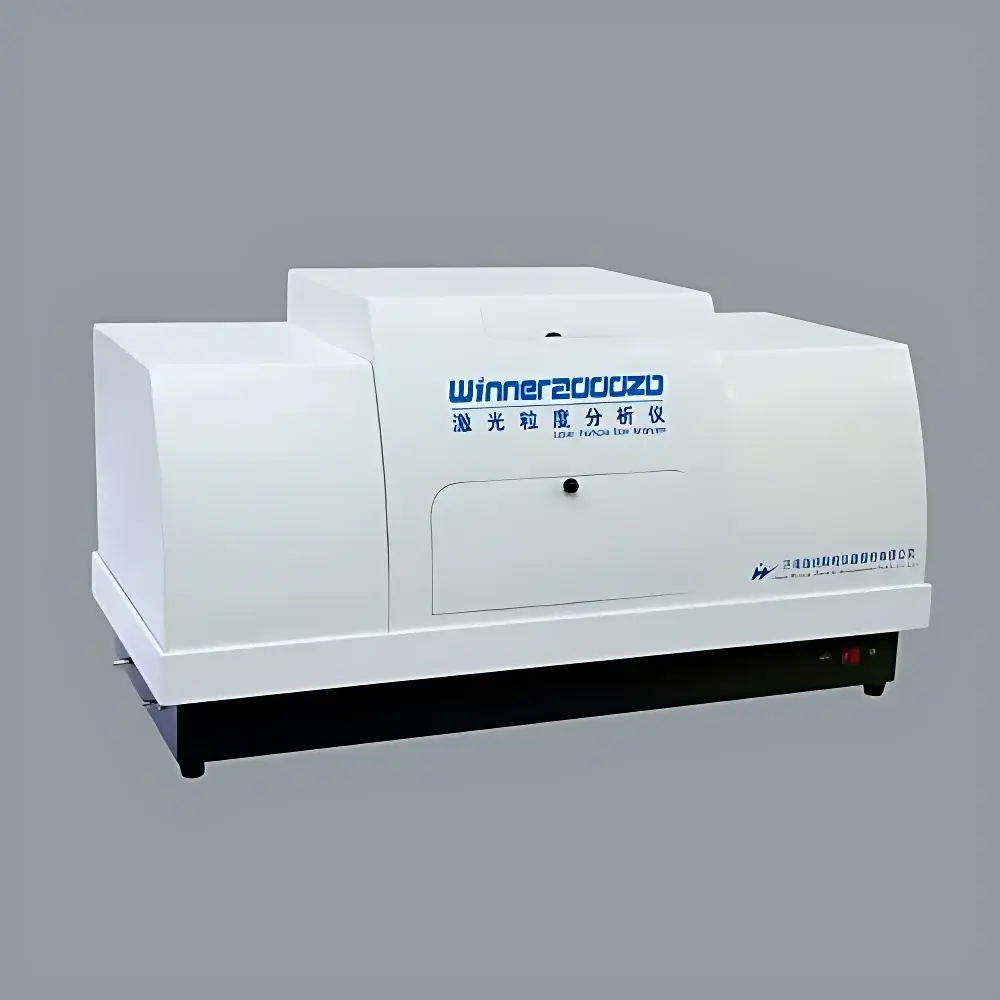
WinNano Winner2000ZDE Advanced Laser Diffraction Particle Size Analyzer
| Brand | WinNano |
|---|---|
| Origin | Shandong, China |
| Manufacturer Type | Direct Manufacturer |
| Instrument Type | Laboratory Laser Diffraction Particle Size Analyzer |
| Measurement Range | 0.1–300 µm |
| Reproducibility | <0.5% (D50 of NIST-traceable standard reference material) |
| Measurement Time | 10–120 s |
| Dispersion Method | Wet Dispersion with Integrated Ultrasonic Stirring & Circulation |
| Optical Design | Convergent Beam Fourier Transform with Multi-Angle Ring Detector Array |
| Compliance | GB/T 19077–2016, ISO 13320:2009, Q/0100JWN001–2013 |
Overview
The WinNano Winner2000ZDE is a high-precision laboratory laser diffraction particle size analyzer engineered for reliable, repeatable quantification of particle size distribution (PSD) in suspensions and slurries. It operates on the principle of Fraunhofer diffraction and Mie scattering theory—automatically selecting the appropriate model based on user-defined optical properties (refractive index, absorption coefficient) and sample characteristics. Its convergent beam Fourier transform optical architecture eliminates aperture-induced angular truncation, significantly enhancing sensitivity to sub-micron particles (down to 0.1 µm) while maintaining robust detection up to 300 µm. The system features a fully automated optical alignment mechanism driven by a four-phase hybrid stepper motor, achieving micron-level positional stability to ensure long-term optical centering without manual intervention. This eliminates operator-dependent alignment drift—a known source of inter-laboratory variability—and supports unattended operation across multi-shift or high-throughput QC environments.
Key Features
- Patented integrated wet dispersion unit (CN ZL.2010 1 0533181.6) combining ultrasonic deagglomeration (40 kHz, 60 W, adjustable duration), programmable mechanical stirring (0–3000 rpm), and closed-loop circulation (8 L/min flow rate) to prevent sedimentation and ensure homogeneous sample presentation.
- 78-channel ring-type photodetector array with optimized angular resolution, enabling high-fidelity capture of forward- and side-scattered light patterns across a broad dynamic angular range.
- Unconstrained free-fitting algorithm for PSD inversion—no pre-assumed distribution function (e.g., log-normal or Rosin-Rammler)—preserving true multimodal structure and minimizing model bias.
- Automated measurement workflow: one-click “Auto Test” initiates dispersion, alignment, acquisition, and analysis; software guides users through sample introduction and validates signal quality in real time.
- Modular sample cell options: standard 350 mL cuvette and optional 10 mL micro-cell for precious or low-volume samples—both compatible with same optical path and calibration traceability.
Sample Compatibility & Compliance
The Winner2000ZDE is validated for aqueous and organic suspensions of insoluble particulates—including metal powders, ceramic precursors, pharmaceutical excipients, mineral fillers (e.g., calcium carbonate, kaolin), catalysts, battery electrode materials, and agrochemical formulations. It complies with ISO 13320:2009 (Particle size analysis — Laser diffraction methods), GB/T 19077–2016 (Chinese national standard aligned with ISO 13320), and internal metrological specifications (Q/0100JWN001–2013). All calibration and verification procedures reference NIST-traceable standard reference materials (e.g., SRM 1963, SRM 2800), with documented uncertainty budgets per ISO/IEC 17025 requirements. The instrument’s design supports GLP-compliant data integrity: audit trails record operator ID, timestamp, parameter changes, and raw scattering pattern files with SHA-256 hash verification.
Software & Data Management
WinNano Particle Analysis Software v4.2 provides full control over measurement parameters, real-time scatter pattern visualization, and ISO-compliant reporting (D10, D50, D90, span, specific surface area, volume/mass/surface distributions). Raw data (.wps) and processed reports (.pdf, .xlsx) are stored with embedded metadata (instrument ID, calibration date, operator, environmental conditions). The software supports FDA 21 CFR Part 11 compliance mode—enabling electronic signatures, role-based access control, and immutable audit logs. Export formats include CSV for LIMS integration and XML for enterprise data lakes. Batch processing allows scheduled analysis of multiple samples with identical SOPs, reducing inter-operator variance in regulated environments.
Applications
This analyzer serves as a primary characterization tool in R&D labs and QC departments across diverse sectors: formulation development of injectable suspensions and topical emulsions (pharma); optimization of slurry rheology in lithium-ion battery cathode manufacturing; quality control of abrasive grits and polishing compounds (metallurgy); monitoring of nanoparticle dispersion stability in conductive inks (electronics); and regulatory testing of respirable fraction in occupational health aerosol studies (environmental safety). Its ability to resolve fine submicron modes makes it particularly valuable for catalysis research, where surface-area-to-volume ratio directly correlates with activity.
FAQ
What refractive index values should I input for common materials like TiO₂ or SiO₂?
Recommended default values are provided in the software’s built-in material library (e.g., TiO₂ anatase: n = 2.55, k = 0.01; fused silica: n = 1.46, k = 0). For critical applications, users may perform iterative refinement using monodisperse standards.
Can the system be validated for GMP production release testing?
Yes—the instrument supports IQ/OQ/PQ documentation packages, including installation checklists, operational performance verification using SRMs, and periodic requalification protocols aligned with ASTM E2918 and USP <429>.
Is remote diagnostics or firmware update supported?
Firmware updates are delivered via encrypted USB key; remote desktop support (with customer authorization) is available for troubleshooting under WinNano’s service agreement.
How is temperature controlled during measurement?
The system does not include active thermal regulation; ambient lab temperature must be maintained between 15–30°C per ISO 13320. Optional Peltier-cooled sample cells are available as accessories for temperature-sensitive formulations.
Does the software support statistical process control (SPC) charting?
Yes—built-in SPC tools generate X-bar/R charts, capability indices (Cp/Cpk), and trend analysis for D50 and span across sequential batches, exportable to JMP or Minitab.



