
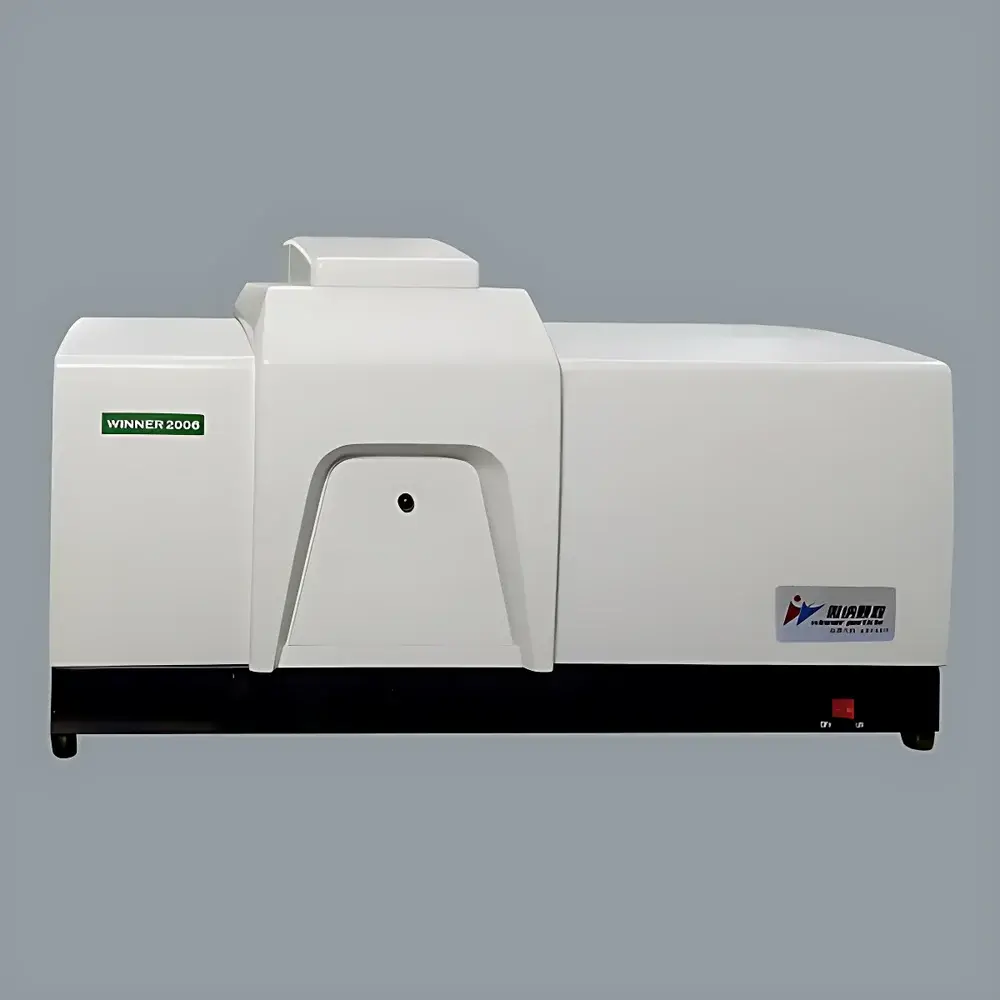
WinNano Winner2006 Advanced Wet-Dispersion Laser Particle Size Analyzer
| Brand | WinNano |
|---|---|
| Origin | Shandong, China |
| Manufacturer Type | Direct Manufacturer |
| Product Category | Domestic |
| Model | Winner2006 |
| Price Range | USD 14,000–21,000 |
| Dispersion Method | Wet Dispersion |
| Instrument Type | Laboratory Laser Diffraction Particle Size Analyzer |
| Measurement Range | 0.01–1000 µm |
| Repeatability | <0.5% RSD (D50 of NIST-traceable standard reference material) |
| Measurement Time | 10–120 s |
| Standards Compliance | GB/T 19077–2016, ISO 13320:2009, Q/0100JWN001–2013 |
| Number of Detection Channels | 90 (Winner2006A) / 86 (Winner2006B) |
| Primary Laser | λ = 639 nm, P > 2 mW |
| Secondary Laser | λ = 532 nm, P > 2 mW |
| Ultrasonic Dispersion | f = 40 kHz, P = 60 W, adjustable duration |
| Stirring Speed | 0–3000 rpm (adjustable) |
| Circulation Flow Rate | 17 L/min, P = 15 W |
| Sample Cell Volume | 450 mL |
| Auto-Alignment System | Patented 3D motorized alignment (ZL201320835882.4) |
| Dispersion Module | Integrated wet dispersion unit with stirring, ultrasonication, circulation, and drainage (ZL201010533181.6) |
| Dual-Beam Optical Design | Patented dual-laser/dual-beam configuration (ZL200720025702.0) |
| Dimensions | 900 × 400 × 500 mm |
| Weight | 40 kg |
Overview
The WinNano Winner2006 Advanced Wet-Dispersion Laser Particle Size Analyzer is a fully automated laboratory instrument engineered for high-precision particle size distribution (PSD) analysis of solid powders, suspensions, emulsions, and slurries in liquid media. It operates on the principle of laser diffraction—specifically, Mie scattering theory—enabling quantitative characterization of particles ranging from sub-micron colloids to coarse granules (0.01–1000 µm). Unlike fixed-parameter models constrained by log-normal or Rosin-Rammler assumptions, the Winner2006 implements WinNano’s proprietary non-negative, unconstrained free-fitting algorithm, which reconstructs the full PSD without imposing mathematical distribution bias. This approach ensures fidelity to raw scattering data, particularly critical for multimodal, highly polydisperse, or irregularly shaped particulates encountered in advanced ceramics, battery cathode materials, pharmaceutical suspensions, and mineral processing streams.
Key Features
- Patented Dual-Beam Optical Architecture: Two synchronized laser sources (639 nm and 532 nm) illuminate the sample cell from orthogonal paths, minimizing optical artifacts from cell wall reflections, meniscus distortion, and refractive index mismatch—significantly improving angular detection fidelity and extending dynamic range for wide-distribution samples.
- Automated 3D Optical Alignment System: A precision four-phase hybrid stepper motor drives real-time adjustment of the laser path in X/Y/Z axes (micrometer-level resolution), maintaining optimal beam centering throughout operation—essential for long-term measurement stability and inter-instrument comparability.
- Integrated Wet Dispersion Module: A self-contained circulation system combines variable-speed mechanical stirring (0–3000 rpm), programmable ultrasonication (40 kHz, 60 W), controlled flow rate (17 L/min), and automatic drain/refill sequencing—eliminating manual handling and mitigating re-agglomeration or sedimentation during analysis.
- Intelligent One-Touch Workflow: The embedded control software supports fully autonomous operation: after sample introduction, the system executes dispersion, equilibration, measurement, and post-run cleaning without user intervention—reducing operator dependency and enhancing procedural consistency across shifts or laboratories.
- Regulatory-Ready Data Integrity: Audit-trail logging, electronic signature support, and user-access-level controls align with GLP and GMP documentation requirements; raw scattering patterns and fitted distributions are stored with timestamped metadata for traceability per FDA 21 CFR Part 11 guidelines.
Sample Compatibility & Compliance
The Winner2006 is validated for aqueous and organic dispersions of insoluble solids—including metal oxides, carbon-based nanomaterials, polymer microspheres, agrochemical formulations, and geological fines. Its 450 mL sample cell accommodates sufficient suspension volume for statistical representativeness while enabling rapid turnover between runs. All performance specifications comply with ISO 13320:2009 (laser diffraction methodology), GB/T 19077–2016 (Chinese national standard equivalent), and internal WinNano calibration protocol Q/0100JWN001–2013. Repeatability (<0.5% RSD on D50 of certified NIST-traceable standards) and accuracy (≤0.5% deviation from certified D50 values) are verified quarterly using SRM 1963 (silicon carbide) and SRM 1979 (alumina).
Software & Data Management
WinNano Particle Analysis Suite (v5.2+) provides intuitive GUI navigation, customizable reporting templates (PDF/CSV/XLSX), batch processing for multi-sample series, and optional export to LIMS via ASTM E1384-compliant XML schema. Raw intensity data (scattering pattern matrix) and intermediate fitting residuals are retained alongside final PSD reports. Version-controlled software updates include enhanced noise suppression algorithms for low-concentration samples and improved refractive index correction modules for high-index particles (e.g., TiO₂, ZnO). Data encryption and role-based access control support secure deployment in regulated environments.
Applications
This analyzer serves quality control and R&D labs across sectors requiring rigorous particulate characterization: catalyst development (Pt/C, NiMo sulfides), lithium-ion battery electrode slurries (NMC, LFP), ceramic green-body formulation (Al₂O₃, Si₃N₄), pharmaceutical oral suspensions (ibuprofen, prednisolone), pigment dispersion stability assessment (TiO₂ in paint binders), and environmental sediment profiling (clay/silt/sand fractions). Its robustness in handling abrasive or high-density suspensions—without optical window fouling—makes it especially suitable for mining, metallurgy, and construction materials testing.
FAQ
Does the Winner2006 support dry powder dispersion?
No—this model is specifically designed for wet dispersion only. Dry dispersion capability requires the complementary Winner3000 series.
Can the instrument be integrated into an automated production line?
Yes—via RS-232/RS-485 serial interface or optional Ethernet/IP module, enabling remote start/stop commands and real-time data streaming to SCADA or MES platforms.
What maintenance intervals are recommended for the circulation pump and ultrasonic transducer?
Pump seals and impellers require inspection every 6 months under continuous use; ultrasonic transducers are rated for ≥10,000 operating hours and include built-in thermal cutoff protection.
Is method validation documentation provided for regulatory submissions?
Yes—WinNano supplies IQ/OQ/PQ protocols, installation qualification checklists, and a full analytical method transfer package compliant with ICH Q5A and USP <729>.
How does the unconstrained fitting algorithm differ from conventional log-normal deconvolution?
It solves the inverse scattering problem directly using non-negative least squares without assuming unimodality or symmetry—preserving bimodal peaks, shoulder features, and tail asymmetries that parametric models inherently suppress.
Related Products



