
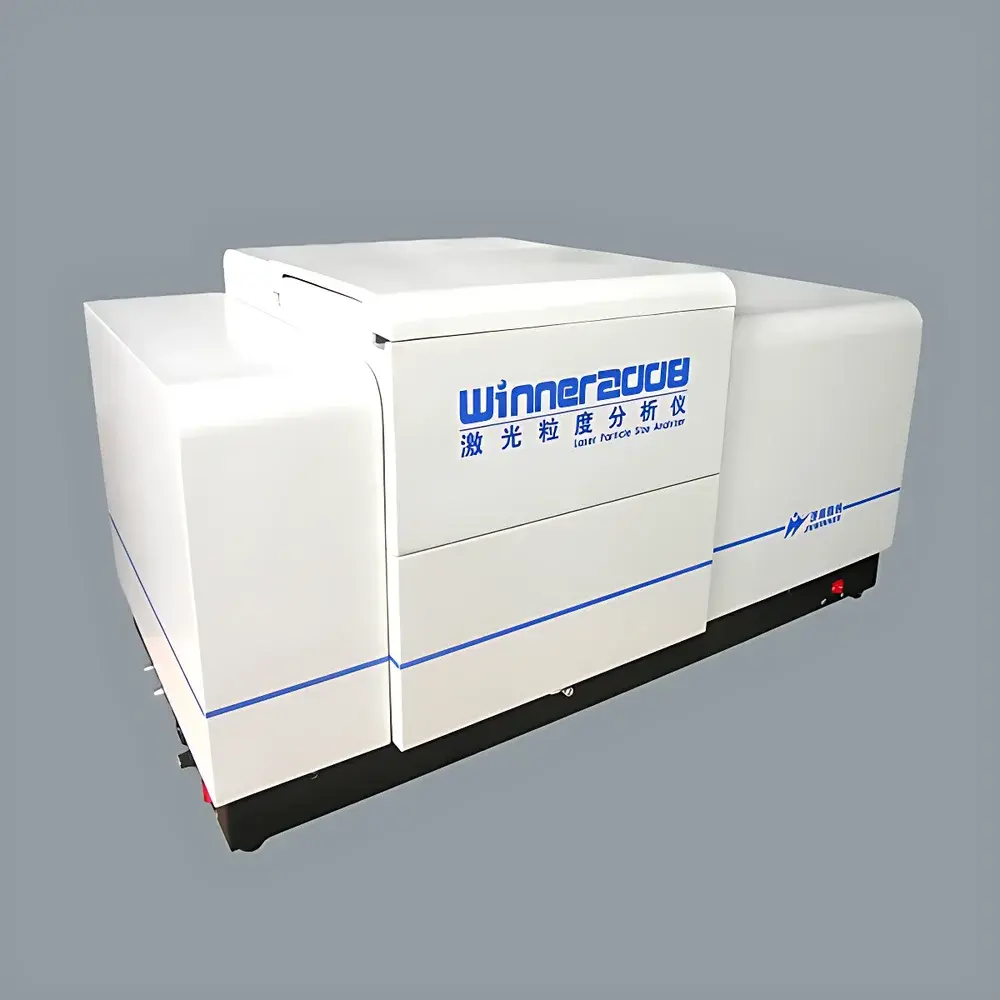
WinNano Winner2008 Advanced Wet-Dispersion Laser Particle Size Analyzer
| Brand | WinNano |
|---|---|
| Origin | Shandong, China |
| Manufacturer Type | Direct Manufacturer |
| Product Origin | Domestic (China) |
| Model | Winner2008 |
| Pricing Range | USD 21,000 – 28,000 |
| Dispersion Method | Wet Dispersion |
| Instrument Type | Laboratory Laser Particle Size Analyzer |
| Measurement Range | 0.01–2000 µm |
| Repeatability | ≤0.5% (D50 of NIST-traceable standard reference material) |
| Measurement Time | 10–120 s |
Overview
The WinNano Winner2008 is a high-precision laboratory laser particle size analyzer engineered for broad-range wet dispersion analysis of solid particulates in liquid suspensions. It operates on the fundamental principle of Mie scattering theory and Fraunhofer diffraction, with dual-laser orthogonal optical architecture enabling rigorous angular resolution across an exceptionally wide scattering vector—spanning from 0.0155° to 164°. This extended angular coverage, combined with a patented convergent beam Fourier transform optical design, eliminates conventional lens aperture limitations and significantly enhances sensitivity to both submicron nanoparticles and coarse aggregates up to 2000 µm. The instrument complies fully with ISO 13320:2009 and GB/T 19077–2016 standards for laser diffraction particle sizing, ensuring metrological traceability and interlaboratory comparability.
Key Features
- Dual-spectrum optical detection system with primary 639 nm semiconductor laser (P > 2 mW) and auxiliary 405 nm violet laser (P > 2 mW), enabling enhanced resolution for polydisperse samples containing both fine and coarse fractions.
- Patented convergent-beam Fourier transform optical path (ZL.2010 1 0533181.6), eliminating diffraction angle truncation and improving low-angle signal fidelity critical for accurate coarse-end reporting.
- Integrated wet dispersion module featuring a high-flow recirculation pump (3.6 L/min), variable-speed magnetic stirrer (0–3000 rpm), programmable ultrasonic bath (40 kHz, 60 W), and automated drainage—designed to minimize sedimentation and ensure representative sampling of particles up to 2 mm.
- Self-aligning three-dimensional automatic optical centering system (ZL.2013 2 0835882.4) using micro-stepping hybrid stepper motors with ≤1 µm positional repeatability, maintaining continuous alignment stability over extended operational cycles.
- Unconstrained free-fitting data inversion algorithm that avoids pre-assumed distribution models (e.g., log-normal or Rosin-Rammler), preserving raw scattering intensity profiles and delivering physically grounded particle size distributions without mathematical bias.
Sample Compatibility & Compliance
The Winner2008 supports aqueous and non-aqueous dispersions of insoluble solids—including metal powders, ceramic precursors, mineral fillers (e.g., calcium carbonate, kaolin), pharmaceutical excipients, carbon black, graphite, agrochemicals, and nanocomposites. Its 550 mL sample cell accommodates sufficient suspension volume for statistical robustness while minimizing multiple scattering artifacts. All measurement protocols adhere to ISO 13320:2009 Annex A guidelines for dispersion optimization and validation. The system meets requirements for GLP-compliant environments through audit-trail-enabled software logging (user actions, parameter changes, calibration events), and supports documentation for FDA 21 CFR Part 11 readiness when deployed with validated IT infrastructure.
Software & Data Management
The proprietary WinNano Particle Analysis Suite provides intuitive GUI-based operation with dual-mode control: manual parameter tuning for method development and fully automated batch sequencing for routine QC. Raw scattering data are stored in HDF5 format with embedded metadata (timestamp, operator ID, instrument serial number, dispersion settings). Export options include CSV, PDF reports compliant with ASTM E2917 and USP , and XML for LIMS integration. Statistical analysis modules support D10/D50/D90, span, relative width, and cumulative frequency plots with uncertainty estimation per ISO/TR 21358. Calibration verification logs and drift monitoring tools facilitate ongoing instrument qualification per ICH Q2(R2).
Applications
The Winner2008 serves as a primary characterization tool in R&D and quality control laboratories across diverse sectors: catalyst formulation and regeneration studies; ceramic slurry rheology and green-body density optimization; pharmaceutical suspension stability assessment; battery electrode slurry homogeneity verification; pigment dispersion quality in coatings; and environmental particulate source apportionment. Its extended dynamic range enables direct comparison of raw feedstock, milled intermediates, and final micronized products—eliminating the need for multiple instruments or sample fractionation. Academic users leverage its open algorithm architecture for custom kernel development and inverse problem research.
FAQ
What standards does the Winner2008 comply with for regulatory submissions?
It conforms to ISO 13320:2009, GB/T 19077–2016, and supports documentation aligned with FDA 21 CFR Part 11 and EU Annex 11 when integrated into validated workflows.
Can the instrument measure nanoparticles below 100 nm in aqueous media?
Yes—the 405 nm auxiliary laser and high-sensitivity side-scatter detection enable reliable quantification down to 10 nm under optimized dispersion and refractive index input.
Is the dispersion system compatible with organic solvents?
The wet module uses chemically resistant PTFE and stainless-316 components; solvent compatibility must be verified case-by-case based on viscosity, vapor pressure, and pump seal material specifications.
How is measurement repeatability validated?
Repeatability is assessed per ISO 13320 using NIST-traceable silica or polystyrene latex standards; typical D50 CV is ≤0.5% across ≥10 consecutive runs under controlled temperature and dispersion conditions.
Does the system support GMP audit trails?
Yes—the software records all user interactions, parameter modifications, calibration events, and report generations with timestamps and operator IDs, supporting full electronic record integrity per ALCOA+ principles.



