
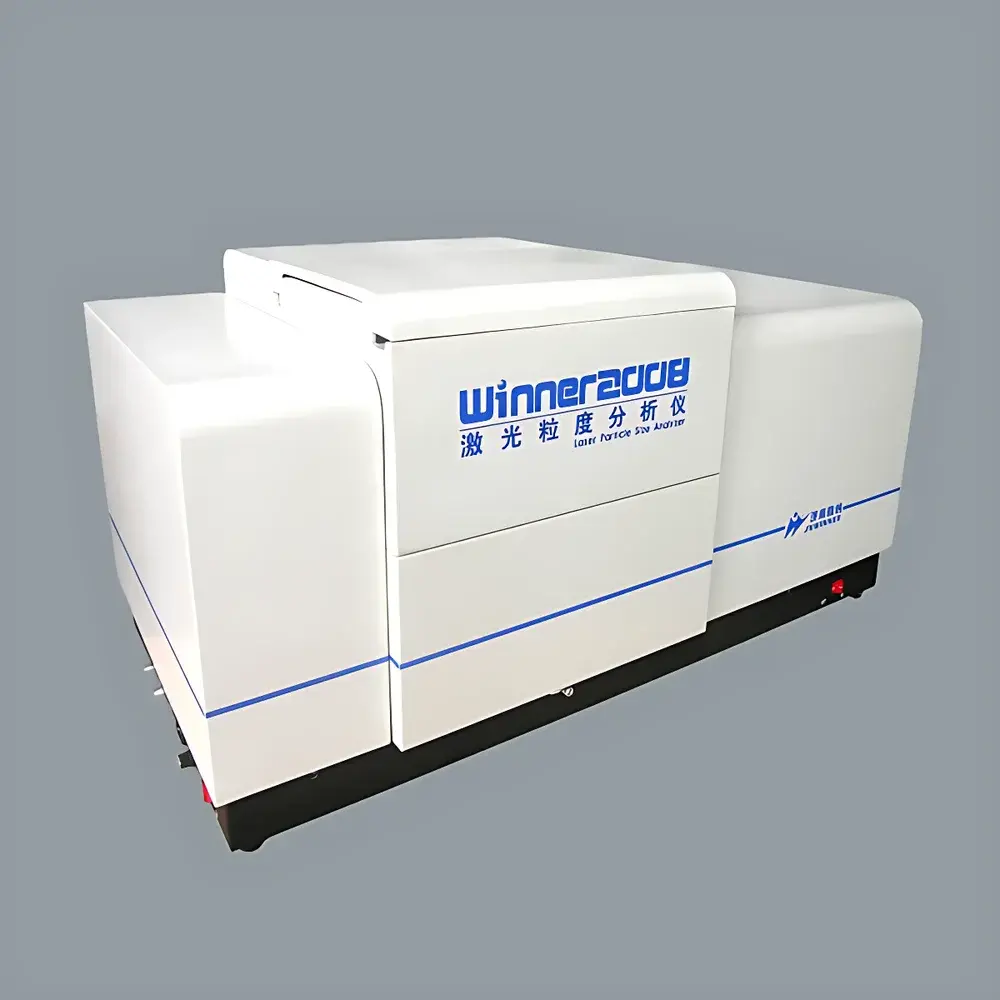
WinNano Winner2008A Laser Particle Size Analyzer
| Brand | WinNano |
|---|---|
| Origin | Shandong, China |
| Manufacturer Type | Direct Manufacturer |
| Product Category | Domestic |
| Model | Winner2008A |
| Price Range | USD 14,000 – 21,000 (FOB) |
| Dispersion Method | Wet Dispersion |
| Instrument Type | Laboratory Laser Diffraction Particle Size Analyzer |
| Measurement Range | 0.01–2000 µm |
| Repeatability | <1% RSD (D50 of NIST-traceable standard reference material) |
| Measurement Time | 10–120 s |
Overview
The WinNano Winner2008A is a high-precision laboratory laser diffraction particle size analyzer engineered for rigorous physical property characterization of solid particulates in suspension. It operates on the principle of Mie scattering theory and Fraunhofer diffraction, with optical detection calibrated across an ultra-broad angular range (0.0155° to 164°) enabled by a patented dual-laser orthogonal optical configuration. This architecture integrates a primary 639 nm semiconductor laser (P > 2 mW) and a secondary 405 nm auxiliary laser (P > 2 mW), allowing simultaneous multi-spectral interrogation to enhance resolution for both submicron and coarse particles. The instrument complies with ISO 13320:2009, GB/T 19077–2016, and supports traceable calibration using NIST-traceable standard reference materials. Designed for metrological integrity in regulated and research environments, it delivers stable, reproducible D10, D50, and D90 values under GLP-aligned operational protocols.
Key Features
- Patented convergent beam Fourier transform optical design eliminates aperture-induced angular truncation, enabling full-scatter capture without lens-based angular limitation.
- Dual spectral plane detection system extends measurable range to 2000 µm while maintaining sub-10 nm lower detection limit — validated against ISO 13320 Annex B reference standards.
- Self-developed wet dispersion module (Patent No. ZL.2010 1 0533181.6) integrates ultrasonic dispersion (40 kHz, 60 W), programmable mechanical stirring (0–3000 rpm), high-flow circulation (3.6 L/min), and automatic drainage in a single sealed loop — optimized to suppress sedimentation of particles >100 µm.
- Auto-alignment optical system (Patent No. ZL.2013 2 0835882.4) employs four-phase hybrid stepper motors with ≤1 µm positional resolution, ensuring continuous beam centering during thermal drift or mechanical vibration.
- Unconstrained free-fitting algorithm processes raw intensity data without pre-assumed distribution models (e.g., log-normal or Rosin-Rammler), preserving true multimodal population structure and minimizing inversion artifacts.
Sample Compatibility & Compliance
The Winner2008A accommodates aqueous and non-aqueous suspensions of insoluble solids including metal/non-metal powders, ceramic precursors, pharmaceutical excipients, mineral fillers (e.g., calcium carbonate, kaolin), catalysts, battery electrode slurries, and environmental particulates. Its wet dispersion cell (550 mL capacity) supports refractive index matching for transparent or opaque samples. All measurement protocols adhere to ISO 13320:2009 requirements for instrument validation, including angular calibration, background subtraction, and signal-to-noise verification. Data acquisition meets ALCOA+ principles for audit readiness; raw scatter patterns and intermediate matrices are retained with full metadata (timestamp, operator ID, dispersion parameters, alignment status). Optional 21 CFR Part 11-compliant software modules support electronic signatures and audit trail generation for GMP-regulated QC labs.
Software & Data Management
WinNano Particle Analysis Software v4.2 provides intuitive workflow control via dual-mode operation: manual parameter tuning for method development and fully automated batch analysis for routine testing. It supports customizable reporting templates compliant with ASTM E29, ISO 9001, and internal SOP formats. Scatter data is stored in HDF5 format with embedded calibration certificates and version-controlled processing algorithms. Export options include CSV, XML, and PDF reports containing statistical summaries (span, skewness, kurtosis), cumulative/differential distributions, and comparative overlays across batches or instruments. Remote diagnostics and firmware updates are supported via secure HTTPS channel with TLS 1.2 encryption.
Applications
This analyzer serves as a primary metrology tool in quality control laboratories for cementitious materials, pigment dispersion stability assessment, nanoparticle synthesis validation, catalyst attrition monitoring, and inhalable pharmaceutical powder aerodynamic characterization. It is widely deployed in academic research for colloidal science, slurry rheology correlation studies, and additive manufacturing feedstock qualification. End-user sectors include advanced ceramics R&D, lithium-ion battery material production, agrochemical formulation QA, wastewater particulate profiling, and food-grade starch granule sizing — all requiring robust, repeatable particle size distribution (PSD) data under ISO/IEC 17025-compliant conditions.
FAQ
What standards does the Winner2008A comply with for regulatory reporting?
It conforms to ISO 13320:2009, GB/T 19077–2016, and Q/0100JWN001–2013. Optional software modules enable full 21 CFR Part 11 compliance for FDA-submitted analytical data.
Can the instrument measure dry powders directly?
No — the Winner2008A is configured exclusively for wet dispersion. Dry powder analysis requires optional pneumatic dispersion accessories not included in the base A-model configuration.
How is measurement repeatability verified during routine operation?
Users perform daily verification using certified reference materials (e.g., NIST SRM 1963 or equivalent); system logs record alignment status, laser power drift, and background noise metrics to support trend analysis per ISO/IEC 17025 Clause 7.7.
Is remote software support available outside China?
Yes — WinNano provides encrypted remote desktop assistance and firmware update services globally via ISO 27001-certified infrastructure, with English-language technical documentation and application notes provided at no additional cost.
What maintenance intervals are recommended for the circulation pump and ultrasonic transducer?
The integrated wet dispersion unit requires quarterly inspection of tubing integrity and transducer coupling gel; pump diaphragms are rated for ≥10,000 operating hours under nominal load (3.6 L/min, 29 W). Full service kits and OEM spare parts are stocked in EU and US regional warehouses.



