
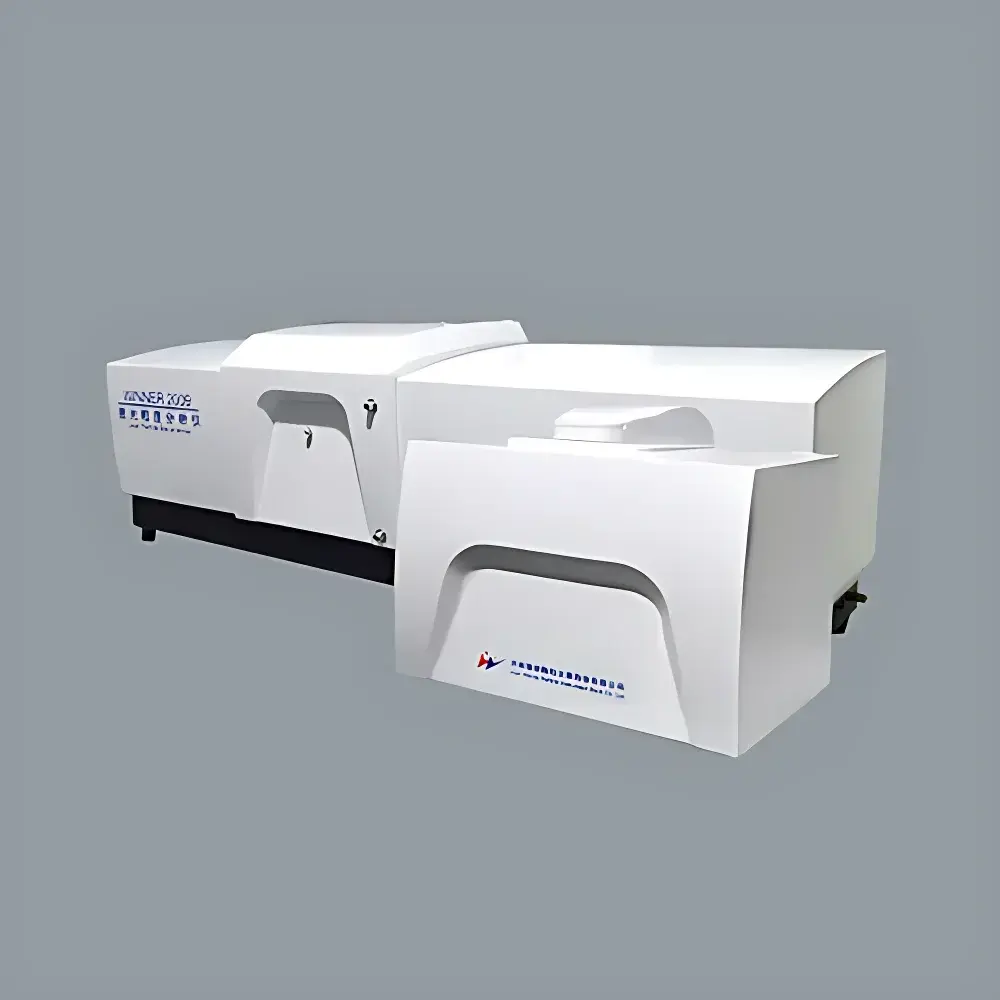
WinNano Winner2009 Advanced Wet-Dispersion Laser Particle Size Analyzer
| Brand | WinNano |
|---|---|
| Origin | Shandong, China |
| Manufacturer Type | Direct Manufacturer |
| Regional Classification | Domestic (China) |
| Model | Winner2009 |
| Price Range | USD 14,000 – 21,000 (FOB Qingdao) |
| Dispersion Method | Wet Dispersion |
| Instrument Type | Laboratory Laser Diffraction Particle Size Analyzer |
| Measurement Range | 0.01–2000 µm |
| Repeatability | <1% RSD (D50 of NIST-traceable standard reference material) |
| Measurement Time | 10–120 s |
| Compliance Standards | GB/T 19077–2016, ISO 13320:2009, Q/0100JWN001–2013 |
| Optical Alignment | Fully Automated 3D Motorized Centering System (Patent ZL201320835882.4) |
| Laser Sources | Dual-wavelength — Main He–Ne λ = 639 nm, P > 2 mW |
| Detection Angle | 0.0155°–164° |
| Detector Channels | 116 |
| Ultrasonic Dispersion | f = 40 kHz, P = 60 W, time-adjustable |
| Stirring Speed | 0–3000 rpm |
| Circulation Flow Rate | 3.6 L/min, P = 29 W |
| Sample Cell Volume | 550 mL |
| Dimensions (Analyzer Unit) | 1200 × 420 × 420 mm |
| Dimensions (Wet Dispersion Unit) | 455 × 310 × 335 mm |
| Weight | 58 kg (analyzer) + 15 kg (disperser) |
Overview
The WinNano Winner2009 is a high-performance laboratory laser diffraction particle size analyzer engineered for broad-range wet dispersion analysis of solid particulates in liquid suspensions. It operates on the fundamental principle of Mie scattering theory and Fraunhofer diffraction modeling, with dual-laser orthogonal optical architecture enabling simultaneous detection of forward, side, and backward scattered light across an exceptionally wide angular range (0.0155° to 164°). This configuration ensures accurate sizing from sub-10 nm colloidal nanoparticles up to coarse particles approaching 2 mm—covering millimeter-, micrometer-, submicron-, and nanometer-scale distributions within a single measurement cycle. Designed for rigorous research and quality control environments, the instrument integrates a fully independent, modular wet dispersion unit featuring high-flow circulation, programmable ultrasonication, and variable-speed mechanical agitation—ensuring reproducible de-agglomeration without cross-contamination or thermal drift.
Key Features
- Fully automated 3D motorized optical alignment system (patented ZL201320835882.4), utilizing precision four-phase hybrid stepper motors with micron-level positional resolution to maintain continuous beam centering—critical for long-term measurement stability and inter-laboratory comparability.
- Dual-wavelength orthogonal illumination: primary 639 nm red laser (He–Ne type, >2 mW) combined with auxiliary 405 nm blue semiconductor laser, enhancing sensitivity to sub-100 nm particles via improved side- and back-scatter signal capture.
- Convergent beam Fourier transform optical design eliminates aperture-induced truncation errors, extending effective detection range while preserving angular resolution.
- Modular wet dispersion subsystem with optimized fluidic pathways, 3.6 L/min rated flow rate, 40 kHz ultrasonic probe (60 W, time-programmable), and 0–3000 rpm adjustable stirrer—designed for rapid equilibration and minimal particle settling during analysis.
- 116-channel high-sensitivity photodetector array with imported Fourier-transform lens assembly, calibrated against NIST-traceable standards per ISO 13320:2009 requirements.
Sample Compatibility & Compliance
The Winner2009 supports aqueous and non-aqueous suspensions of insoluble or poorly soluble solids—including metal/non-metal powders, ceramic precursors, pharmaceutical excipients, mineral fillers (e.g., calcium carbonate, kaolin), catalysts, battery electrode materials, carbon black, graphite, agrochemical formulations, and colloidal dispersions. Its wet dispersion protocol complies with ISO 13320:2009 for laser diffraction methodology and meets the metrological validation criteria of GB/T 19077–2016. The system supports GLP-compliant data integrity through audit-trail-enabled software logging, user access controls, and electronic signature capability aligned with FDA 21 CFR Part 11 expectations. All calibration and verification procedures are documented per internal SOPs traceable to national metrology institutes.
Software & Data Management
The proprietary WinNano Particle Analysis Suite (v5.x) provides intuitive workflow-driven operation—from method setup and real-time scatter pattern visualization to ISO-compliant reporting (D10, D50, D90, span, specific surface area, volume/mass distribution). Raw intensity data is stored in HDF5 format with embedded metadata (instrument ID, operator, timestamp, dispersion parameters). Batch processing, statistical comparison across sample sets, and export to CSV, PDF, or XML formats are supported. Software includes built-in uncertainty estimation per ISO Guide 98-3 (GUM), and optional IQ/OQ/PQ documentation packages are available for regulated laboratories requiring formal validation under GMP or ISO/IEC 17025 frameworks.
Applications
This analyzer serves as a primary characterization tool in academic research labs studying nanoparticle synthesis kinetics, industrial QC departments monitoring ceramic slurry homogeneity, pharmaceutical development teams evaluating dry powder inhaler formulations, battery material suppliers qualifying cathode/anode powders, and environmental labs assessing sediment grain-size distributions. Its extended dynamic range makes it particularly suitable for multi-modal samples—such as composite additives containing both nano-sized TiO₂ and micron-scale silica—and for process optimization studies where particle breakage or agglomeration behavior must be tracked across varying shear conditions.
FAQ
What dispersion media are compatible with the Winner2009?
Deionized water, ethanol, isopropanol, cyclohexane, and other low-viscosity solvents commonly used in particle suspension preparation are fully supported. Viscosity should remain below 20 cP for optimal pump performance and laminar flow in the measurement cell.
Does the system support dry powder measurement?
No—the Winner2009 is configured exclusively for wet dispersion analysis. For dry powder applications, WinNano offers the Winner3008 series air jet dispersion analyzers.
How is instrument calibration verified?
Calibration is performed using NIST-traceable polystyrene latex standards (e.g., NIST SRM 1963, 100.3 nm ± 0.5 nm) and silica standards (e.g., NIST SRM 1979, D50 ≈ 5.4 µm). Daily verification protocols include background noise assessment and reference material repeatability checks.
Is remote diagnostics supported?
Yes—the embedded Ethernet interface enables secure remote connection via SSH or VNC for technical support, firmware updates, and troubleshooting under IT-administered network policies.
Can the system integrate with LIMS or MES platforms?
Data export modules support ASTM E1384-compliant structured output and direct ODBC connectivity for integration into enterprise laboratory information management systems (LIMS) or manufacturing execution systems (MES).



