
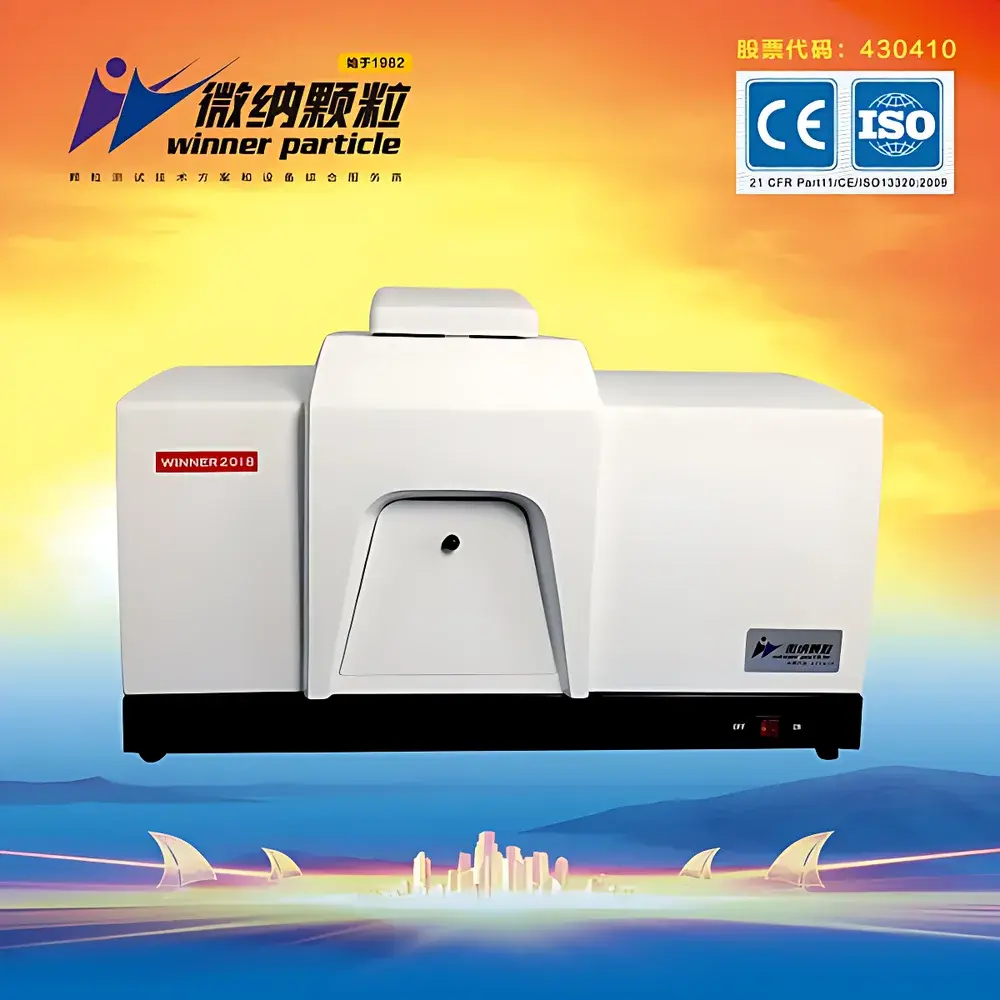
WinNano Winner2018 Intelligent Wet-Dispersion Laser Particle Size Analyzer
| Brand | WinNano |
|---|---|
| Origin | Shandong, China |
| Manufacturer Type | Direct Manufacturer |
| Product Category | Domestic Instrument |
| Model | Winner2018 |
| Price Range | USD 0–14,500 |
| Dispersion Method | Wet Dispersion |
| Instrument Type | Laboratory Laser Diffraction Particle Size Analyzer |
| Measurement Range | 0.1–450 µm |
| Repeatability | <1% (D50 of NIST-traceable standard reference material) |
| Measurement Time | 10–120 s |
| Standards Compliance | GB/T 19077–2016, ISO 13320:2009, Q/0100JWN001–2013 |
| Number of Detection Channels | 80 |
| Optical Alignment | Fully Automatic Real-Time Centering System |
| Laser Source | He–Ne, λ = 639 nm, P > 2 mW |
| Ultrasonic Dispersion | f = 40 kHz, P = 60 W, adjustable duration |
| Stirring Speed | 0–3000 rpm (adjustable) |
| Circulation Flow Rate | 8 L/min, P = 10 W |
| Standard Sample Cell Volume | 350 mL |
| Optional Micro-Cell Volume | 10 mL |
| Dimensions | 822 × 365 × 495 mm |
| Weight | 40 kg |
Overview
The WinNano Winner2018 Intelligent Wet-Dispersion Laser Particle Size Analyzer is a laboratory-grade instrument engineered for high-precision particle size distribution (PSD) analysis of suspensions, emulsions, colloidal dispersions, and insoluble solid powders in liquid media. It operates on the principle of laser diffraction—specifically Mie scattering theory—enabling quantitative characterization of particles from 0.1 µm to 450 µm with metrological traceability to international standards. Unlike conventional instruments constrained by pre-defined distribution models (e.g., log-normal or Rosin-Rammler), the Winner2018 implements WinNano’s proprietary unconstrained free-fitting algorithm, which reconstructs the full PSD without imposing mathematical assumptions. This approach preserves bimodality, skewness, and fine structural features in the distribution—critical for R&D validation, formulation optimization, and quality control in regulated environments.
Key Features
- Convergent-beam Fourier-transform optical design: Eliminates angular truncation caused by lens aperture limitations, significantly enhancing sensitivity to submicron particles (<1 µm) while maintaining robust signal-to-noise ratio across the full dynamic range.
- Fully integrated wet dispersion system: Patented circulation unit (CN ZL.2010 1 0533181.6) combines ultrasonication, mechanical stirring, fluid recirculation, and drain control within a single sealed module—minimizing particle reagglomeration and sedimentation during measurement cycles.
- Real-time automatic optical alignment: Motorized translation stages continuously monitor and adjust laser beam position relative to the detection plane, ensuring consistent optical path integrity across repeated measurements and extended operational periods.
- Intelligent one-click workflow: Software initiates standardized dispersion protocols (ultrasonication duration, stir speed ramping, flow stabilization) upon sample introduction—reducing operator dependency and inter-user variability.
- Dual-cell configuration support: Standard 350 mL cell for routine batch analysis; optional 10 mL micro-cell for precious, hazardous, or low-volume samples—both compatible with automated cleaning and rinse sequences.
Sample Compatibility & Compliance
The Winner2018 is validated for aqueous and organic-based dispersions including metal oxides, pharmaceutical actives, ceramic precursors, polymer latexes, catalyst supports, and mineral slurries. Its wet-dispersion architecture accommodates both volatile and non-volatile solvents (e.g., water, ethanol, isopropanol, xylene), provided viscosity remains below 20 cP and refractive index contrast exceeds Δn ≥ 0.05 relative to the dispersant. The instrument meets the performance requirements of ISO 13320:2009 (laser diffraction particle sizing), GB/T 19077–2016 (Chinese national standard aligned with ISO), and internal WinNano specification Q/0100JWN001–2013. All calibration and verification procedures are documented per GLP principles, supporting audit readiness for ISO/IEC 17025-accredited laboratories.
Software & Data Management
The embedded WinNano Particle Analysis Suite v4.x provides ISO-compliant reporting templates (D10, D50, D90, span, specific surface area), statistical batch comparison (t-test, ANOVA), and raw intensity matrix export in ASCII or CSV format. Audit trail functionality records user ID, timestamp, parameter changes, and calibration events—fully compliant with FDA 21 CFR Part 11 requirements when deployed with network authentication and electronic signature modules. Data files include embedded metadata (instrument ID, firmware version, dispersion parameters), enabling traceable reprocessing and cross-laboratory method transfer.
Applications
The Winner2018 serves as a primary characterization tool in materials science labs evaluating nanoparticle synthesis consistency; QC departments monitoring pigment dispersion stability in coatings; pharmaceutical development teams assessing inhalable dry powder aerosol uniformity; and environmental research groups quantifying sediment grain-size distributions in runoff studies. Its ability to resolve multimodal distributions makes it particularly valuable for battery cathode slurry analysis (e.g., NMC/LFP blends), where secondary agglomerates must be distinguished from primary crystallites.
FAQ
What dispersion media are compatible with the Winner2018?
Deionized water, ethanol, isopropanol, acetone, and low-viscosity hydrocarbons (e.g., hexane, toluene) are routinely used. Viscosity should not exceed 20 cP; refractive index difference between particle and medium must be ≥ 0.05.
Is the instrument suitable for measuring nanoparticles below 100 nm?
Yes—the convergent optical design and Mie-based inversion algorithm provide reliable resolution down to 0.1 µm (100 nm), contingent on adequate refractive index contrast and stable dispersion.
How is calibration verified?
Calibration is confirmed using NIST-traceable polystyrene latex standards (e.g., NIST SRM 1963, D50 = 10.04 µm ± 0.07 µm); repeatability is assessed per ISO 13320 Annex B using three consecutive runs on certified reference material.
Can the software generate GMP-compliant reports?
Yes—when configured with user access controls, electronic signatures, and audit trail logging, the software satisfies documentation requirements for GMP-regulated pharmaceutical and medical device manufacturing.
What maintenance is required for the circulation system?
Routine cleaning after each sample type (using appropriate solvent flush), quarterly inspection of ultrasonic transducer coupling gel, and annual verification of pump flow rate accuracy against gravimetric measurement.
Related Products



