
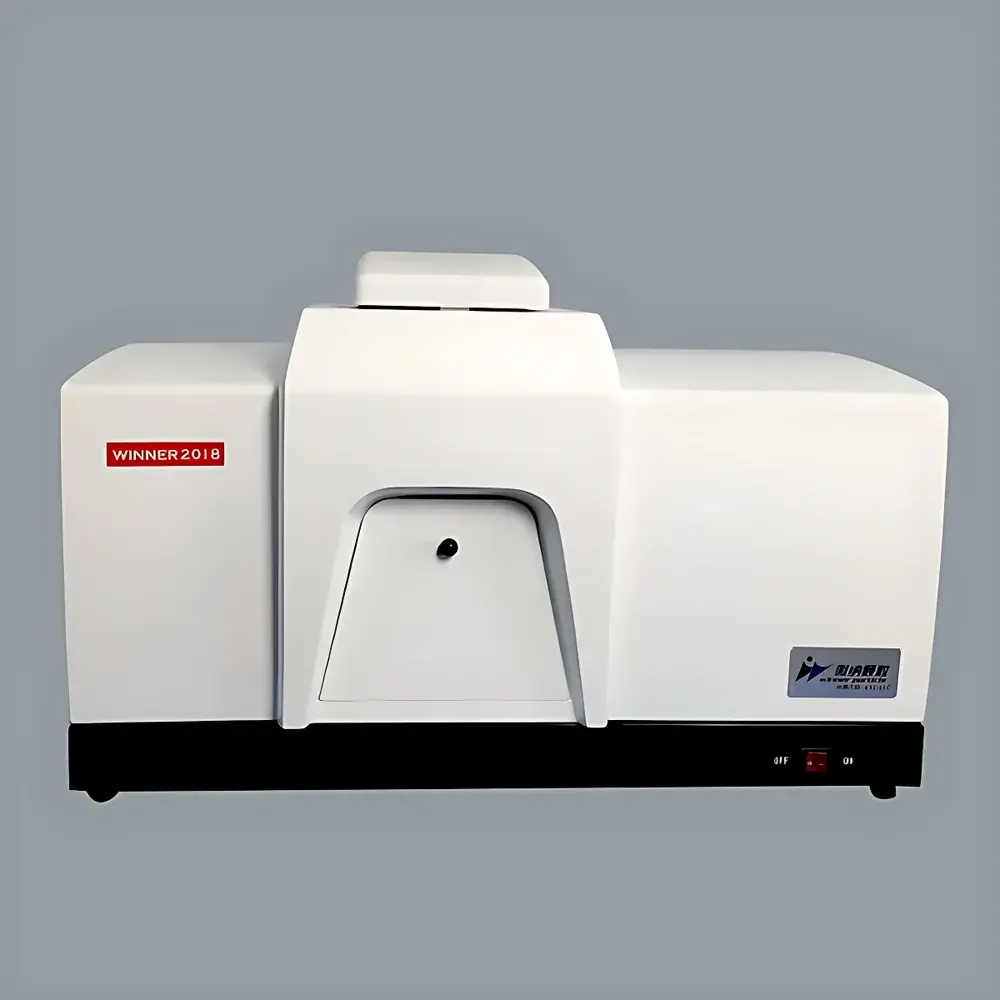
WinNano Winner2018 Laser Particle Size Analyzer
| Brand | WinNano |
|---|---|
| Origin | Shandong, China |
| Manufacturer Type | Direct Manufacturer |
| Instrument Type | Laboratory Wet-Dispersion Laser Diffraction Particle Size Analyzer |
| Measurement Range | 0.1–450 µm |
| Repeatability | <0.5% (D50 of NIST-traceable standard reference material) |
| Measurement Time | 10–120 s |
| Dispersion Method | Integrated Wet Dispersion System with Ultrasonication, Stirring & Circulation |
| Optical Design | Convergent Beam Fourier Transform with Extended Low-Angle Detection |
| Standard Compliance | GB/T 19077–2016, ISO 13320:2009, Q/0100JWN001–2013 |
| Laser Source | λ = 639 nm, P > 2 mW |
| Ultrasonic Frequency | 40 kHz, Power: 60 W (adjustable duration) |
| Stirring Speed | 0–3000 rpm (stepless control) |
| Circulation Flow Rate | 8 L/min |
| Sample Cell Volume | 350 mL (standard), 10 mL (optional micro-cell) |
| Auto-Alignment | Fully Motorized Optical Centering System |
| Dimensions | 822 × 365 × 495 mm |
| Weight | 40 kg |
Overview
The WinNano Winner2018 Laser Particle Size Analyzer is a benchtop wet-dispersion instrument engineered for precision particle size distribution (PSD) analysis of solid particulates suspended in liquid media. It operates on the fundamental principle of laser diffraction—specifically Mie scattering theory—enabling quantitative characterization of particles from 0.1 µm to 450 µm in equivalent spherical diameter (ESD). Unlike empirical or simplified Fraunhofer-based systems, the Winner2018 employs unconstrained free-fitting inversion algorithms, eliminating assumptions about distribution shape (e.g., log-normal or Rosin-Rammler) and preserving true multimodal resolution. Its convergent-beam Fourier transform optical architecture expands low-angle detection capability, significantly improving sensitivity to submicron fractions (<1 µm) without compromising upper-range fidelity. Designed for routine laboratory use, the system integrates all core dispersion functions—ultrasonication, mechanical stirring, fluid circulation, and overflow drainage—into a single, self-contained module, minimizing operator intervention while ensuring hydrodynamic stability during measurement.
Key Features
- Unconstrained free-fitting data inversion algorithm—no pre-assumed distribution function, enabling accurate representation of bimodal, trimodal, or irregular PSDs.
- Convergent beam Fourier transform optical path—eliminates aperture-induced angular truncation, enhancing resolution for particles below 1 µm.
- Fully automated optical alignment system—motor-driven centering ensures consistent beam positioning across daily operation and long-term stability.
- Integrated wet dispersion unit with patented design (ZL.2010 1 0533181.6)—combines ultrasonication (40 kHz, 60 W), variable-speed stirring (0–3000 rpm), and controlled circulation (8 L/min) within a sealed, corrosion-resistant flow cell.
- Dual sample cell options—standard 350 mL chamber for general-purpose analysis and optional 10 mL micro-cell for precious or limited-quantity samples.
- Compliance-ready firmware architecture—supports audit trails, user access levels, and electronic signature logging aligned with GLP/GMP documentation requirements.
Sample Compatibility & Compliance
The Winner2018 is validated for aqueous and organic suspensions of insoluble solids—including oxides, polymers, pigments, pharmaceutical actives, catalysts, and nanocomposites. It accommodates emulsions, colloidal dispersions, gels, and slurries with viscosity up to 1000 cP when diluted appropriately. All measurements adhere to ISO 13320:2009 (laser diffraction particle sizing), GB/T 19077–2016 (Chinese national standard equivalent), and internal validation protocol Q/0100JWN001–2013. Repeatability is verified using NIST-traceable silica and polystyrene latex standards; typical D50 repeatability is ≤0.5% RSD over ten consecutive runs under identical dispersion conditions. The system supports calibration verification per ASTM E2919 and is compatible with IQ/OQ documentation packages for regulated environments.
Software & Data Management
WinNano Particle Analysis Software (v4.2+) provides intuitive workflow-driven operation—from method setup and dispersion parameter programming to real-time scatter pattern visualization and report generation. Raw intensity data is stored in HDF5 format, preserving full angular resolution for retrospective reanalysis. Batch processing supports statistical comparison across multiple samples, including d10/d50/d90, span, relative width, and modal peak identification. Export formats include CSV, PDF, and XML, with metadata embedding (operator ID, timestamp, instrument serial number, dispersion parameters). For regulated laboratories, optional 21 CFR Part 11 compliance modules provide role-based authentication, electronic signatures, and immutable audit logs—fully traceable to individual measurement events.
Applications
The Winner2018 serves as a primary PSD characterization tool across diverse sectors requiring robust, reproducible particle sizing. In pharmaceutical development, it quantifies micronized API distributions prior to formulation and monitors granule growth during wet granulation. In advanced materials R&D, it validates synthesis consistency of battery cathode precursors (e.g., NMC, LFP), ceramic powders, and quantum dot suspensions. Industrial users in cement, mining, and coatings leverage its rapid turnaround for QC release testing of fillers, pigments, and abrasive grits. Academic researchers utilize its high-resolution submicron detection for nanoparticle toxicity studies, environmental sediment analysis, and food colloid stability assessment.
FAQ
What particle size standards are recommended for routine calibration verification?
NIST SRM 1963 (10.02 ± 0.10 µm polystyrene latex) and SRM 2800 (1.15 ± 0.03 µm silica) are used for mid- and submicron range validation, respectively.
Can the system analyze dry powders directly?
No—the Winner2018 is configured exclusively for wet dispersion. Dry powder analysis requires optional pneumatic dispersion accessories not included in this model.
Is the software compatible with LIMS integration?
Yes—via configurable ODBC drivers and structured XML output, enabling bidirectional data exchange with major LIMS platforms including LabWare, Thermo Fisher SampleManager, and STARLIMS.
How often does the optical alignment require manual intervention?
None—the fully motorized auto-alignment system performs real-time correction before each measurement; no scheduled maintenance or manual adjustment is required.
Does the instrument meet FDA 21 CFR Part 11 requirements out of the box?
Base configuration includes audit trail and user management features; full Part 11 compliance requires activation of the optional Validation Package with electronic signature and secure archive modules.



