
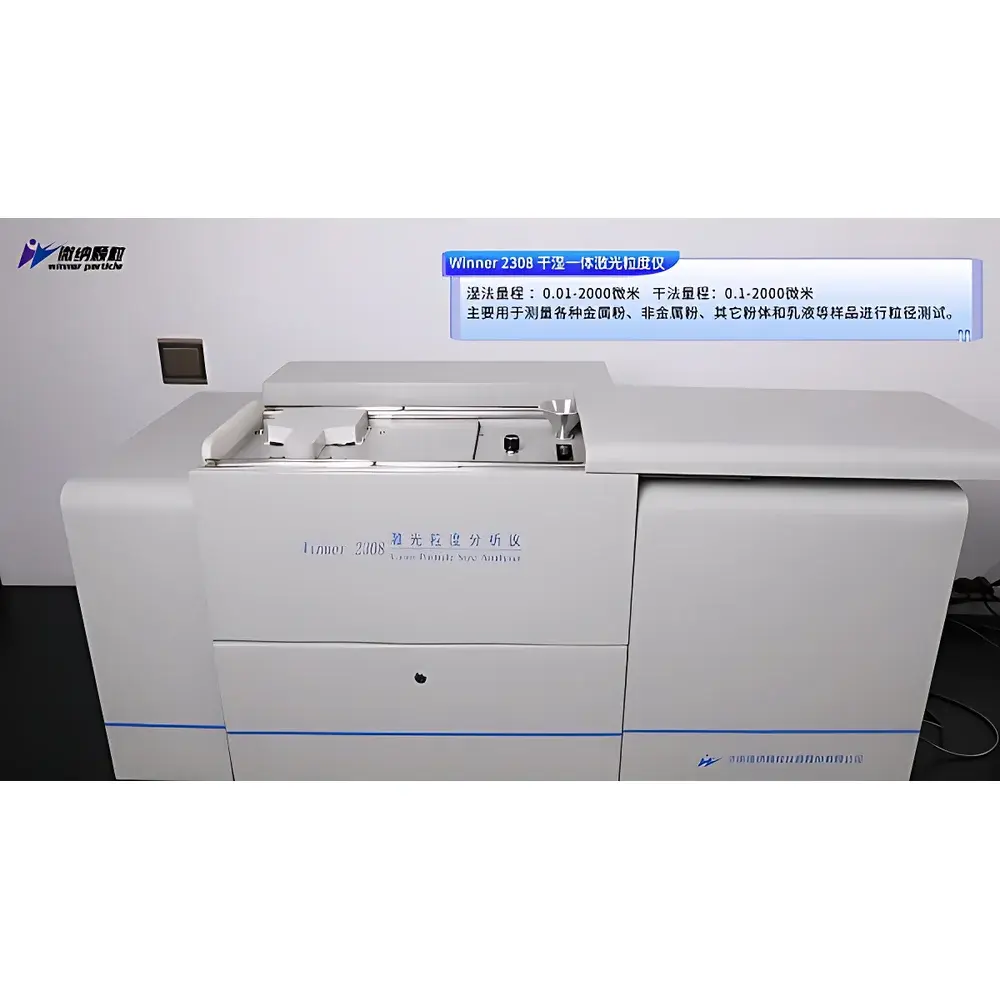
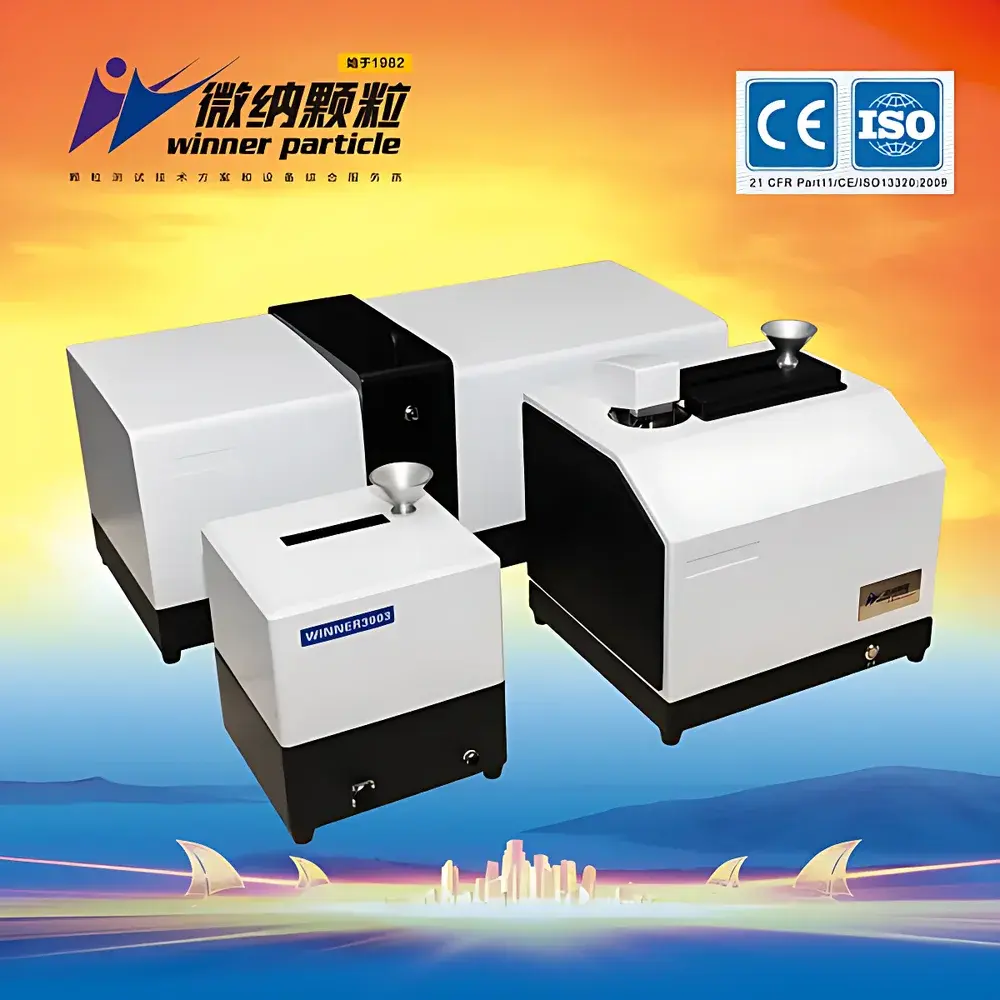
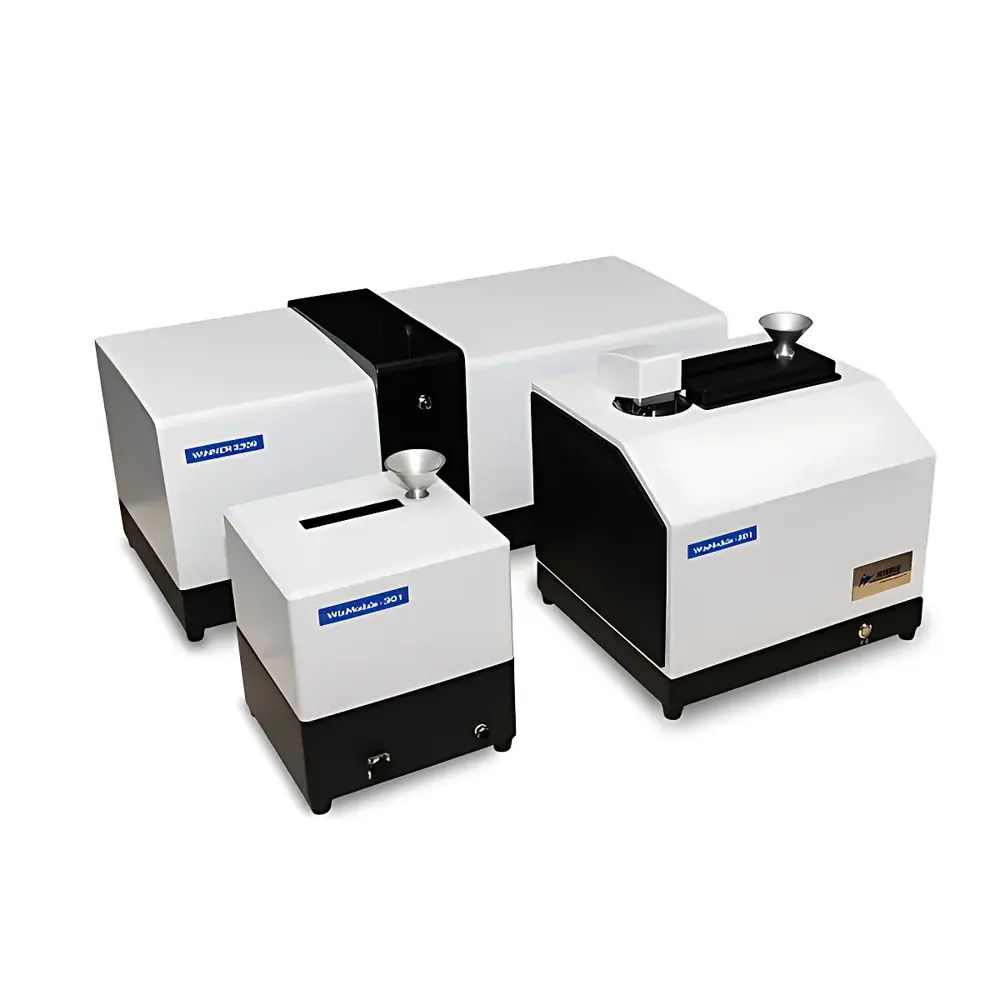
WinNano Winner2309A PRO High-Range Intelligent Laser Particle Size Analyzer
| Brand | WinNano |
|---|---|
| Origin | Shandong, China |
| Manufacturer Type | Direct Manufacturer |
| Instrument Type | Laboratory Laser Particle Size Analyzer |
| Model | Winner2309A PRO |
| Dispersion Method | Dry & Wet Dispersion |
| Measurement Range | Wet: 0.01–3500 µm |
| Dry | 0.1–3000 µm |
| Repeatability | ≤0.5% (wet), ≤1.0% (dry, D50 of certified reference material) |
| Measurement Time | 10–120 s |
| Laser Sources | Dual-wavelength—639 nm (≥2 mW), 405 nm (≥2 mW) |
| Optical Alignment | Fully Automated, 0.1 µm precision |
| Data Acquisition Rate | Up to 10 kHz |
| Compliance | GB/T 19077–2016, ISO 13320:2020, Q/0100JWN001–2024 |
Overview
The WinNano Winner2309A PRO is a high-range, dual-mode laser particle size analyzer engineered for rigorous laboratory environments where broad dynamic range, measurement consistency across dispersion modes, and long-term operational stability are critical. Based on the Mie scattering theory and validated against ISO 13320:2020 principles, the instrument employs a dual-laser optical system (639 nm red + 405 nm blue) to enhance detection sensitivity across sub-100 nm fine particles and coarse fractions up to 3500 µm. Its modular architecture integrates independent dry and wet dispersion modules while maintaining a shared optical path—ensuring identical angular scattering detection geometry regardless of sample introduction method. This design eliminates inter-method calibration drift and supports traceable, comparable results between dry powder aerosolization and liquid-phase suspension analysis. The system is optimized for applications demanding regulatory compliance, including pharmaceutical excipient characterization (per USP ), catalyst quality control, and mineral processing QA/QC.
Key Features
- Modular dual-dispersion platform: Separately configurable WinModule-201 (wet) and WinModule-301 (dry) modules enable rapid, tool-free switching without optical realignment.
- Dual-laser detection system: 639 nm primary laser for high signal-to-noise ratio in mid-to-coarse ranges; 405 nm auxiliary laser improves resolution below 100 nm and enhances refractive index discrimination.
- Intelligent dispersion control: Wet module features programmable ultrasonication (40 kHz, 0–60 W, time-adjustable); dry module utilizes pulsed jet shear with adjustable air pressure and flow rate for deagglomeration of cohesive powders.
- Automated optical alignment: Precision stepper motor-driven alignment mechanism achieves 0.1 µm positional repeatability, ensuring optimal beam centering before each measurement cycle.
- Dual-flow hydraulic design: Integrated peristaltic circulation (1000–8000 mL/min) and direct-through (straight-pass) modes allow selection between high-resolution narrow-distribution analysis (circulation) and rapid large-particle screening (direct-through).
- High-speed data acquisition: 10 kHz sampling rate captures transient dispersion events and enables robust statistical averaging over short measurement windows (as fast as 10 s).
Sample Compatibility & Compliance
The Winner2309A PRO accommodates diverse particulate systems—including water-sensitive, electrostatically charged, or highly cohesive powders (e.g., metal oxides, graphite, explosives) via dry dispersion, and aqueous/non-aqueous suspensions (e.g., polymer lattices, ceramic slurries, pharmaceutical nanosuspensions) via wet dispersion. Its 600 mL sample cell volume and adjustable stirrer speed (0–3000 rpm) support stable suspension homogenization for high-concentration or high-viscosity media. All hardware and firmware comply with GB/T 19077–2016 and ISO 13320:2020 for laser diffraction methodology validation. Software includes audit trail logging, user access levels, and electronic signature capability—enabling alignment with GLP, GMP, and FDA 21 CFR Part 11 requirements when deployed in regulated laboratories.
Software & Data Management
WinNano Particle Analysis Suite v5.2 provides comprehensive data handling with full SOP scripting, automated report generation (PDF, Excel, Word, BMP, TXT), and multi-format export. It supports multiple distribution models—free inversion (non-negative least squares), Rosin-Rammler, and log-normal—alongside customizable percentile reporting (e.g., D10, D50, D90, Dv50, Dn10). Statistical comparison tools enable batch-to-batch variance analysis, trend monitoring across production runs, and deviation mapping versus historical baselines. Refractive index libraries include >200 preloaded values; users may input custom complex refractive indices (real + imaginary components) for accurate Mie modeling. Language localization supports English, Chinese, and optional third-language UI deployment via configuration file import.
Applications
This analyzer serves cross-industry R&D and QC workflows: cement and refractory raw material grading; pigment and coating formulation optimization; pharmaceutical API and excipient particle engineering; battery cathode/anode powder characterization (LiCoO₂, graphite); food additive particle uniformity assessment (starches, lecithins); environmental dust and sediment analysis; and advanced ceramic green-body preparation. Its extended upper range (3500 µm wet / 3000 µm dry) makes it suitable for coarse abrasives, foundry sands, and mineral aggregates where conventional analyzers reach physical detection limits.
FAQ
Does the instrument require recalibration when switching between dry and wet modes?
No. The shared optical path and fixed detector array eliminate the need for recalibration; only sample-specific dispersion parameters (e.g., ultrasonication time, jet pressure) are adjusted.
Can the software generate reports compliant with FDA 21 CFR Part 11?
Yes—when configured with enabled audit trails, role-based permissions, and electronic signatures, the system meets core Part 11 requirements for electronic records and signatures.
What is the minimum detectable particle size under wet dispersion?
The validated lower limit is 0.01 µm (10 nm), achieved using the 405 nm auxiliary laser and optimized signal processing algorithms.
Is external compressed air required for dry dispersion?
Yes—dry module operation requires clean, oil-free compressed air (0.4–0.6 MPa, dew point ≤−20°C) for consistent jet shear performance.
How is instrument verification performed?
Certified NIST-traceable PSL and silica reference materials (e.g., NIST SRM 1963, 1970) are used for daily performance checks per ISO 21501-4 protocols.



