
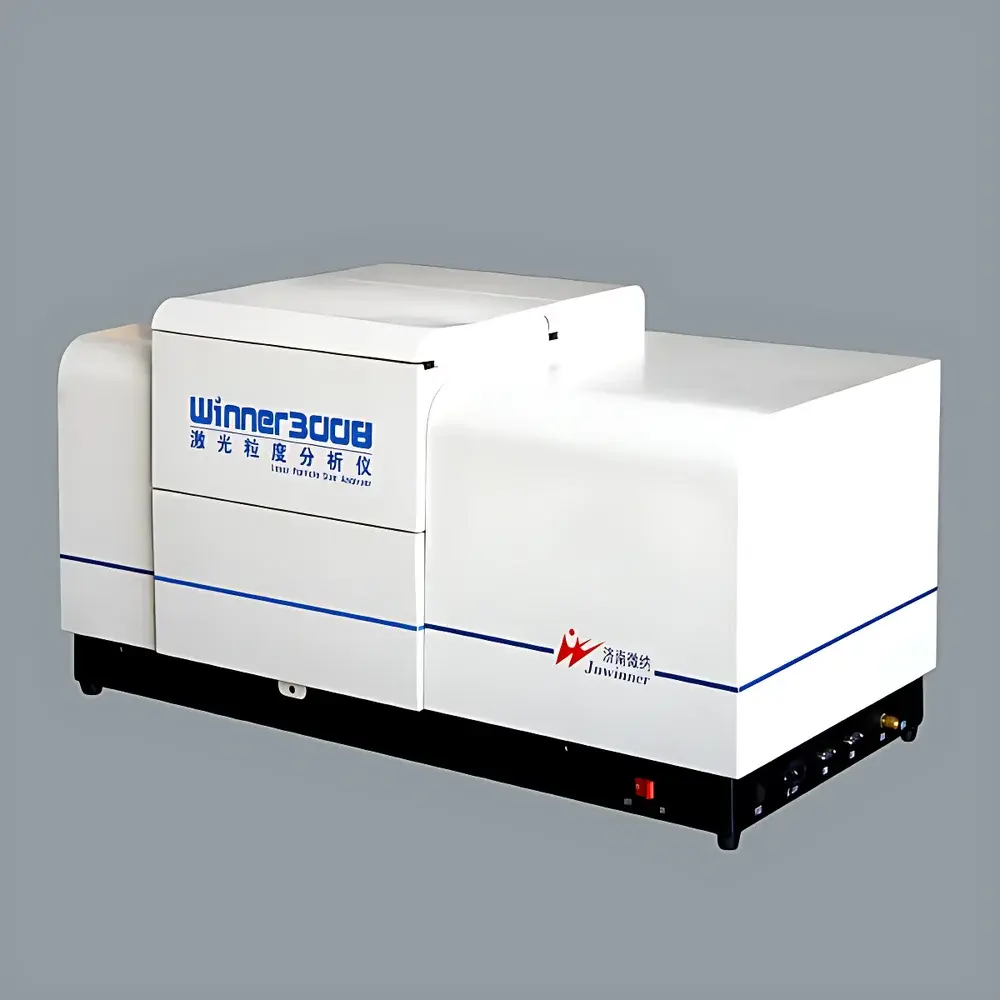
WinNano Winner3008 Intelligent Dry-Dispersion Laser Particle Size Analyzer
| Brand | WinNano |
|---|---|
| Origin | Shandong, China |
| Manufacturer Type | Direct Manufacturer |
| Product Category | Domestic |
| Model | Winner 3008 |
| Dispersion Method | Dry Dispersion |
| Instrument Type | Laboratory Laser Particle Size Analyzer |
| Measurement Range | 0.1–2000 µm |
| Repeatability | <1% (D50 of NIST-traceable standard reference material) |
| Measurement Time | 10–120 s |
Overview
The WinNano Winner3008 Intelligent Dry-Dispersion Laser Particle Size Analyzer is a high-precision laboratory instrument engineered for robust, reproducible particle size distribution (PSD) analysis of dry powders across an exceptionally wide dynamic range—from submicron (0.1 µm) to coarse particles (2000 µm). It operates on the fundamental principle of laser diffraction, leveraging a convergent-beam Fourier transform optical configuration to overcome conventional angular detection limitations imposed by lens aperture constraints. This architecture significantly enhances sensitivity to fine particles below 1 µm while maintaining fidelity across the full measurement span. The system employs Mie theory-based inversion algorithms with non-negative least-squares (NNLS) unconstrained free-fitting, ensuring physically realistic PSD reconstruction without artificial binning or regularization bias. Designed for compliance-driven environments, it adheres to ISO 13320:2009 and GB/T 19077–2016 standards for laser diffraction methodology, supporting traceable calibration using certified reference materials.
Key Features
- Convergent-beam Fourier transform optical path: Eliminates angular truncation, enabling high-resolution detection of forward-scattered light from submicron particles.
- Dual-stage dry dispersion system: Integrates patented turbulent flow dispersion (ZL.200720018648.7) and normal-shock shear technology to de-agglomerate cohesive powders without liquid media—critical for moisture-sensitive, reactive, or hygroscopic samples.
- Ceramic wear-resistant dispersion components: Extends service life under abrasive conditions common in cement, metal oxide, and mineral powder applications.
- Expanded angular detection array: 116 photodetector channels (Winner3008A variant) cover scattering angles from 150°, augmented by auxiliary detectors for optimized signal capture across the full 0.1–2000 µm range.
- Fully automated workflow: One-click “Auto Test” initiates synchronized feeding, carrier gas control (compressed air or inert gas), cyclonic dust collection, and real-time optical alignment verification.
- High-stability laser source: 639 nm diode laser with output power >2 mW ensures consistent beam profile and long-term intensity stability per ISO 13320 requirements.
Sample Compatibility & Compliance
The Winner3008 is specifically validated for dry, free-flowing, and moderately cohesive powders that cannot be suspended in liquid media—such as pharmaceutical actives prone to hydrolysis, magnetic nanoparticles susceptible to oxidation, herbal extracts that degrade in solvents, and energetic materials (e.g., explosives, propellants) requiring solvent-free handling. It meets the instrumental performance criteria defined in ISO 13320:2009 Annex A for dry dispersion systems and supports GLP-compliant operation through audit-trail-enabled software logging (user actions, calibration events, sample IDs, timestamps). While not FDA 21 CFR Part 11–certified out-of-the-box, its data export architecture (CSV, TXT, XML) enables integration into validated LIMS or electronic lab notebook (ELN) platforms meeting regulatory documentation requirements.
Software & Data Management
The embedded WinNano Particle Analysis Software v5.x provides real-time data acquisition at ≥10 kHz sampling rate, followed by rapid NNLS inversion and statistical post-processing—including D10/D50/D90, span, specific surface area estimation, and multi-modal peak identification. All raw scattering patterns and intermediate matrices are retained for reprocessing. Export formats include ASTM E2921–compliant particle size reports, batch comparison overlays, and customizable PDF certificates. Raw data files are timestamped, digitally signed, and stored with metadata (operator ID, instrument serial number, environmental temperature/humidity logs if external sensors are connected), facilitating retrospective review and quality audits.
Applications
This analyzer serves QC/QA and R&D laboratories across industries where dry-powder characterization is essential: cement and refractory manufacturing (clinker fineness control); ceramic tile and glaze formulation; pharmaceutical dry powder inhalers (DPIs) and excipient grading; pigment and coating development (TiO₂, carbon black, iron oxides); food-grade starches and dairy powders; catalyst support materials (zeolites, alumina); battery electrode materials (LiCoO₂, graphite); and advanced ceramics (SiC, AlN). Its wide dynamic range makes it especially suitable for raw material screening, process optimization, and supplier qualification where both fines and coarse fractions must be quantified simultaneously.
FAQ
What dry dispersion gases are compatible with the Winner3008?
Compressed air is standard; nitrogen or argon may be used for oxygen-sensitive or pyrophoric samples via optional gas inlet module.
Can the system be integrated into an automated production line?
Yes—RS-232, Ethernet, and optional PLC I/O interfaces support semi-automated batch triggering and pass/fail result feedback to SCADA systems.
Is wet dispersion possible on this model?
No—the Winner3008 is exclusively configured for dry dispersion; WinNano offers separate wet-module instruments (e.g., Winner2000 series) for liquid suspension analysis.
How is instrument calibration verified?
Using NIST-traceable polystyrene latex (PSL) standards or ISO 13320-recommended silica reference materials; calibration verification reports include D50 repeatability (%RSD) and width-of-distribution metrics.
What maintenance intervals are recommended?
Optical window cleaning every 500 tests; ceramic disperser inspection every 2,000 cycles; annual laser power and detector linearity validation per manufacturer’s SOP.



