
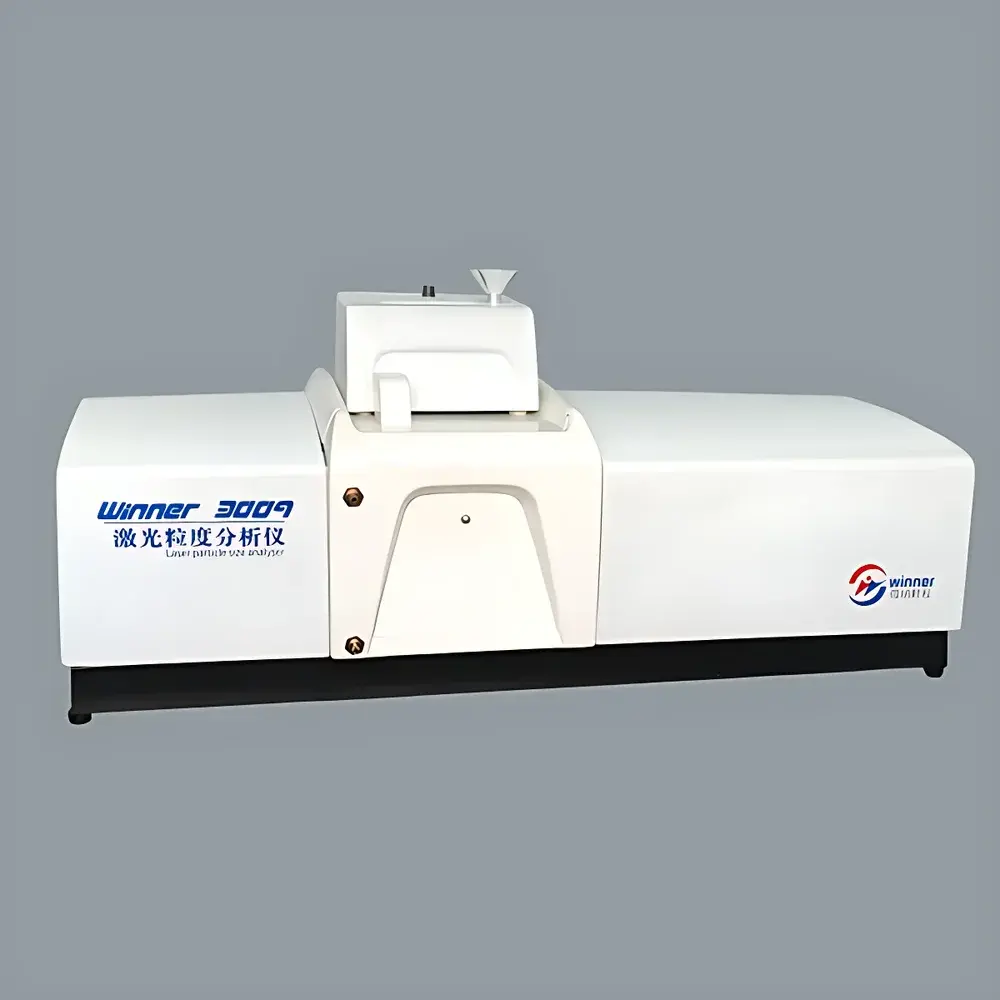
WinNano Winner3009 Intelligent Dry-Dispersion Laser Particle Size Analyzer
| Brand | WinNano |
|---|---|
| Origin | Shandong, China |
| Manufacturer Type | Direct Manufacturer |
| Origin Category | Domestic (China) |
| Model | Winner3009 |
| Price Range | USD 14,000 – 21,000 |
| Dispersion Method | Dry Dispersion |
| Instrument Type | Laboratory Laser Particle Size Analyzer |
| Measurement Range | 0.1–2000 µm |
| Repeatability | <1% |
| Measurement Time | <1 min |
Overview
The WinNano Winner3009 Intelligent Dry-Dispersion Laser Particle Size Analyzer is a fifth-generation laboratory-grade instrument engineered for high-precision, wide-range particle size distribution (PSD) analysis of dry powders. It operates on the principle of laser diffraction—specifically, Mie scattering theory combined with Fraunhofer approximation—optimized for robust performance across submicron to coarse particulate regimes (0.1–2000 µm). Unlike wet-dispersion systems, the Winner3009 eliminates solvent-related artifacts such as particle agglomeration, chemical degradation, or morphological alteration—making it indispensable for materials that are hydrophobic, reactive in liquid media (e.g., metal powders, pharmaceutical actives, explosives), or prone to hydration-induced phase change (e.g., certain clays, herbal extracts, magnetic oxides). Its optical architecture integrates a convergent beam Fourier transform design and dual detection plane geometry, effectively overcoming aperture-induced angular truncation and significantly enhancing sensitivity to fine particles below 1 µm.
Key Features
- Patented turbulent dispersion system (ZL.200720018648.7) coupled with normal shockwave shear technology ensures complete de-agglomeration of cohesive powders without mechanical grinding or ultrasonication.
- Ceramic-reinforced dispersion components—including nozzle, venturi, and sample chamber—deliver exceptional wear resistance and extended service life under continuous industrial-grade operation.
- Ultra-wide angular detection range (0.0155°–164°) enabled by spectral amplification technology, allowing simultaneous capture of forward-scattered (coarse) and backward-scattered (fine) signals with high signal-to-noise ratio.
- Automated workflow: single-button initiation triggers synchronized feeding, carrier gas control (compressed air or inert gas), cyclonic dust collection, and real-time optical alignment verification.
- High-stability 639 nm diode laser (P > 2 mW) with TEM00 beam profile ensures consistent illumination intensity and minimal thermal drift during extended measurement sequences.
Sample Compatibility & Compliance
The Winner3009 is validated for use with free-flowing and moderately cohesive dry powders, including but not limited to cement, ceramic raw materials, pharmaceutical excipients and APIs, pigments, catalysts, coal and fly ash, food-grade starches and flours, battery-grade graphite, and metallurgical powders. It complies with ISO 13320:2009 (Particle size analysis — Laser diffraction methods), GB/T 19077–2016 (Chinese national standard equivalent to ISO 13320), and internal enterprise standard Q/0100JWN001–2013. While not inherently 21 CFR Part 11 compliant out-of-the-box, its data acquisition and reporting modules support audit-trail-enabled configurations when integrated with validated LIMS or ELN platforms meeting GLP/GMP documentation requirements.
Software & Data Management
The proprietary WinNano Particle Analysis Software (v5.x) performs real-time, high-speed data acquisition at ≥10 kHz sampling rate. It employs non-negative least-squares (NNLS) unconstrained inverse modeling to reconstruct PSD from raw scattering patterns—avoiding preset distribution assumptions (e.g., log-normal or Rosin-Rammler). Output includes D10, D50, D90, span, specific surface area (SSA), and volume-surface mean diameter (D[4,3]). Batch mode supports statistical comparison across up to 99 measurements; all raw data (.wps), processed reports (.pdf/.xlsx), and instrument logs (.csv) are timestamped, user-ID tagged, and exportable for external QA review. Optional password-protected method locking and electronic signature modules facilitate regulated environments.
Applications
The Winner3009 serves critical quality control and R&D functions across industries where dry-state characterization is mandatory. In pharmaceutical manufacturing, it verifies granule uniformity prior to tableting and monitors milling endpoint for inhalable dry powder formulations. In advanced ceramics, it quantifies sintering feedstock fineness to predict green density and final microstructure. For catalyst producers, it correlates particle size distribution with pore accessibility and reaction kinetics. In mineral processing, it enables rapid feedback on grinding circuit efficiency for kaolin, calcium carbonate, and talc. Its ability to handle large-diameter particles (>1 mm equivalent spherical diameter) without pre-sieving also benefits refractory and abrasive manufacturers.
FAQ
What types of samples are incompatible with the Winner3009?
Samples with extremely low bulk density (<0.1 g/cm³), strong electrostatic charge retention, or fibrous/mesh-like morphology (e.g., cellulose nanofibers, carbon nanotubes) may exhibit inconsistent dispersion and require method optimization or alternative techniques.
Can the instrument be calibrated using NIST-traceable standards?
Yes—certified polystyrene latex (PSL) and glass bead reference materials (e.g., NIST SRM 1963, 2800 series) are fully supported for daily verification and periodic calibration per ISO 21501-4.
Is inert gas dispersion supported?
Yes—the gas inlet accepts regulated nitrogen or argon supply; optional pressure regulator and flow meter kits enable controlled atmosphere operation for oxygen-sensitive materials.
How is maintenance performed on the optical path?
The folded optical train features sealed, alignment-free modules; routine maintenance involves periodic cleaning of the front lens (using spectroscopic-grade methanol) and replacement of the cyclone filter every 200–300 runs.
Does the software support multi-language UI and report generation?
The interface defaults to English; localized versions (German, French, Spanish, Japanese) are available upon request. All reports include configurable headers, company branding, and ISO-compliant uncertainty statements.



