
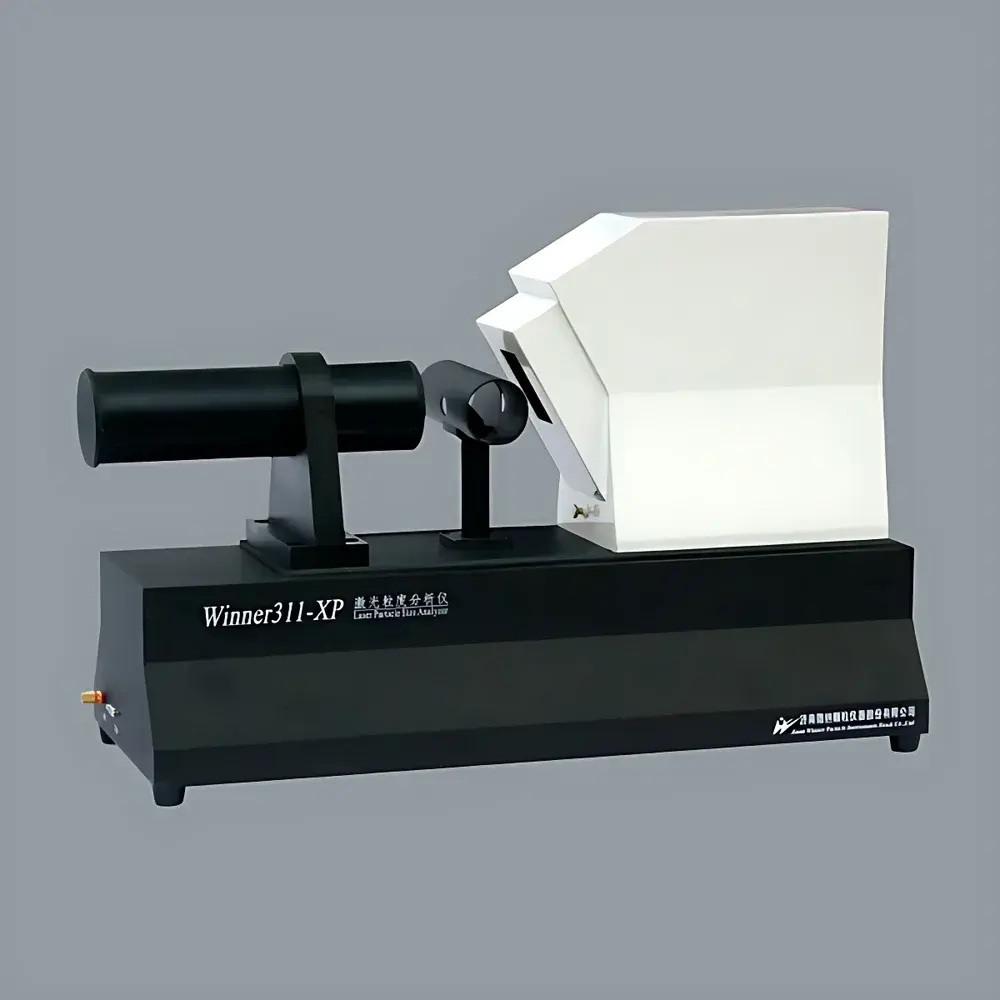
WinNano Winner311XP Spray Laser Particle Size Analyzer
| Brand | WinNano |
|---|---|
| Origin | Shandong, China |
| Manufacturer Type | Direct Manufacturer |
| Origin Category | Domestic (China) |
| Model | Winner 311XP |
| Price Range | USD 0–14,500 |
| Dispersion Method | Dry & Wet Dispersion |
| Instrument Type | Benchtop Laser Particle Size Analyzer |
| Measurement Range | 0.1–100 µm |
| Repeatability | <1% (D50 of NIST-traceable standard reference material) |
| Measurement Time | 10–120 s |
| Standard Compliance | GB/T 19077–2016, ISO 13320:2009, Q/0100JWN001–2013 |
| Optical Configuration | Single-beam collimated laser (λ = 650 nm, P > 1 mW), dual-lens dual-array detector system |
| Sampling Zone | Open-tube design, 60 mm effective path length |
| Dimensions | 660 × 260 × 450 mm |
| Weight | 19 kg |
Overview
The WinNano Winner311XP Spray Laser Particle Size Analyzer is a benchtop instrument engineered for non-contact, real-time measurement of droplet size distributions in airborne aerosols—specifically optimized for pharmaceutical inhalation products and micro-scale atomization systems. It operates on the principle of Fraunhofer diffraction and Mie scattering theory, with rigorous optical calibration traceable to ISO 13320:2009 and GB/T 19077–2016 standards. Unlike conventional wet-dispersion laser diffraction analyzers, the Winner311XP features an open-tube measurement zone that enables direct interrogation of freely suspended droplets, mist, smoke, or fine particulate plumes without physical sampling or dilution. This architecture eliminates wall deposition artifacts and preserves native droplet morphology—critical for evaluating respirable fraction (RF), mass median aerodynamic diameter (MMAD), and geometric standard deviation (GSD) in pressurized metered-dose inhalers (pMDIs), soft-mist inhalers (SMIs), nasal sprays, and dry powder inhalers (DPIs). The system employs a single-beam, collimated 650 nm semiconductor laser and a dual-lens dual-array photodetector configuration to capture high-fidelity angular scattering intensity profiles across 60 detection channels, ensuring robust resolution down to 0.1 µm while maintaining full-range linearity up to 100 µm.
Key Features
- Open-tube aerosol measurement zone (60 mm effective path length) enabling true in-situ, non-invasive droplet sizing without impaction or electrostatic charging.
- Integrated laminar air sheath system that forms a protective boundary layer around the optical axis, preventing lens contamination during continuous spray operation—eliminating downtime for cleaning and preserving long-term optical alignment stability.
- Dual-lens dual-array detector architecture with optimized angular coverage (0.015°–150°), enhancing signal-to-noise ratio and improving low-angle forward-scatter sensitivity for submicron droplet detection.
- Benchtop footprint (660 × 260 × 450 mm) and modular design support integration into ISO Class 5–7 cleanrooms, QC laboratories, and R&D inhalation test suites with minimal infrastructure requirements.
- Compliant with pharmacopeial particle sizing requirements: fully aligned with USP <601>, Ph. Eur. 2.9.31, and ChP 0982 for aerolized dosage forms—including quantitative assessment of fine particle fraction (FPF < 5 µm) and extrathoracic deposition modeling.
Sample Compatibility & Compliance
The Winner311XP accommodates a broad spectrum of spray-based samples without modification: aqueous and propellant-driven pMDI actuations, nebulized saline or drug suspensions, thermal- or piezoelectric-driven SMIs, nasal spray formulations, cosmetic steam mists, e-cigarette condensate aerosols, and lab-scale atomizer outputs. Its dry-mode capability supports transient, low-volume spray events (<1 mL per actuation), while optional humidity-controlled inlet conditioning permits evaluation under physiologically relevant RH conditions (30–70%). All measurements adhere to ISO/IEC 17025:2017 technical competence requirements when operated within validated SOPs. Instrument performance verification is supported by NIST-traceable polystyrene latex (PSL) standards and certified inhalation reference materials (e.g., EGA-1, EGA-2), with documented repeatability ≤1% RSD (D50) per GB/T 19077–2016 Annex B protocols.
Software & Data Management
The proprietary WinNano Particle Analysis Suite (v4.2+) provides FDA 21 CFR Part 11–compliant data acquisition, processing, and audit trail functionality—including electronic signatures, role-based user access control, immutable raw scattering pattern archiving, and automated report generation per ICH Q5A and Q5C guidelines. Real-time visualization includes volume-weighted (D[4,3]), surface-weighted (D[3,2]), and number-based distributions, with configurable thresholds for FPF, RF, and coarse/fine cut points. Batch analysis mode supports multi-actuation statistical aggregation (n ≥ 6), outlier rejection via Grubbs’ test, and export to CSV, PDF, or LIMS-compatible XML formats. Software validation documentation (IQ/OQ/PQ templates) and 21 CFR Part 11 configuration files are supplied as part of the delivery package.
Applications
- Pharmaceutical development: formulation screening of pMDIs, SMIs, and DPIs; stability assessment under accelerated aging; excipient interaction studies.
- Medical device QA/QC: verification of nebulizer output consistency, breath-actuated inhaler performance, and spacer compatibility testing.
- Inhalation toxicology: aerosol characterization for OECD 412 and 413 inhalation studies; dose estimation in nose-only or whole-body exposure chambers.
- Consumer product R&D: e-liquid aerosol physics, fragrance mist uniformity, humidifier output profiling, and agricultural micronutrient spray optimization.
- Academic research: fundamental studies of droplet breakup dynamics, evaporation kinetics, and coalescence behavior in confined shear flows.
FAQ
Does the Winner311XP require sample collection or filtration prior to measurement?
No. The open-tube design enables direct, real-time interrogation of aerosols in ambient air—no impaction plates, filters, or cascade impactors are needed.
Can it measure droplets below 0.1 µm?
The validated lower limit is 0.1 µm per ISO 13320:2009 Annex A. Sub-100 nm detection requires complementary techniques such as SMPS or NTA.
Is the system compatible with GMP-regulated environments?
Yes—when deployed with configured audit trails, electronic signatures, and periodic performance qualification (PQ) per ASTM E2925, it meets GLP/GMP data integrity expectations.
What maintenance is required for long-term optical stability?
Annual recalibration using PSL standards and quarterly inspection of air sheath flow rates and laser power output are recommended per manufacturer’s PQ protocol.
Can the software interface with LIMS or MES platforms?
Yes—via configurable ODBC drivers and RESTful API endpoints supporting structured metadata exchange (e.g., sample ID, operator, timestamp, D50, FPF).
Related Products



