
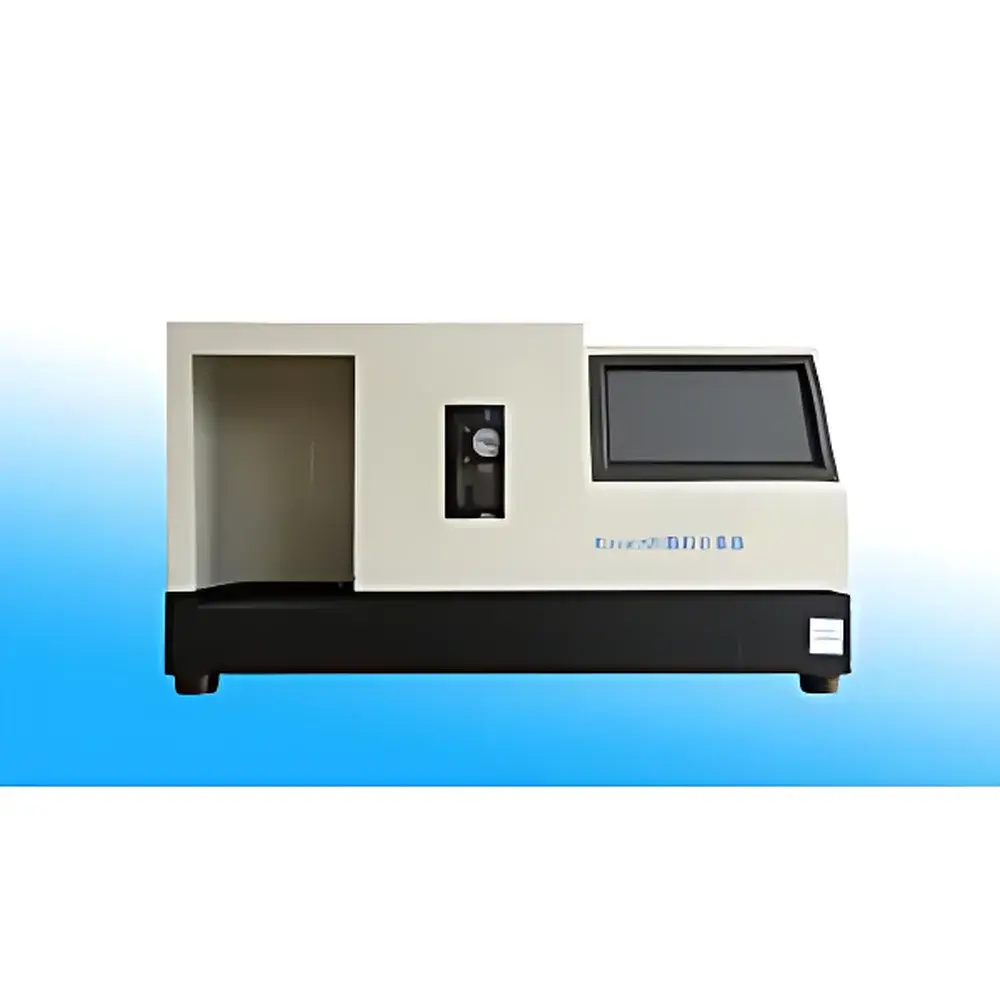
WinNano Winner602 Liquid Automatic Particle Counter
| Brand | WinNano |
|---|---|
| Origin | Shandong, China |
| Manufacturer Type | Direct Manufacturer |
| Country of Origin | China |
| Model | Winner602 |
| Price Range | USD 7,000 – 14,000 (FOB) |
| Instrument Type | Optical Particle Counter (Light Obscuration Principle) |
| Particle Size Range | 2–200 µm |
| Resolution | Better than 10% (per GB/T 18854–2002 / ISO 11171:1999) |
| Coincidence Error | ≤5% at 10,000 particles/mL |
| Size Channels | 5, 15, 25, 50, 100 µm |
| Sample Volume | 5 mL (±1% accuracy) |
| Flow Rate | 25 mL/min |
| Dispersion Method | Magnetic Stirring |
| Display & Interface | Color LCD + Touchscreen |
| Laser Source | Semiconductor Diode, λ = 635 nm |
| Compliance | GB/T 18854–2002, ISO 11171:1999 |
Overview
The WinNano Winner602 Liquid Automatic Particle Counter is a dedicated optical particle counter engineered for quantitative analysis of insoluble particulate contamination in liquid media. It operates on the light obscuration (LO) principle—also known as the optical blockage or photometric blocking method—in which particles suspended in a flowing liquid stream pass through a focused laser beam (635 nm semiconductor diode). Each particle causes a transient reduction in detected light intensity proportional to its cross-sectional area; pulse height and count rate are converted into particle size distribution and concentration data per unit volume. This methodology is explicitly referenced in international standards including ISO 11171:1999 and its national adoption GB/T 18854–2002, making the Winner602 suitable for routine compliance testing in regulated environments where particle cleanliness directly impacts product safety and performance.
Key Features
- Light Obscuration Detection Architecture: Utilizes a stable 635 nm semiconductor laser and precision-aligned optical path to ensure consistent signal-to-noise ratio across the 2–200 µm measurement range.
- Dual-Controlled Fluidic System: Integrates a calibrated piston pump with a high-stability electromagnetic flow regulator to maintain constant volumetric delivery (25 mL/min) and exact sample draw (5 mL ±1%), minimizing flow-induced variability and coincidence error.
- Standalone Operational Design: Features an integrated color LCD touchscreen interface and built-in thermal printer—enabling full test execution, real-time result visualization, and hardcopy reporting without external PC or peripheral hardware.
- Standardized Size Classification: Reports particle counts in five user-defined channels: ≥5 µm, ≥15 µm, ≥25 µm, ≥50 µm, and ≥100 µm—aligned with common fluid cleanliness specifications such as ISO 4406 and NAS 1638.
- Onboard Magnetic Dispersion: Equipped with adjustable-speed magnetic stirring to maintain homogeneous particle suspension during aspiration, reducing sedimentation bias in low-viscosity aqueous and organic liquids.
Sample Compatibility & Compliance
The Winner602 is validated for use with clear to slightly turbid Newtonian liquids—including purified water, hydraulic fluids, pharmaceutical solvents, dialysate solutions, and treated wastewater effluents—provided optical transmission exceeds 70% at 635 nm. It is not intended for highly viscous, opaque, or strongly fluorescent samples. Calibration traceability follows ISO 11171:1999 using NIST-traceable polystyrene latex (PSL) reference particles. The instrument meets the metrological requirements of GB/T 18854–2002 for resolution (≤10% deviation), coincidence limit (≤5% at 104 particles/mL), and volumetric accuracy. While not inherently 21 CFR Part 11 compliant, audit-ready operation can be supported via external documentation protocols aligned with GLP and GMP quality systems.
Software & Data Management
Although the Winner602 operates as a standalone instrument, its embedded firmware supports export of raw count data and channel-based histograms via USB interface to standard spreadsheet applications. All measurement parameters—including date/time stamp, sample ID, volume aspirated, and flow rate—are logged with each test record. Firmware updates are provided free-of-charge for the lifetime of the device, ensuring continued alignment with evolving calibration practices and reporting conventions. No proprietary software installation is required for basic operation or data retrieval.
Applications
- Monitoring particulate load in purified water systems (PW, WFI) per USP and EP 2.9.19 guidelines.
- Hydraulic and lubricating oil cleanliness verification against ISO 4406:2017 classification codes.
- Quality control of injectable drug formulations and ophthalmic solutions during manufacturing and stability studies.
- Performance evaluation of membrane filters, depth filters, and ultrapure water polishing units.
- Environmental surveillance of treated wastewater discharge compliance with local regulatory thresholds (e.g., EPA Method 160.1).
FAQ
What particle detection principle does the Winner602 employ?
It uses light obscuration (optical blockage), where particles passing through a collimated 635 nm laser beam generate voltage pulses whose amplitude correlates with particle cross-sectional area.
Is the instrument compliant with ISO 11171:1999?
Yes—the optical design, calibration protocol, and reported sizing accuracy meet the requirements of ISO 11171:1999 and its Chinese equivalent GB/T 18854–2002.
Can the Winner602 measure particles below 2 µm?
No—it is optimized for the 2–200 µm range; sub-micron particles require alternative techniques such as light scattering or Coulter counting.
Does it support automated data archiving or network connectivity?
No—it is a self-contained unit with local display, touchscreen control, and thermal printing; data export is manual via USB.
What maintenance is required for long-term reliability?
Routine cleaning of the flow cell and sensor window with isopropyl alcohol; annual verification of volumetric accuracy and laser alignment using certified reference materials is recommended.



