
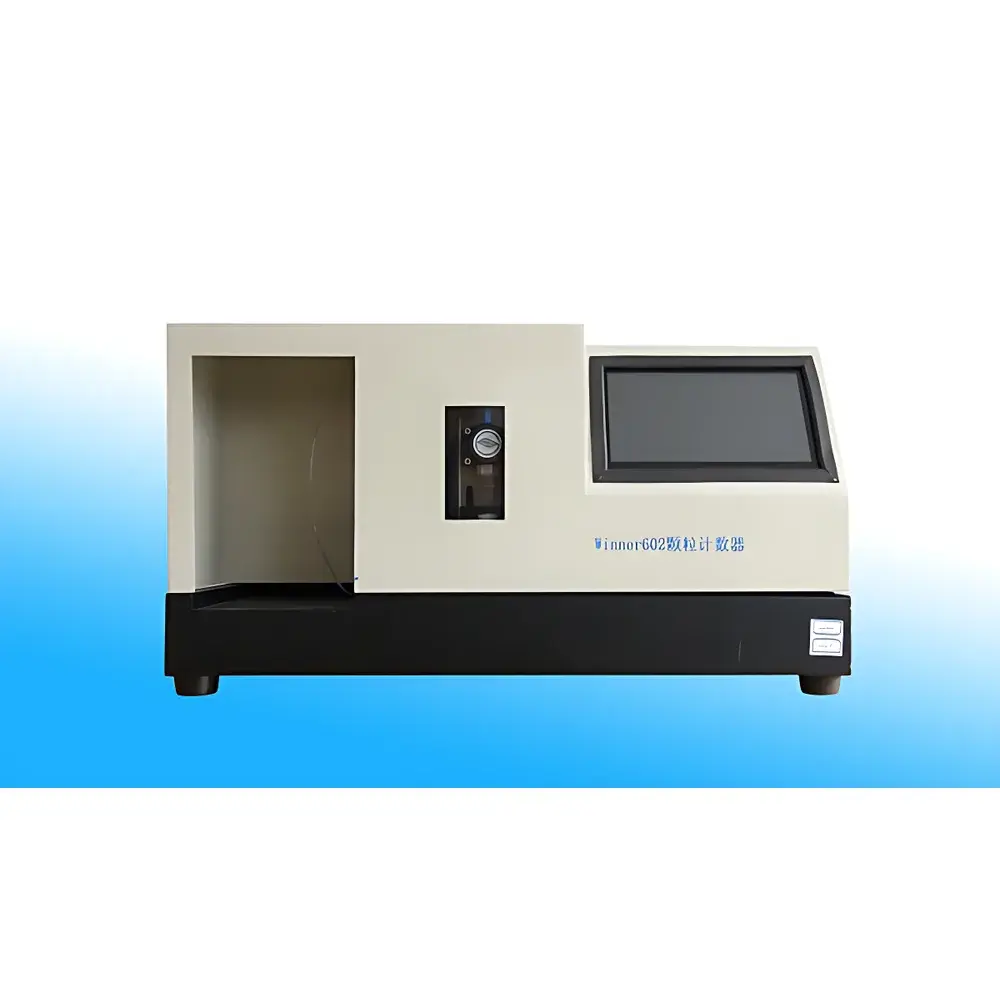
WinNano Winner602 Optical Liquid Automatic Particle Counter
| Brand | WinNano |
|---|---|
| Origin | Shandong, China |
| Manufacturer Type | Direct Manufacturer |
| Instrument Category | Domestic |
| Model | Winner602 |
| Price Range | USD 7,000–14,000 (FOB) |
| Instrument Type | Optical Particle Counter (Light Obscuration Principle) |
| Particle Size Range | 2–200 µm |
| Resolution | Better than 10% (per GB/T 18854–2002) |
| Coincidence Error | ≤5% at 10,000 particles/mL |
| Size Channels | 5, 15, 25, 50, 100 µm |
| Sample Volume | 5 mL |
| Volume Accuracy | ±1% |
| Flow Rate | 25 mL/min |
| Dispersion Method | Magnetic Stirring |
| Display & Interface | Color LCD + Touchscreen |
| Laser Source | Semiconductor Laser, λ = 635 nm |
| Compliance Standard | GB/T 18854–2002 (equivalent to ISO 11171:1999) |
Overview
The WinNano Winner602 Optical Liquid Automatic Particle Counter is a dedicated instrument for quantitative analysis of insoluble particulate contamination in liquid media. It operates on the light obscuration (also known as light blockage or optical blocking) principle — a standardized method widely adopted in hydraulic fluid cleanliness, pharmaceutical parenteral quality control, and water purity assessment. When suspended particles pass through a collimated laser beam (635 nm), each particle generates a transient reduction in detected light intensity proportional to its cross-sectional area. The system digitizes these pulses, classifies them into user-defined size channels (5, 15, 25, 50, and 100 µm), and calculates particle concentration per unit volume (particles/mL). Designed for stand-alone operation, the Winner602 integrates a high-stability semiconductor laser source, precision volumetric pumping, real-time touchscreen interface, and thermal printing — eliminating dependency on external PCs or peripheral printers while maintaining metrological traceability per GB/T 18854–2002 and ISO 11171:1999.
Key Features
- Light obscuration detection architecture compliant with ISO 11171:1999 calibration protocols and GB/T 18854–2002 performance validation requirements
- Dual-controlled sampling system combining a calibrated piston pump and ultra-precise electromagnetic flow regulation to ensure repeatable 5 mL draw volume (±1% accuracy) and stable 25 mL/min flow rate
- Integrated magnetic stirring dispersion mechanism to minimize particle settling during aspiration, enhancing representativeness of heterogeneous suspensions
- Self-contained operational interface featuring a 7-inch color TFT-LCD touchscreen with intuitive icon-driven menu navigation and real-time histogram visualization
- Built-in thermal printer supporting immediate hard-copy output of particle counts per channel, cumulative distribution, and test metadata (date/time, sample ID, operator)
- Laser diode source (635 nm) optimized for signal-to-noise ratio in clear to mildly turbid liquids, with thermal stabilization to maintain pulse amplitude consistency across extended runs
Sample Compatibility & Compliance
The Winner602 is validated for use with low-viscosity, optically transparent to semi-transparent liquids including purified water, saline solutions, hydraulic oils (ISO VG 10–68), pharmaceutical injectables (e.g., 0.9% NaCl, 5% dextrose), and filtered process streams. Samples must be free of air bubbles and macroscopic debris that could clog the 200 µm nominal aperture flow cell. While not intended for highly viscous fluids (>100 cP) or opaque suspensions (e.g., slurries, emulsions), it meets minimum requirements for ISO 4406:2017 code assignment when used with certified reference materials traceable to NIST SRM 2806. The instrument supports GLP-aligned documentation practices: all test parameters, raw pulse data logs (stored internally), and printed reports include timestamps and operator identifiers. Though not FDA 21 CFR Part 11-compliant out-of-the-box, audit trails can be exported via USB for integration into validated QA/QC workflows.
Software & Data Management
The embedded firmware provides local data storage for up to 1,000 test records, each containing full size-distribution histograms, channel-specific counts, and system diagnostics (laser power, flow sensor status, temperature). Data export is supported via USB flash drive in CSV format for post-processing in Excel or statistical software (e.g., JMP, Minitab). No proprietary desktop application is required; however, optional Windows-based configuration utility (WinNano PC Suite v3.2) enables advanced calibration management, custom size bin definition, and batch report generation. All firmware updates are delivered as signed binary packages with version rollback capability — critical for regulated environments requiring configuration control.
Applications
- Pharmaceutical manufacturing: USP and compliance testing of large-volume parenterals (LVPs) and ophthalmic solutions for subvisible particle content
- Power generation: ISO 4406:2017 cleanliness grading of turbine oils and transformer insulating fluids prior to commissioning or after filtration maintenance
- Water treatment facilities: Quantitative verification of filter performance in drinking water and ultrapure water (UPW) distribution loops
- Environmental monitoring labs: Assessment of suspended solids in wastewater effluents against discharge permit limits (e.g., EPA Method 160.1 adaptation)
- R&D laboratories: Stability studies of colloidal formulations, nanosuspensions, and biologics where aggregation onset correlates with >5 µm particle count increases
FAQ
What calibration standards are recommended for routine verification?
Certified polystyrene latex (PSL) microsphere suspensions traceable to NIST SRM 2806 (e.g., 5 µm, 10 µm, 25 µm) are advised for daily system suitability checks per ISO 21501-4.
Can the Winner602 measure particles below 2 µm?
No — the optical design and signal processing threshold limit reliable detection to ≥2 µm. For submicron analysis, dynamic light scattering (DLS) or nanoparticle tracking analysis (NTA) instrumentation is required.
Is cleaning validation supported for multi-use fluid pathways?
Yes. The flow cell and tubing set are chemically resistant to IPA, 70% ethanol, and 0.1N NaOH. A built-in rinse cycle (3 × 5 mL solvent flush) is programmable between samples.
Does the instrument meet ASTM D7619 for hydraulic fluid particle counting?
It satisfies core measurement requirements of ASTM D7619 (light extinction method), though full conformance requires lab-specific validation per Section 8.2 due to procedural variables (e.g., sample agitation protocol, dwell time).
How is coincidence error managed during high-concentration measurements?
Automatic dilution is not supported; users must pre-dilute samples exceeding 10,000 particles/mL (per manufacturer specification) using clean, particle-free diluent — verified by blank run — to maintain ≤5% coincidence error.



