
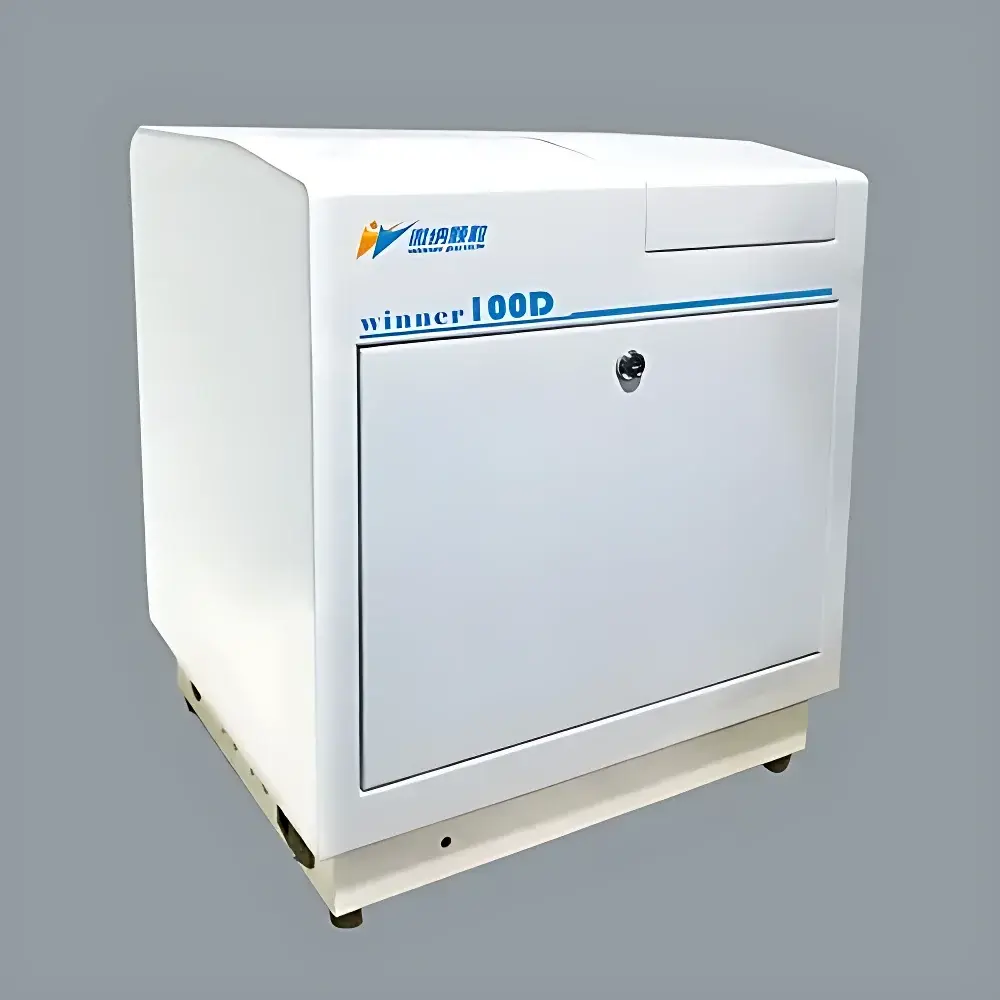
Winner100D Dynamic Image-Based Particle Size and Shape Analyzer by Jinan Winner
| Brand | Jinan Winner |
|---|---|
| Origin | Shandong, China |
| Manufacturer Type | Direct Manufacturer |
| Country of Origin | China |
| Model | Winner100D |
| Price Range | USD 1,400 – 42,000 |
| Instrument Type | Dynamic |
| Number of Lenses | 4 |
| Measurement Range | 1–3000 µm |
| Dispersion Method | Wet Dispersion |
| Image Resolution | 1920×1080 |
| Measured Parameters | Area-equivalent diameter, perimeter-equivalent diameter, Martin diameter, perimeter, projected area, particle length, particle width, estimated surface area, estimated volume, X-tangent, Y-tangent, tangent diameter, sphericity, aspect ratio |
Overview
The Winner100D Dynamic Image-Based Particle Size and Shape Analyzer is an industrial-grade, real-time imaging system engineered for high-throughput morphological characterization of particulate materials in motion. It operates on the principle of high-speed digital microscopy combined with calibrated optical magnification and automated image segmentation—fully compliant with ISO/DIS 13322-2:2022 (Particle size analysis — Image analysis methods — Part 2: Dynamic image analysis). Unlike static image analyzers that rely on dried, immobilized samples, the Winner100D captures particles in continuous laminar flow across a precision-engineered flat-slot observation chamber. Its proprietary telecentric optical path—featuring anti-distortion field lenses and extended depth-of-field illumination—ensures minimal geometric distortion and consistent focus across the entire field of view, enabling sub-pixel edge detection and metrologically traceable dimensional measurements.
Key Features
- Telecentric optical architecture with integrated anti-distortion field lens, delivering uniform magnification and >15 mm effective depth of field for robust focus stability across heterogeneous particle streams.
- Self-cleaning sample window system utilizing controlled fluid shear and inertial flushing—reducing maintenance intervals to less than once per year under standard operation and eliminating manual disassembly in most routine applications.
- Dual dynamic testing modes: closed-loop recirculation mode for repeatability validation and inline sampling interface (optional) for process-integrated monitoring of time-resolved morphological evolution.
- Real-time imaging at 16 fps with 20 µs exposure time and 1/3″ progressive-scan CCD sensor—optimized to freeze motion blur of fast-moving particles in wet dispersion media.
- Comprehensive morphological parameter set including sphericity, circularity (per API RP 58), convexity, aspect ratio, convex hull area ratio, and tangent-based equivalent diameters—calculated from binary segmentation masks generated via adaptive thresholding and subpixel edge interpolation.
- Automated image preprocessing suite comprising 12 deterministic algorithms: agglomerate splitting (watershed + curvature-guided separation), noise suppression (morphological opening/closing), boundary completion (active contour interpolation), hollow region filling, and edge smoothing (Gaussian-Laplacian convolution).
Sample Compatibility & Compliance
The Winner100D supports aqueous and organic suspensions with viscosity ≤ 50 mPa·s and solid loading up to 15 vol%. It accommodates particles ranging from fine clays (1 µm) to coarse abrasives (3000 µm), provided they remain suspended and optically resolvable under laminar flow conditions. The system meets ISO/DIS 13322-2 requirements for dynamic image analysis validation, including verification of pixel calibration traceability, measurement repeatability (RSD < 3% for D50 across five consecutive runs), and inter-operator comparability. For regulated environments, raw image metadata—including timestamp, exposure settings, lens ID, and scale bar calibration history—is embedded in TIFF headers and retained in audit trails. Optional integration with LIMS supports 21 CFR Part 11-compliant electronic signatures and user-level access control.
Software & Data Management
The proprietary WinPAS v5.2 software employs a task-oriented workflow engine with hierarchical project folders, version-controlled image archives, and encrypted SQLite database storage. Key modules include: (i) real-time video capture with lossless AVI export; (ii) batch processing pipeline supporting unlimited image stacks via memory-mapped I/O; (iii) multi-modal calibration—linear, polynomial, and grid-based—verified against NIST-traceable stage micrometers; (iv) statistical reporting engine generating ISO-standard distribution plots (number-, area-, volume-weighted), cumulative curves, and bivariate scatter matrices (e.g., sphericity vs. aspect ratio). All reports are exportable as PDF, Excel, or XML, with customizable templates adhering to GLP documentation standards—including operator ID, instrument serial number, environmental conditions, and QA/QC flags.
Applications
The Winner100D serves critical quality assurance and R&D functions across sectors where particle morphology directly impacts performance: catalyst pellet integrity in petrochemical refining; granule sphericity and friability in pharmaceutical wet-granulation processes; angularity and roundness grading of silica sand in foundry molding; wear debris analysis in lubricant condition monitoring; and crystallization endpoint detection in fine chemical synthesis. Its API RP 58–compliant circularity algorithm enables direct comparison with sedimentological classification charts used in oilfield core analysis and reservoir simulation modeling. In battery material production, it quantifies secondary particle sphericity and primary agglomerate dispersion—key predictors of electrode coating uniformity and ionic conductivity.
FAQ
What dispersion media are compatible with the Winner100D?
Aqueous buffers, ethanol, isopropanol, and low-viscosity hydrocarbon solvents (e.g., hexane, toluene) are routinely used. Surfactants may be added to stabilize dispersions, but must be selected to avoid foaming or refractive index mismatch.
Can the system measure transparent or low-contrast particles?
Yes—via adjustable LED point-source illumination angle and intensity, coupled with histogram-equalized contrast enhancement during preprocessing. Refractive index matching fluids further improve edge definition for glass or polymer particles.
Is the software validated for GMP environments?
WinPAS v5.2 includes configurable audit trail logging, electronic signature support, and IQ/OQ documentation templates. Full 21 CFR Part 11 compliance requires on-site installation qualification and role-based permission configuration.
How is calibration verified between runs?
Each session initiates automatic scale bar verification using a motorized stage micrometer. Deviations >0.5% trigger recalibration prompts and log entries. Calibration history is exported with every report.
Does the self-cleaning window require consumables or compressed air?
No—cleaning is achieved through synchronized fluid flow reversal and shear-induced particle detachment. No external gas supply or disposable wipers are required.



