
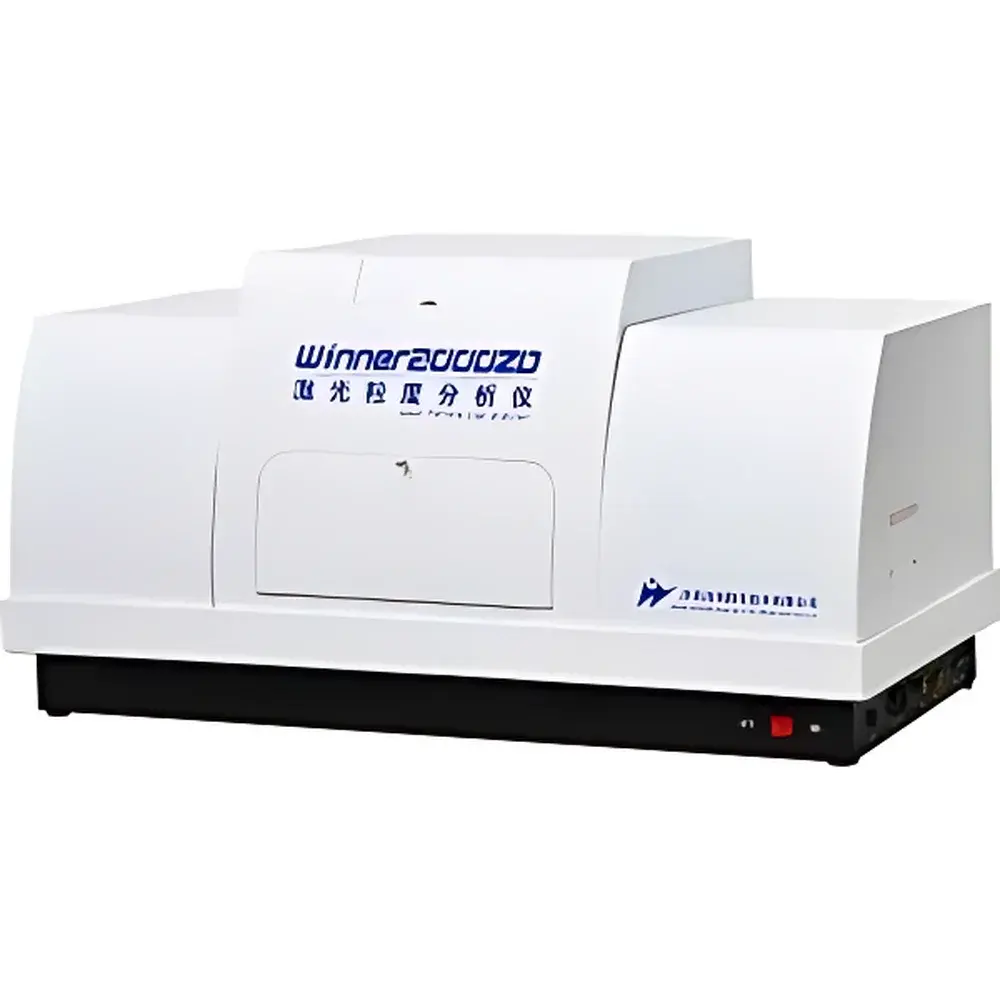
Winner2000ZD Fully Automated Wet-Dispersion Laser Particle Size Analyzer
| Brand | Jinan Winner |
|---|---|
| Origin | Shandong, China |
| Manufacturer Type | Direct Manufacturer |
| Country of Origin | China |
| Model | Winner2000ZD |
| Price Range | USD 0–15,000 (FOB) |
| Dispersion Method | Wet Dispersion |
| Measurement Range | 0.1–300 µm |
| Repeatability | <0.5% (D50 of NIST-traceable standard samples) |
| Measurement Time | <2 min per run |
| Laser Source | He-Ne, λ = 632.8 nm, power >2 mW, lifetime >25,000 h |
| Detector Channels | 39 |
| Compliance | ISO 13320:2020, GB/T 19077–2016, Q/0100JWN001–2013 |
| Ultrasonic Dispersion | 40 kHz, 35 W, adjustable duration ≥1 s |
| Stirring Speed | 0–3000 rpm (continuously variable) |
| Circulation Flow Rate | 8 L/min |
| Sample Cell Volume | 350 mL |
| Dimensions | 860 × 360 × 440 mm |
| Weight | 40 kg |
Overview
The Winner2000ZD Fully Automated Wet-Dispersion Laser Particle Size Analyzer is an industrial-grade instrument engineered for high-precision, routine particle size distribution (PSD) analysis of suspensions across research, quality control, and production environments. It operates on the Mie scattering theory—rigorously validated for spherical and near-spherical particles in liquid media—and integrates a patented convergent-beam Fourier transform optical design. This architecture eliminates aperture limitation on large-angle scattered light, shortens effective focal length, and enhances angular resolution—critical for accurate detection of fine submicron particles and coarse fractions up to 300 µm. Unlike conventional backscatter-only or fixed-optic systems, the Winner2000ZD employs a full 39-channel photodetector array with optimized angular coverage (0.02°–160°), enabling robust inversion of raw scattering patterns without pre-assumed distribution models. Its fully enclosed wet dispersion module—including integrated ultrasonication (40 kHz, 35 W), programmable mechanical stirring (0–3000 rpm), and recirculating flow (8 L/min)—ensures homogeneous deagglomeration and stable sample presentation, minimizing sedimentation artifacts and operator-induced variability.
Key Features
- Fully automated optical alignment system using precision 4-phase hybrid stepper motors, performing real-time beam centering and periodic recalibration to maintain long-term optical stability.
- Proprietary constraint-free inverse algorithm for data processing—capable of resolving multimodal distributions without forcing log-normal or Rosin-Rammler assumptions—ideal for R&D applications requiring unbiased PSD reconstruction.
- Modular wet dispersion unit with internalized ultrasonic transducer, variable-speed impeller, and closed-loop circulation path; eliminates external tubing, reduces dead volume, and prevents particle settling during measurement.
- Multi-modal analysis software supporting volume-based, number-based, and surface-area-weighted distributions—compliant with ISO 9276-2:2014 for standardized reporting formats.
- Optional 10-mL micro-circulation cell for high-value or scarce samples, maintaining hydraulic consistency with the main system while reducing reagent consumption.
- Intelligent workflow engine automating water intake, dispersion initiation, stabilization delay, measurement sequence, and flush cycle—reducing manual intervention and improving inter-operator reproducibility.
Sample Compatibility & Compliance
The Winner2000ZD is validated for aqueous and organic suspensions of inorganic oxides (e.g., SiO₂, Al₂O₃), pharmaceutical actives and excipients, ceramic precursors, pigment dispersions, catalysts, coal-water slurries, and biological colloids (e.g., micronized cells, bacterial aggregates). It meets ISO 13320:2020 requirements for laser diffraction instrumentation—including angular calibration traceability, detector linearity verification, and reference material validation protocols using NIST SRM 1963 (10.0 µm) and SRM 2800 (100 µm). The system supports GLP-compliant operation via audit-trail-enabled software logging (user actions, parameter changes, calibration events), and its output format aligns with FDA 21 CFR Part 11 readiness when deployed with networked authentication and electronic signature modules. All hardware components comply with IEC 61000-4 electromagnetic compatibility standards and CE safety directives.
Software & Data Management
The embedded Windows-based analysis suite provides dual-language UI (English/Chinese), with extensible localization support for additional languages upon request. Core analytical functions include: free-distribution fitting, Rosin-Rammler (R-R), and log-normal modeling; comparative overlay of up to 12 PSD curves with statistical delta analysis (ΔD10, ΔD50, ΔD90); custom percentile queries (e.g., “determine particle size at 95% volume cumulative”); and batch-mode report generation in Word (.docx), Excel (.xlsx), bitmap (.bmp), and plain-text (.txt) formats. Raw scattering intensity files (.dat) are stored with metadata (timestamp, operator ID, method name, dispersion settings), enabling retrospective reprocessing with updated algorithms. Data export supports CSV and XML schemas compatible with LIMS integration and statistical process control (SPC) platforms such as JMP or Minitab.
Applications
This analyzer serves critical roles in cement fineness optimization (ASTM C114), pharmaceutical suspension uniformity testing (USP particulate matter guidance), pigment dispersion quality assurance in coatings (ISO 8503-2), catalyst attrition resistance evaluation, and mineral processing slurry characterization (e.g., kaolin, limestone, graphite). In academic settings, it supports nanoparticle synthesis monitoring, polymer latex sizing, and environmental aerosol surrogate analysis (e.g., clay suspensions mimicking soil leachates). Its rapid (<2 min) single-run capability enables real-time feedback during milling, homogenization, or spray-drying process development—facilitating Design of Experiments (DoE) studies with minimal throughput interruption.
FAQ
Does the Winner2000ZD support dry powder measurement?
No—this model is configured exclusively for wet dispersion. Dry powder analysis requires a separate pneumatic dispersion module not included in the ZD configuration.
Can the instrument be calibrated using non-NIST reference materials?
Yes—while NIST-traceable standards are recommended for regulatory submissions, users may perform routine performance qualification using in-house secondary standards, provided their size distribution and uncertainty are independently verified.
Is remote diagnostics or firmware update supported?
Yes—the system includes Ethernet connectivity and supports secure remote access for technical support and over-the-air software updates, subject to user-configured firewall policies.
What maintenance intervals are recommended for the ultrasonic transducer and circulation pump?
Ultrasonic transducers require annual inspection for cavitation erosion; the peristaltic circulation pump tubing should be replaced every 6 months under continuous use, or after 500 operational hours.
How does the constraint-free inversion algorithm differ from standard regularization methods?
Unlike Tikhonov regularization—which imposes smoothness constraints—the Winner2000ZD’s algorithm applies no prior assumptions on distribution shape, allowing true bimodality or skewness to emerge directly from scattering data, enhancing fidelity for complex industrial formulations.



