
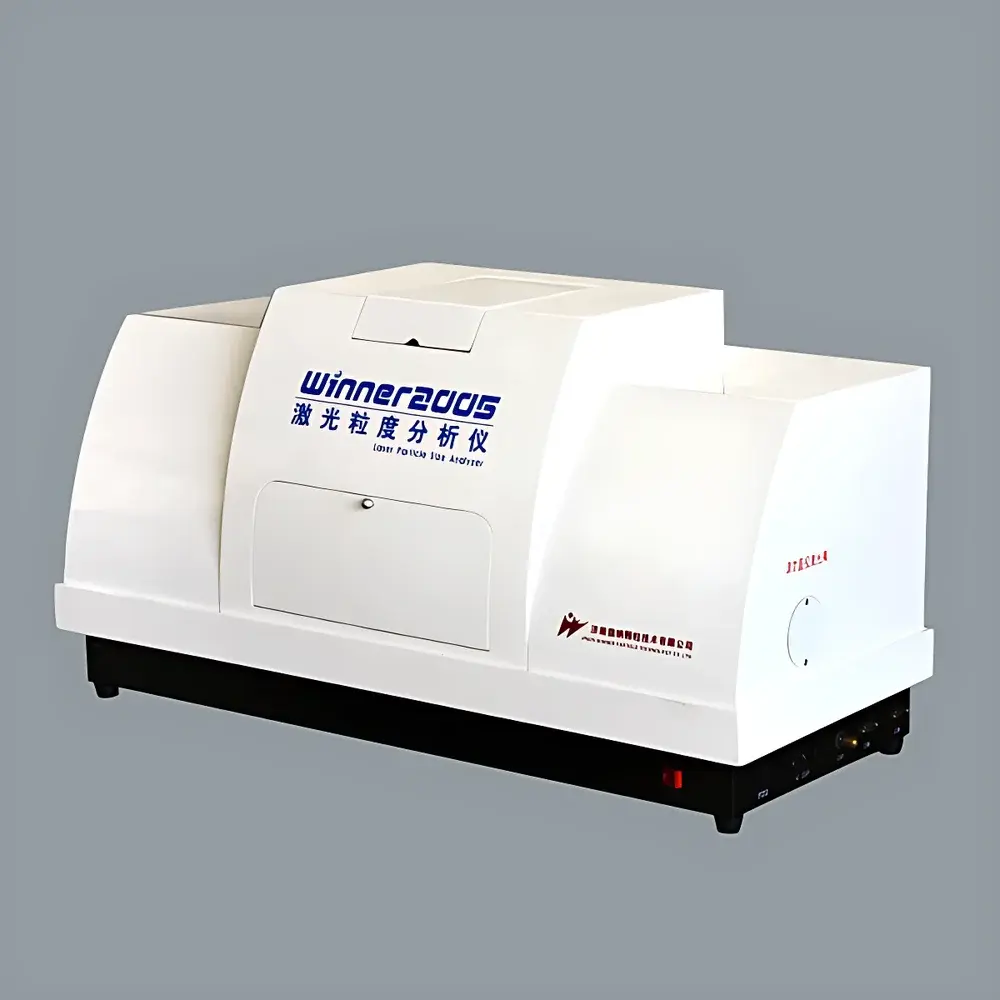
Winner2005 Intelligent Wet-Dispersion Laser Particle Size Analyzer
| Brand | Jinan Winner |
|---|---|
| Origin | Shandong, China |
| Manufacturer Type | Direct Manufacturer |
| Origin Category | Domestic |
| Model | Winner2005 |
| Price Range | USD 0–14,000 |
| Dispersion Method | Wet Dispersion |
| Instrument Type | Laboratory Laser Diffraction Particle Size Analyzer |
| Measurement Range | 0.01–1000 µm |
| Repeatability | <1% RSD |
| Measurement Time | 10–120 s |
Overview
The Winner2005 Intelligent Wet-Dispersion Laser Particle Size Analyzer is a laboratory-grade instrument engineered for high-precision particle size distribution (PSD) analysis of solid particulates suspended in liquid media. It operates on the principle of laser diffraction—based on Mie scattering theory and Fraunhofer approximation—enabling quantitative determination of volume-weighted particle size distributions across a broad dynamic range. Designed for rigorous scientific and industrial quality control environments, the system integrates an optically stable measurement cell, dual-wavelength laser sources (639 nm and 532 nm), and a fully automated wet dispersion module. Its compliance with ISO 13320:2009 and GB/T 19077–2016 ensures traceable, internationally recognized measurement validity. The instrument is particularly suited for routine batch testing, method development, and regulatory-compliant characterization where reproducibility, resolution, and operational robustness are critical.
Key Features
- Unconstrained free-fitting algorithm: Eliminates reliance on pre-defined distribution models (e.g., log-normal or Rosin-Rammler), enabling raw data-driven reconstruction of true particle size distribution without mathematical bias.
- Patented three-dimensional automatic optical alignment system (Patent No.: ZL201320835882.4): Utilizes precision four-phase hybrid stepper motors with sub-micron positional resolution to maintain continuous beam centering—ensuring long-term optical stability and measurement fidelity.
- Fully integrated wet dispersion unit (Patent No.: ZL201010533181.6): Combines ultrasonic dispersion (40 kHz, 60 W, adjustable duration), programmable mechanical stirring (0–3000 rpm), controlled sample circulation (17 L/min), and automatic drainage—minimizing sedimentation artifacts and ensuring homogeneous suspension prior to measurement.
- Intelligent software architecture: Supports one-click automated workflows—including water priming, sample introduction, dispersion activation, measurement acquisition, and post-run cleaning—reducing operator dependency and inter-user variability.
- Multi-point calibration protocol: Validated across nanoscale (sub-100 nm), submicron (100 nm–1 µm), and micron-range (1–1000 µm) national standard reference materials to guarantee consistent resolution and accuracy across the full 0.01–1000 µm measurement span.
Sample Compatibility & Compliance
The Winner2005 is optimized for aqueous and organic suspensions of non-soluble or sparingly soluble particulates, including but not limited to calcium carbonate, ceramic powders, metal oxides, graphite, kaolin, abrasives, pharmaceutical excipients, pesticide formulations, battery electrode slurries, and colloidal gels. It supports both refractive index input and complex refractive index modeling for improved Mie-based interpretation. The system meets essential requirements for GLP-aligned laboratories, supporting audit-ready operation through timestamped test logs, user-access controls, and parameter-locking functions. While not inherently 21 CFR Part 11 compliant out-of-the-box, its software architecture permits integration with third-party electronic lab notebook (ELN) systems supporting electronic signatures and audit trails.
Software & Data Management
The proprietary WinMias software provides intuitive GUI navigation, real-time scatter pattern visualization, and multi-format export (CSV, PDF, XML). Raw intensity data, deconvoluted size distributions (D10/D50/D90), span values, and statistical summaries are stored with full metadata—including instrument configuration, dispersion parameters, and calibration history. Batch reporting tools enable comparative analysis across multiple samples; trend monitoring functions support SPC-based process validation. All data files adhere to FAIR principles (Findable, Accessible, Interoperable, Reusable) and may be imported into LIMS or statistical analysis platforms (e.g., JMP, MATLAB, Python pandas).
Applications
The Winner2005 serves as a primary characterization tool in academic research labs, QC/QA departments of chemical and pharmaceutical manufacturers, R&D centers developing advanced ceramics or battery materials, and environmental testing facilities assessing sediment or aerosol-derived particulate fractions. Typical use cases include: optimizing milling and classification processes; validating nanoparticle synthesis consistency; evaluating emulsion stability via droplet size tracking; certifying raw material specifications per ASTM D4294 or ISO 8503; and supporting regulatory submissions requiring PSD documentation under ICH Q5A or USP . Its adaptability to diverse suspension chemistries and particle morphologies makes it especially valuable in cross-sectoral innovation pipelines—from additive manufacturing feedstock qualification to food-grade functional ingredient characterization.
FAQ
What dispersion media are compatible with the Winner2005?
Deionized water, ethanol, isopropanol, and other low-viscosity, low-absorption solvents commonly used in particle dispersion are supported. Viscosity limits are typically ≤20 cP at 25°C.
Does the system require external compressed air or vacuum?
No—the integrated peristaltic pump and ultrasonic transducer eliminate dependence on auxiliary utilities, enabling standalone operation in standard lab environments.
Can the instrument measure particles smaller than 0.1 µm?
Yes: the A-version model extends down to 0.01 µm using enhanced signal processing and optimized detector geometry, subject to proper refractive index input and adequate suspension stability.
Is remote monitoring or network connectivity supported?
The system features Ethernet and USB interfaces; optional OPC UA or Modbus TCP gateways allow integration into factory-wide MES or SCADA infrastructures.
How often must the optical alignment be verified?
The patented auto-alignment system performs continuous real-time correction; manual verification is recommended only after physical relocation or major maintenance—typically every 6–12 months under normal usage conditions.



