
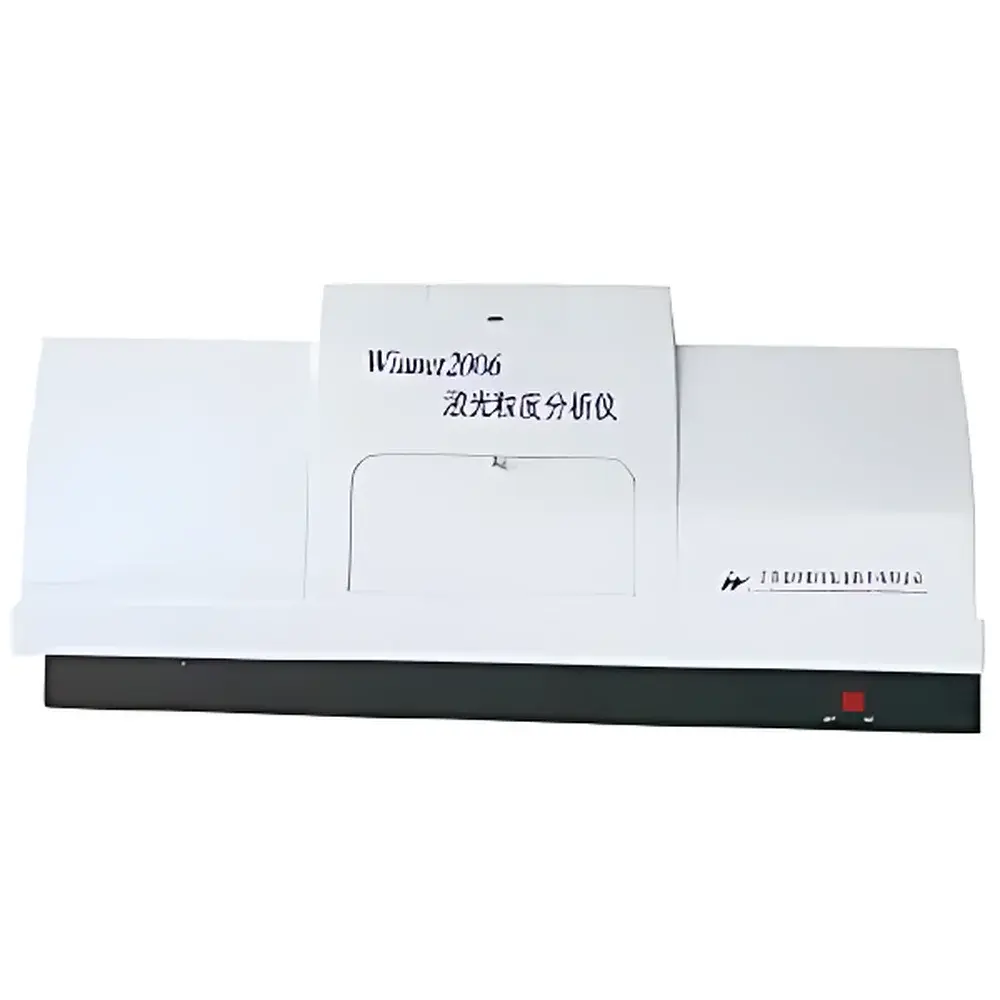
Winner2006 Automated Wet-Dispersion Laser Particle Size Analyzer
| Brand | Jinan Winner |
|---|---|
| Origin | Shandong, China |
| Manufacturer Type | Direct Manufacturer |
| Model | Winner2006 |
| Price Range | USD 14,000–21,000 |
| Dispersion Method | Wet Dispersion |
| Measurement Range | 0.01–780 µm |
| Repeatability | <0.5% (D50 of NIST-traceable standard) |
| Measurement Time | <120 s |
| Compliance | ISO 13320:2020, GB/T 19077–2016 |
| Detector Channels | 68 |
| Laser Source | Dual 650 nm semiconductor fiber-coupled lasers (main + auxiliary), output power >2 mW each |
| Ultrasonic Dispersion | 40 kHz, 35 W, programmable duration ≥1 s |
| Stirring Speed | 0–3000 rpm (adjustable) |
| Circulation Flow Rate | 10 L/min |
| Sample Cell Volume | 450 mL |
| Auto-Alignment | Fully automated optical alignment system |
| Data Output Formats | CSV, TXT, BMP, XLSX, DOCX |
| Software Languages | English & Chinese (customizable UI localization available) |
Overview
The Winner2006 Automated Wet-Dispersion Laser Particle Size Analyzer is an ISO 13320:2020–compliant instrument engineered for high-precision, reproducible particle size distribution (PSD) analysis of suspensions across broad dynamic ranges. It operates on the principle of laser diffraction—measuring angular intensity distribution of light scattered by particles in a laminar-flow suspension—and employs Mie theory-based inversion algorithms with optional Fraunhofer approximation for rapid, robust sizing. Designed specifically for industrial quality control and R&D laboratories requiring routine analysis of fine to coarse particulates, the system integrates fully automated wet dispersion, real-time hydrodynamic stabilization, and intelligent optical alignment to minimize operator dependency and maximize inter-laboratory comparability. Its extended lower detection limit (0.01 µm) enables reliable characterization of colloidal dispersions, while its upper range (780 µm) accommodates coarse aggregates common in construction materials, mineral slurries, and agrochemical formulations.
Key Features
- Dual-wavelength, fiber-coupled 650 nm semiconductor lasers with >25,000 h lifetime—ensuring stable beam profile, minimal thermal drift, and consistent scattering signal integrity across full operational duty cycles.
- TD41 high-sensitivity main detector array (68 channels) optimized for submicron resolution, paired with Japan-sourced filtered photodiode auxiliary detectors—eliminating measurement gaps between primary and secondary angular detection zones.
- Integrated dispersion module featuring programmable 40 kHz ultrasonication (35 W), variable-speed magnetic stirring (0–3000 rpm), and high-capacity recirculation pump (10 L/min)—enabling complete de-agglomeration of cohesive powders without manual intervention.
- Fully automated optical alignment system that dynamically adjusts laser path and detector positioning prior to each measurement—critical for maintaining long-term calibration stability and reducing sensitivity to mechanical vibration or thermal expansion.
- Modular software architecture supporting ASTM E29, ISO 13320, USP <429>, and pharmacopeial reporting templates—including volume-weighted (Dv10/Dv50/Dv90), number-weighted, and surface-area distributions.
Sample Compatibility & Compliance
The Winner2006 is validated for aqueous and organic suspensions of inorganic oxides (e.g., SiO₂, Al₂O₃), pharmaceutical actives and excipients, ceramic precursors, pigment dispersions, catalyst supports, coal-water slurries, and biological particulates (e.g., yeast, micronized cells). It complies with ISO 13320:2020 for laser diffraction methodology, GB/T 19077–2016 (Chinese national standard equivalent), and supports audit-ready data handling per FDA 21 CFR Part 11 requirements when deployed with optional electronic signature and audit trail modules. All calibration verifications are traceable to NIST SRM 1963 (10.01 ± 0.10 µm) and SRM 2800 (11.1 ± 0.3 µm), with documented uncertainty budgets provided in factory certification reports.
Software & Data Management
The embedded WinPAS v4.2 software offers dual-mode operation: guided wizard-based workflows for routine QC testing and advanced scripting interface for method development. Key capabilities include multi-modal distribution fitting (Rosin-Rammler, log-normal, free distribution), comparative overlay of up to 16 historical runs with statistical delta reporting (±σ, %RSD), and customizable report generation compliant with GLP/GMP documentation standards. Raw scatter data (.DAT) and processed results (.CSV/.XLSX) are stored with full metadata (operator ID, timestamp, instrument serial, environmental conditions). Optional network deployment enables centralized database synchronization and remote monitoring via secure HTTPS API endpoints.
Applications
This analyzer serves critical functions across regulated and non-regulated sectors: cement fineness verification per ASTM C114; pharmaceutical blend uniformity assessment under USP <429>; pigment particle size optimization for inkjet ink rheology; catalyst support grading in petrochemical refining; and slurry stability evaluation in battery electrode manufacturing. Its ability to resolve bimodal distributions—such as calcium carbonate fillers containing both nano- and micro-fractions—is routinely leveraged in polymer composite formulation and ceramic green-body densification studies.
FAQ
What reference standards are used for factory calibration and user verification?
NIST-traceable SRM 1963 (10.01 µm) and SRM 2800 (11.1 µm) are employed for initial calibration; certified reference materials from HORIBA, Malvern Panalytical, and Bettersize are supported for cross-platform validation.
Is the system compatible with non-aqueous dispersants such as ethanol or xylene?
Yes—the fluidic path is chemically resistant to common organic solvents; optional corrosion-resistant wetted materials (e.g., PTFE seals, sapphire flow cell) are available upon request.
Can raw scattering pattern data be exported for third-party Mie modeling?
Yes—full 68-channel intensity vs. scattering angle arrays (.DAT format) are exportable with wavelength, refractive index, and absorption coefficient metadata.
Does the software support automated pass/fail decision logic against predefined specification limits?
Yes—user-defined acceptance criteria (e.g., Dv50 ∈ [15.2–16.8] µm, Span ≤ 1.2) trigger color-coded status flags and configurable alerts (email/SNMP).
What maintenance intervals are recommended for the ultrasonic transducer and circulation pump?
Ultrasonic generator requires no scheduled maintenance; transducer inspection every 12 months is advised. Pump impeller and seal replacement is recommended at 10,000 operating hours or biannually—whichever occurs first.



