
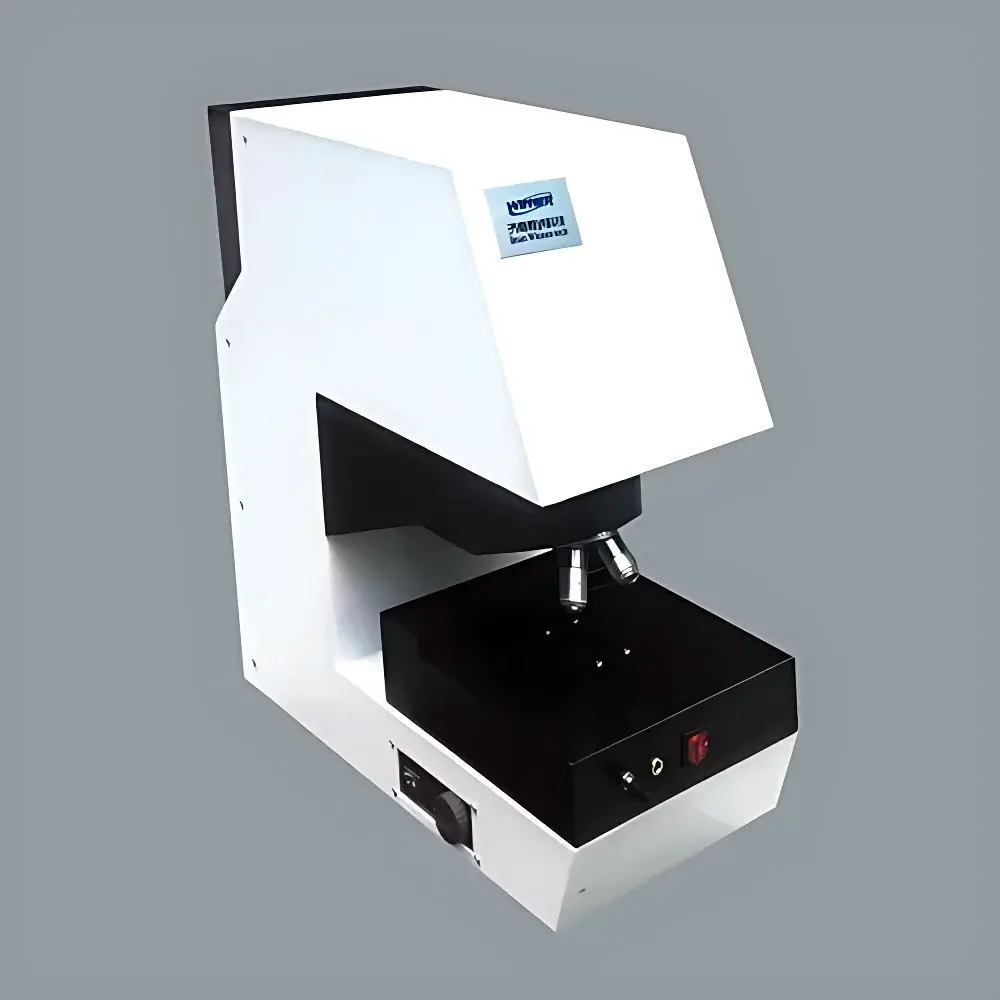
Winner208 Micro-Nano Hardened Concrete Air Content Analyzer
| Brand | Jinan Winner |
|---|---|
| Origin | Shandong, China |
| Manufacturer Type | Direct Manufacturer |
| Regional Category | Domestic (China) |
| Model | WINNER208 |
| Price Range | USD 1,400 – 42,000 |
| Application Category | Construction Materials Testing |
| Instrument Type | Static Image-Based Analyzer |
| Number of Lenses | 2 |
| Measurement Range | 1–3000 µm |
| Sample Dispersion Method | Wet Dispersion |
| Image Resolution | 3264 × 2448 |
| Measured Parameters | Area-equivalent diameter, Perimeter-equivalent diameter, Martin diameter, Perimeter, Projected area, Particle length, Particle width, Estimated surface area, Estimated volume, X-tangent, Y-tangent, Tangent diameter, Sphericity, Length-to-width ratio |
Overview
The Winner208 Micro-Nano Hardened Concrete Air Content Analyzer is a static, image-based particle analysis system engineered for quantitative microstructural characterization of air voids in hardened concrete. Unlike traditional linear traverse methods—such as the ASTM C457 wire-section technique—which rely on statistical approximation of void area from intersected chord lengths, the Winner208 employs high-resolution digital microscopy combined with calibrated optical magnification and automated image stitching to deliver direct, pixel-accurate measurements of void morphology, spatial distribution, and volumetric fraction. Its core measurement principle is based on grayscale thresholding and binary segmentation of optically contrast-enhanced voids within polished concrete sections, followed by morphometric computation using ISO 9276-2 compliant shape descriptors. This enables traceable, operator-independent determination of critical parameters including total air content (% by volume), specific surface area of voids (cm²/cm³), void spacing factor (µm), and void size distribution—parameters directly linked to freeze-thaw durability per ASTM C457, EN 480-11, and GB/T 50080–2016.
Key Features
- Optical System: Dual-lens configuration with continuously variable zoom optics (7×–450× total magnification, including digital zoom); UV LED illumination (365–380 nm) optimized for enhanced void–matrix contrast in epoxy-impregnated samples.
- Motion Control: Precision XY motorized stage (60 mm × 60 mm standard travel; optional 100 mm × 100 mm) with Hall-effect position feedback; Z-axis electric focus drive (50 mm travel, 1 µm step resolution) for consistent depth-of-field control across large-area scans.
- Imaging Hardware: 1/1.8″ progressive-scan CMOS sensor (3.1 MP, 2048 × 1536 native resolution; upgradeable to 3264 × 2448); configurable frame rates up to 30 fps at VGA resolution for real-time preview and dynamic focus assessment.
- Integrated Computing Platform: Onboard AMD low-power CPU, 4 GB RAM, 500 GB SSD, and Windows 7 embedded OS—enabling fully autonomous operation without external PC dependency.
- Concrete-Specific Software Suite: Dedicated “Hardened Concrete Pore Mode” with one-click mosaic stitching, automatic crack and aggregate artifact removal, and ISO/ASTM-compliant void classification logic.
Sample Compatibility & Compliance
The Winner208 accepts standard ASTM C457-compliant polished concrete specimens (typically 50 mm × 50 mm × 10 mm thick), prepared via diamond grinding, polishing, and epoxy impregnation to preserve pore integrity and enhance optical contrast. It supports both water- and resin-based mounting media. The system complies with metrological traceability requirements for construction materials testing labs operating under ISO/IEC 17025:2017. All calibration procedures—including stage movement verification, pixel-to-micron scaling, and grayscale threshold validation—are documented and repeatable. While not FDA-regulated, its audit-ready software architecture supports GLP-aligned data integrity practices, including user login tracking, timestamped result export, and immutable raw image archiving.
Software & Data Management
The proprietary analysis software implements a task-driven workflow with hierarchical project folders, version-stamped reports, and customizable metadata fields (e.g., operator ID, sample ID, curing age, mix design code). Image acquisition includes live video streaming, time-lapse capture, and synchronized stage coordinate logging. Post-acquisition tools include: (i) multi-level binary threshold optimization; (ii) 12-step automated particle refinement (de-clumping, hole filling, edge smoothing, boundary completion); (iii) granular sphericity and aspect ratio computation per ISO 9276-2 Annex B; (iv) cumulative frequency distributions binned by number, area, volume, or perimeter. Export formats include CSV, PDF, TIFF (with embedded scale bar and measurement overlays), and XML for LIMS integration. Software updates are delivered free of charge for the lifetime of the instrument.
Applications
The Winner208 serves laboratories engaged in durability-oriented concrete research and quality assurance, particularly where air-void system characterization is mandated by specification or performance modeling. Primary use cases include: evaluation of air-entraining admixture efficacy; validation of air void parameters against ASTM C457 limits (e.g., spacing factor < 200 µm for severe exposure); correlation of void structure with rapid chloride permeability (ASTM C1202) or sorptivity (ASTM C1585); forensic analysis of premature spalling in bridge decks or parking structures; and development of machine learning models for predictive durability assessment. It is also deployed in academic settings for teaching microstructure–property relationships in cementitious composites.
FAQ
What sample preparation is required prior to analysis?
Polished, epoxy-impregnated concrete sections—prepared per ASTM C457 Section 6—must be mounted on standard glass slides. Surface roughness should be ≤ 0.1 µm Ra; no additional coating or sputtering is needed.
Does the system meet ASTM C457 reporting requirements?
Yes. The software calculates and exports all mandatory ASTM C457 parameters—including total air content, specific surface, void frequency, and spacing factor—with traceable pixel-scale calibration and documented threshold methodology.
Can the instrument analyze non-concrete porous materials?
While optimized for cement paste and mortar, the system can characterize voids or pores in other brittle, opaque, sectioned materials (e.g., ceramics, foamed polymers, lightweight aggregates) using custom segmentation protocols.
Is remote operation supported?
The system operates autonomously but includes USB-RS232 interface compatibility for external control via LabVIEW or Python-based automation scripts.
What is the typical analysis time per specimen?
A full 8102 × 7680-pixel mosaic scan—including stage motion, auto-focus, stitching, segmentation, and parameter extraction—requires 18–25 minutes, depending on void density and selected resolution mode.



