
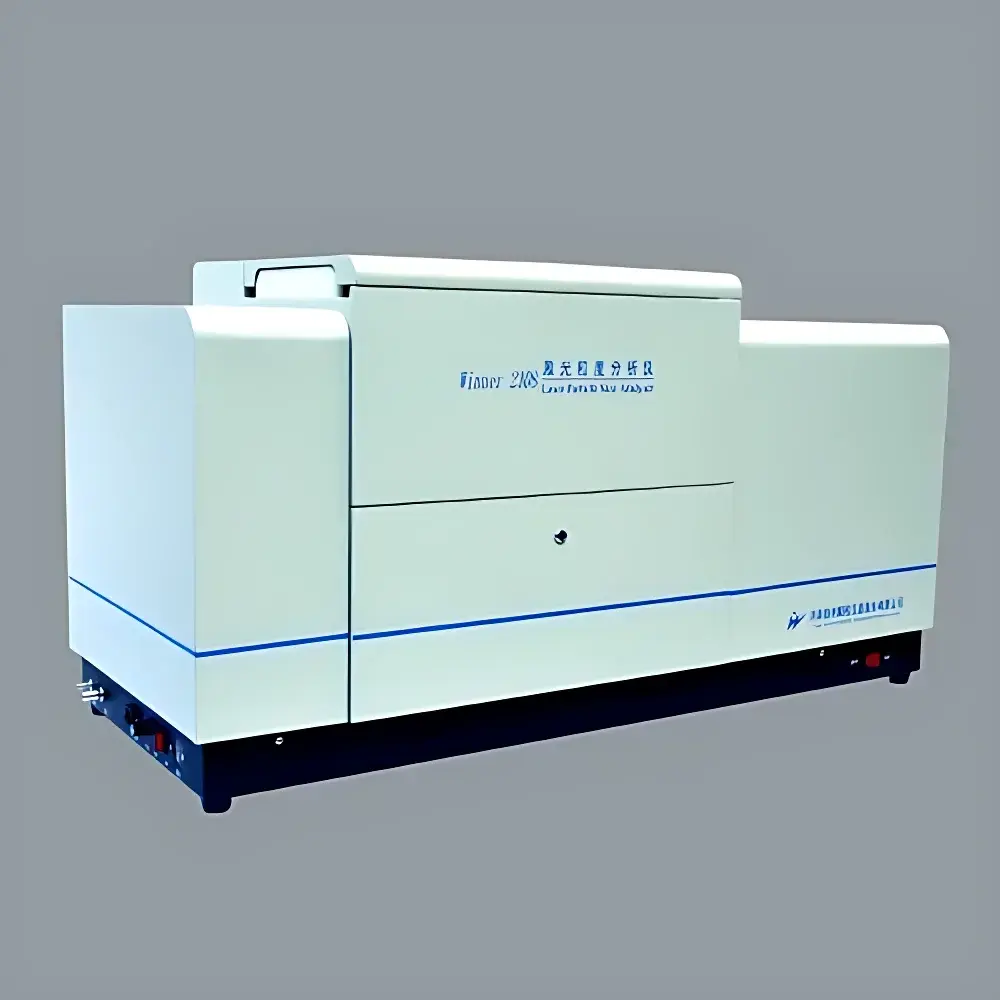
Winner2308 Intelligent Dry/Wet Integrated Laser Particle Size Analyzer
| Brand | Jinan Winner |
|---|---|
| Origin | Shandong, China |
| Manufacturer Type | Direct Manufacturer |
| Instrument Type | Laboratory Laser Particle Size Analyzer |
| Measurement Range | Wet Dispersion: 0.01–2000 µm |
| Dry Dispersion | 0.1–200 µm |
| Repeatability | Wet: <0.5% |
| Dry | <1% |
| Measurement Time | Wet: <2 min per test |
| Dry | <1 min per test |
| Compliance | GB/T 19077–2016, ISO 13320:2009 |
| Laser Sources | Main: 639 nm, >2 mW |
| Auxiliary | 405 nm, >2 mW |
| Ultrasonic Dispersion | 40 kHz, 60 W, adjustable duration |
| Stirring Speed | 0–3000 rpm, continuously adjustable |
| Circulation Flow Rate | 3.6 L/min, 29 W |
| Sample Cell Volume | 550 mL |
| Auto-Alignment | Patented 3D motorized optical centering system (ZL201320835882.4) |
| Scattering Angle Range | 0.0155°–164° |
| Detection Channels | 116 |
| Dimensions | 1062 × 460 × 548 mm |
| Weight | 58 kg |
Overview
The Winner2308 Intelligent Dry/Wet Integrated Laser Particle Size Analyzer is a laboratory-grade instrument engineered for high-precision, high-reproducibility particle size distribution (PSD) analysis across diverse sample types and industrial sectors. It operates on the principle of laser diffraction—specifically, convergent beam Fourier transform optics—enabling accurate quantification of scattered light intensity patterns generated when a collimated laser beam interacts with dispersed particles. Its dual-path optical architecture incorporates both a primary red semiconductor laser (639 nm) and a secondary blue auxiliary laser (405 nm), extending sensitivity to sub-micron particles down to 0.01 µm in wet mode and ensuring robust detection of fine aerosolized powders in dry mode. Unlike conventional systems requiring separate dry and wet modules, the Winner2308 integrates fully self-contained dispersion subsystems within a single chassis, eliminating inter-system variability and minimizing operator-induced error. This architecture supports rapid, repeatable transitions between dispersion modes without hardware reconfiguration—critical for laboratories handling heterogeneous sample portfolios ranging from pharmaceutical suspensions to battery cathode powders.
Key Features
- Integrated dry/wet dispersion platform with one-button mode switching—no manual disassembly or external module swapping required.
- Patented built-in wet dispersion system (ZL201010533181.6) combining ultrasonication (40 kHz, up to 60 W), programmable stirring (0–3000 rpm), high-flow circulation (3.6 L/min), and automated drainage—optimized to suppress sedimentation of coarse particles (>100 µm) during measurement.
- Automated 3D optical alignment system (ZL201320835882.4) utilizing precision four-phase hybrid stepper motors with micron-level positional resolution, ensuring continuous maintenance of optimal laser-beam–detector geometry throughout daily operation.
- Unconstrained free-fitting algorithm for PSD calculation—avoids assumptions inherent in log-normal or Rosin-Rammler models, delivering raw, model-independent distribution profiles directly traceable to Mie or Fraunhofer scattering theory.
- Dual-spectral plane detection with extended angular coverage (0.0155°–164°), enabled by orthogonal dual-laser illumination, broadening dynamic range without sacrificing resolution at either extreme of the measurable spectrum.
Sample Compatibility & Compliance
The Winner2308 accommodates a wide spectrum of particulate materials: aqueous and non-aqueous suspensions (e.g., colloidal silica, polymer emulsions), water-soluble crystalline powders (e.g., APIs, excipients), and cohesive or electrostatic dry powders (e.g., metal oxides, graphite anode materials). Its wet cell (550 mL capacity) supports refractive index matching for transparent media, while the dry dispersion unit employs controlled air shear and vibration-assisted feeding to minimize agglomeration. The instrument complies with international standards for laser diffraction instrumentation, including ISO 13320:2009 and GB/T 19077–2016, and meets metrological requirements for repeatability (<0.5% RSD in wet mode, <1% in dry mode, verified using NIST-traceable standard reference materials). While not pre-certified for FDA 21 CFR Part 11, its software architecture supports audit trail logging, user access control, and electronic signature implementation—facilitating validation under GLP and GMP environments.
Software & Data Management
The proprietary WinSize 3.0 software provides full instrument control, real-time scatter pattern visualization, and ISO-compliant reporting templates. All measurement parameters—including ultrasonication duration, stir speed, flow rate, and laser power—are digitally logged with timestamps and user IDs. Raw scattering data (116-channel intensity vectors) are stored in open ASCII format for third-party analysis. Batch processing, statistical comparison across multiple runs, and customizable report generation (PDF/Excel) are supported. Data integrity safeguards include automatic checksum verification upon file save and optional encrypted database storage. The interface is compatible with Windows 10/11 (64-bit) and supports integration into LIMS via ODBC drivers.
Applications
The Winner2308 serves as a core analytical tool in quality assurance laboratories across regulated and research-intensive industries. In pharmaceutical development, it characterizes active ingredient particle size in oral suspensions and inhalable dry powders—supporting QbD-based formulation optimization. In advanced materials, it monitors grain size evolution during sintering of ceramic precursors or post-milling consistency of LiCoO₂ cathode powders. Chemical manufacturers employ it for catalyst support grading and pigment dispersion stability assessment. Food science labs use it to verify homogeneity of milk protein aggregates or starch granule breakdown during extrusion. Academic researchers apply it in environmental studies (soil particulate fractionation), nanomaterial synthesis (quantifying nanoparticle aggregation kinetics), and additive manufacturing (metal powder flowability correlation).
FAQ
Does the Winner2308 require external compressed air for dry dispersion?
No—the integrated dry dispersion module includes a built-in air pump and pressure-regulated nozzle assembly, eliminating dependency on facility-supplied compressed air lines.
Can the instrument measure particles smaller than 0.1 µm in dry mode?
Dry dispersion is optimized for 0.1–200 µm; sub-100 nm particles are reliably measured only in wet mode due to Brownian motion stabilization and reduced agglomeration risk.
Is calibration traceable to national standards?
Yes—factory calibration uses NIST SRM 1963 (10.03 µm) and SRM 2806b (5.2 µm) latex standards; users may perform routine verification with certified reference materials.
What maintenance is required for the wet dispersion system?
Routine cleaning of the sample cell and circulation tubing with deionized water after each session is recommended; ultrasonic transducer performance should be verified quarterly using amplitude monitoring.
Does the software support multi-language interfaces?
WinSize 3.0 offers English and Chinese language options; additional localization requires custom firmware deployment through authorized service channels.
Related Products



