
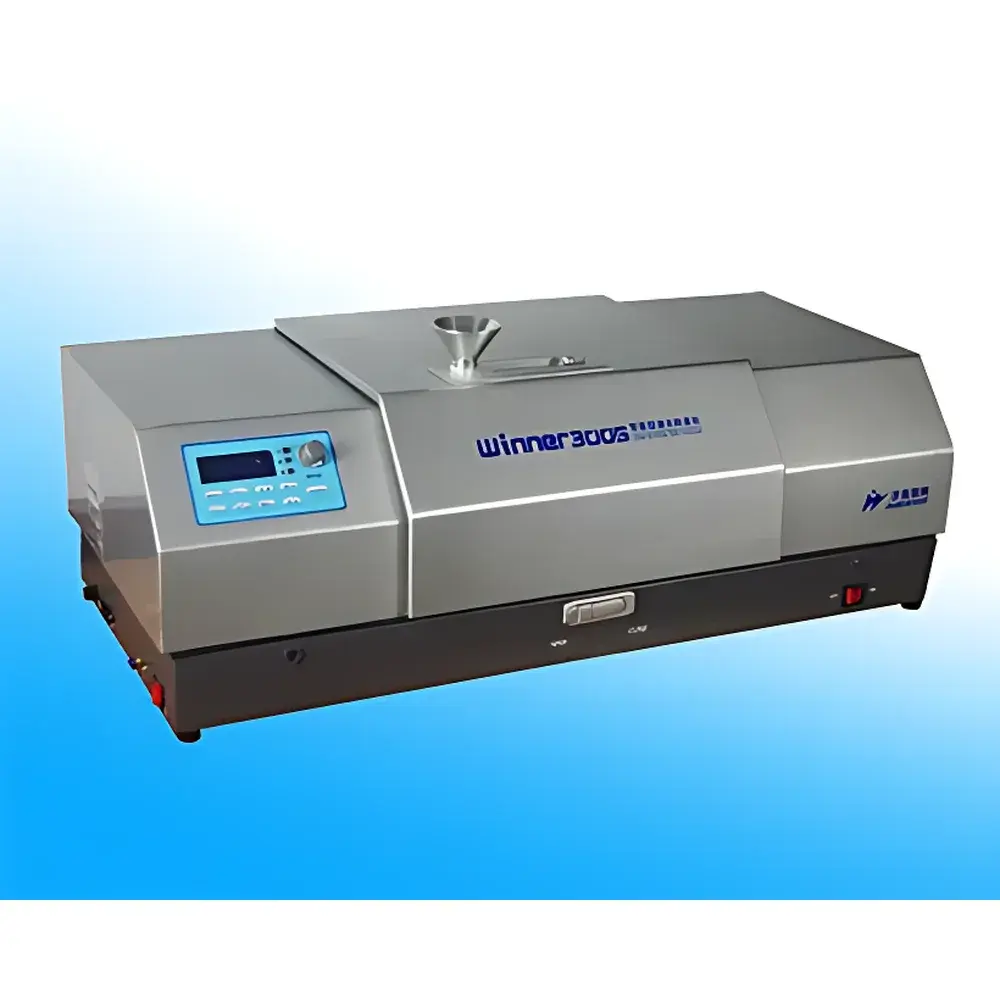
Winner3005 Dry-Method Laser Particle Size Analyzer by Jinan Winner
| Brand | Jinan Winner |
|---|---|
| Origin | Shandong, China |
| Manufacturer Type | Direct Manufacturer |
| Model | Winner3005 |
| Price Range | USD 21,000–28,000 (FOB) |
| Dispersion Method | Dry-air turbulent dispersion |
| Measurement Range | 0.1–500 µm |
| Repeatability | < 1% (RSD of D50 on certified reference materials) |
| Analysis Time | < 60 s per measurement |
| Laser Source | He-Ne, λ = 632.8 nm, P > 2 mW, lifetime > 25,000 h |
| Detector Channels | 40-channel concentric ring photodetector array |
| Alignment | Motorized auto-centering (micrometer-level precision) |
| Sample Feeding | Vibratory hopper with patented powder jet pump |
| Air Supply | Oil-free, silent compressor |
| Compliance | GB/T 19077.1–2008, ISO 13320:2016, Q/0100JWN001–2013 |
| Dimensions | 880 × 400 × 300 mm |
| Weight | 36 kg |
Overview
The Winner3005 Dry-Method Laser Particle Size Analyzer is an industrial-grade, fully automated instrument engineered for precise and reproducible particle size distribution (PSD) analysis of dry powders using Mie scattering theory. It employs a convergent-beam Fourier transform optical configuration—optimized to eliminate aperture-induced angular truncation—enabling high-fidelity detection of forward- and wide-angle scattered light across the full 0.1–500 µm range. The system integrates a stabilized He-Ne laser (632.8 nm), a 40-channel concentric-ring photodetector array, and motorized optical alignment to maintain optimal beam path integrity throughout operation. Designed specifically for samples incompatible with liquid media—including hygroscopic, reactive, thermally labile, or shape-sensitive powders—the Winner3005 delivers metrological performance equivalent to wet-dispersion systems while eliminating solvent-related artifacts, aggregation risks, and post-analysis drying steps.
Key Features
- Convergent-beam Fourier transform optical design with dual-zone detection (main + extended-angle auxiliary sensors) ensures complete angular coverage and minimizes inversion uncertainty in PSD calculation.
- Turbulent air dispersion system utilizing shock-wave shear forces and a patented powder jet pump achieves deagglomeration efficiency exceeding conventional dry dispersers by ≥100%, validated via NIST-traceable reference standards.
- Motor-driven auto-centering mechanism with sub-micrometer positional resolution maintains optical axis alignment under thermal drift or mechanical vibration, sustaining long-term measurement stability.
- Dual-mode operation: fully automated sequence control via PC software or standalone manual operation via front-panel interface—supporting rapid method development and troubleshooting without external computing.
- Oil-free, low-noise compressed air supply (0.1–0.8 MPa, continuously adjustable) with integrated coalescing and desiccant filtration prevents contamination of optical components and sample chamber.
- Vibratory feed hopper with programmable amplitude/frequency control enables consistent mass flow rates across diverse powder rheologies—from free-flowing silica to cohesive pharmaceutical actives.
Sample Compatibility & Compliance
The Winner3005 is validated for use with non-aqueous, chemically reactive, or morphologically unstable powders including but not limited to: cement clinker, ceramic precursors, metal oxides, magnetic nanoparticles, herbal extracts, explosives, catalyst supports, and battery electrode materials. It complies with ISO 13320:2016 (Particle size analysis — Laser diffraction methods), GB/T 19077.1–2008 (Chinese national standard aligned with ISO 13320), and internal enterprise specification Q/0100JWN001–2013. While not inherently 21 CFR Part 11 compliant, the instrument’s data acquisition architecture supports integration with validated LIMS or ELN platforms that enforce electronic signature, audit trail, and data integrity requirements per GLP/GMP guidelines.
Software & Data Management
The proprietary WinMAS v5.2 analysis software implements non-negative constrained least-squares inversion with regularization parameter optimization to reconstruct volume-based PSD from raw scattering intensities. It supports batch processing, statistical comparison (t-test, ANOVA), and customizable reporting templates. Output includes D10, D50, D90, D[4,3], D[3,2], span, and user-defined percentile ranges (e.g., % < 10 µm, % between 50–150 µm). All raw intensity arrays, intermediate matrices, and final distributions are stored in HDF5 format with embedded metadata (timestamp, operator ID, method name, environmental conditions), enabling full traceability and reprocessing without loss of fidelity.
Applications
The Winner3005 serves quality control and R&D laboratories in cement manufacturing (clinker fineness verification), pharmaceutical solid dosage development (API crystallinity and blend uniformity assessment), advanced ceramics (slurry precursor characterization), catalyst production (support particle homogeneity), and energy materials (anode/cathode powder grading for Li-ion batteries). Its dry-mode capability is critical for evaluating heat-sensitive biologics, pyrophoric metal powders, and water-reactive compounds such as alkali metal hydrides—where wet dispersion would induce decomposition, hydrolysis, or irreversible agglomeration.
FAQ
Does the Winner3005 require calibration with traceable reference standards?
Yes. Routine calibration uses NIST SRM 1963 (silica, ~10 µm median) and SRM 1978 (alumina, ~50 µm median) to verify optical alignment, detector response linearity, and inversion algorithm accuracy.
Can the instrument be integrated into an automated production line?
It supports RS-232 and Ethernet communication protocols with Modbus TCP and OPC UA drivers available upon request for SCADA/MES integration.
What maintenance is required for the air dispersion system?
Filter elements (particulate and coalescing) must be replaced every 6 months under continuous operation; the powder jet pump wear inserts are rated for ≥10,000 cycles and are field-replaceable without optical realignment.
Is software validation documentation available for regulated environments?
IQ/OQ protocols and a software requirements specification (SRS) document are provided to support customer-led 21 CFR Part 11 or Annex 11 validation activities.
How does the system handle highly cohesive or electrostatic powders?
Optional anti-static ionizing bars and variable-frequency vibratory feed control allow empirical optimization of dispersion energy without altering core optical or detection parameters.



