
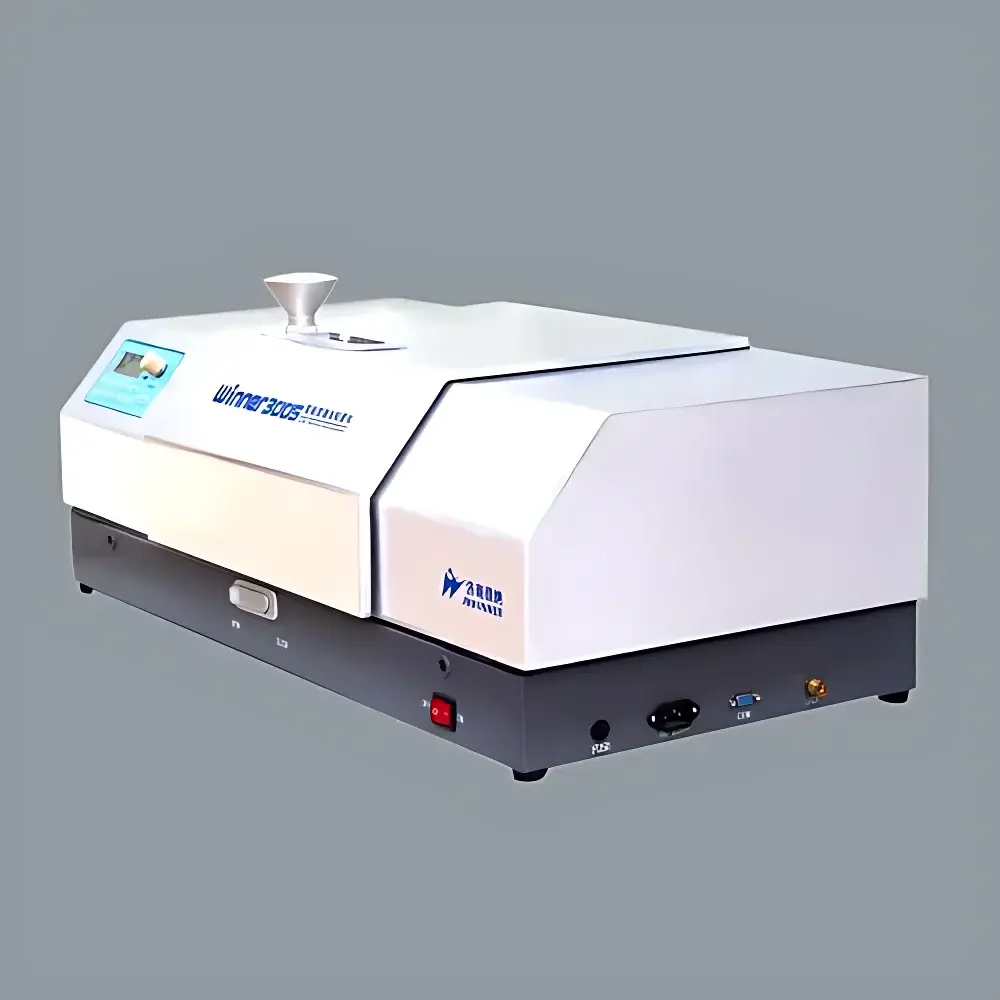
Winner3005 Intelligent Dry-Method Laser Particle Size Analyzer
| Brand | Jinan Winner |
|---|---|
| Origin | Shandong, China |
| Manufacturer Type | Direct Manufacturer |
| Instrument Type | Laboratory Laser Particle Size Analyzer |
| Dispersion Method | Dry Air Dispersive |
| Measurement Range | 0.1–500 µm |
| Repeatability | <1% (D50 of standard reference material) |
| Measurement Time | <1 min per test |
| Compliance Standards | ISO 13320:2020, GB/T 19077.1–2016, Q/0100JN001–2013 |
| Laser Source | He–Ne, λ = 632.8 nm, power >2 mW |
| Detector Channels | 80-ring radial array |
| Dimensions | 850 × 380 × 240 mm |
| Weight | 50 kg |
| Software | Windows-based, bilingual (English/Chinese), FDA 21 CFR Part 11–compliant audit trail optional |
Overview
The Winner3005 Intelligent Dry-Method Laser Particle Size Analyzer is a laboratory-grade instrument engineered for high-fidelity particle size distribution (PSD) characterization of free-flowing dry powders. It operates on the fundamental principle of Mie scattering theory, supported by a convergent-beam Fourier transform optical configuration. This architecture enables full angular detection of scattered light—from near-forward to wide-angle—without physical aperture constraints, thereby extending effective measurement range while preserving resolution across the entire 0.1–500 µm span. A stabilized helium–neon laser (632.8 nm, >2 mW) serves as the coherent light source, coupled with an 80-channel annular photodetector array optimized for signal-to-noise ratio and dynamic range. Unlike wet-dispersion systems, the Winner3005 uses compressed air as the dispersing medium, eliminating solvent-related artifacts such as particle swelling, hydration, agglomeration inhibition failure, or chemical degradation—critical for hygroscopic, reactive, or morphologically labile materials including pharmaceutical actives, magnetic oxides, herbal extracts, and energetic powders.
Key Features
- Convergent-beam Fourier transform optical design with patented multi-angle scattering collection, enabling extended dynamic range without sacrificing angular resolution.
- Dry dispersion system based on turbulent jet dispersion technology, incorporating a ceramic-lined powder injection pump and oil-free, low-noise air supply (≤55 dB(A)) for consistent, shear-intensive deagglomeration.
- Automated workflow control: one-touch operation initiates synchronized sequence of dust extraction, gas purging, precision feeding, measurement, and post-cycle cleaning—minimizing operator intervention and inter-user variability.
- Calibration traceability across full range using NIST-traceable standard reference materials (e.g., NIST SRM 1963, ISO 13320-compliant silica standards), with continuous in-situ verification capability.
- Rugged mechanical construction with wear-resistant ceramic components in high-erosion zones (e.g., feed nozzle, dispersion chamber), ensuring long-term dimensional stability and measurement consistency over >10,000 test cycles.
Sample Compatibility & Compliance
The Winner3005 is validated for use with industrially relevant dry particulates exhibiting broad size distributions and variable morphology—including cement clinker, kaolin, titanium dioxide pigments, catalyst supports, battery-grade graphite, pyrotechnic compositions, and API powders. It complies with ISO 13320:2020 (Laser diffraction methods for particle size analysis), GB/T 19077.1–2016 (Chinese national standard aligned with ISO), and internal quality protocol Q/0100JN001–2013. Optional software modules support GLP/GMP environments, including electronic signatures, user-level access control, and 21 CFR Part 11–compliant audit trails for regulated pharmaceutical and medical device manufacturing.
Software & Data Management
The embedded Windows-based analysis platform provides dual-language interface (English/Chinese) and supports customizable reporting in Word, Excel, BMP, and plain-text formats. Analytical modes include volume-weighted distribution, number-weighted distribution, Rosin–Rammler (R–R), log-normal fitting, and sieve-equivalent grading. Multi-sample statistical comparison tools enable batch-to-batch deviation mapping, time-series trend analysis, and process capability assessment (e.g., Cp/Cpk). User-defined parameter queries allow inverse calculations—e.g., determining particle size at specified cumulative percentile or computing mass fraction within custom diameter intervals—facilitating direct integration into QC documentation and regulatory submissions.
Applications
This instrument is routinely deployed in R&D laboratories and production QA/QC settings for raw material qualification, milling optimization, blending uniformity verification, and stability monitoring of dry powder formulations. Key application domains include: cement and refractory manufacturing (fineness control per ASTM C114); pharmaceutical solid dosage development (USP <429> compliance support); pigment and coating formulation (hue consistency via PSD correlation); catalyst synthesis (surface area proxy via Dv50–Dv90 spread); and advanced ceramics processing (green body density prediction from submicron fraction quantification).
FAQ
What types of samples are incompatible with the Winner3005?
Samples with extremely low bulk density (<0.05 g/cm³), strong electrostatic charge retention, or cohesive behavior under low-shear airflow (e.g., fumed silica, nanocellulose) may require pre-conditioning or hybrid dispersion strategies.
Does the system support external LIMS integration?
Yes—the software exposes standardized ODBC and CSV export interfaces, and optional OPC UA or REST API modules enable bidirectional data exchange with enterprise LIMS and MES platforms.
How is optical alignment maintained during routine operation?
The optical path employs monolithic baseplate mounting and passive thermal compensation; automated real-time baseline correction occurs before each measurement cycle using dark-current and reference-beam normalization algorithms.
Can the instrument be validated for GMP use?
Full IQ/OQ/PQ documentation packages are available, including installation checklists, operational boundary testing protocols, and performance qualification against certified reference materials per ISO/IEC 17025 requirements.
Is service and calibration support available outside mainland China?
Global technical support is delivered through authorized regional partners in North America, EU, Southeast Asia, and the Middle East, with annual calibration services traceable to NPL or PTB primary standards.



