
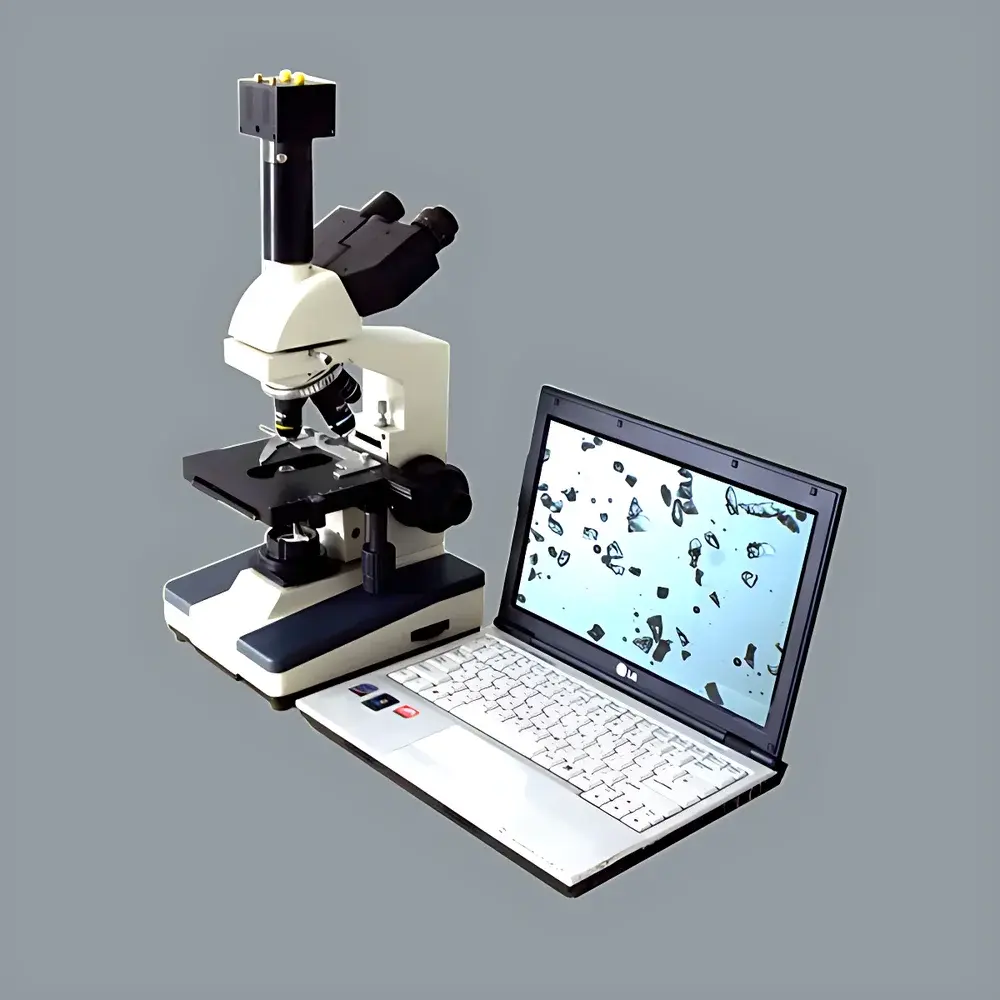
Winner99E Static Particle Image Analyzer by Jinan Winner (Micro-Nano Technology)
| Brand | Jinan Winner |
|---|---|
| Origin | Shandong, China |
| Manufacturer Type | Direct Manufacturer |
| Product Category | Domestic |
| Model | Winner99E |
| Price Range | USD 0–15,000 |
| Dispersion Method | Dry & Wet Dispersion |
| Instrument Type | Laboratory Static Image-Based Particle Analyzer |
| Measurement Range | 1–6000 µm |
| Repeatability | <3% (D50 of NIST-traceable standard reference materials) |
| Analysis Time per Sample | ~200 s |
| Compliance | ISO 13322-1:2014, GB/T 21649.1–2008 |
Overview
The Winner99E Static Particle Image Analyzer is a high-resolution, laboratory-grade instrument engineered for simultaneous quantitative analysis of particle size distribution and morphological characteristics—including sphericity, aspect ratio, convexity, surface area ratio, and circularity—based on static optical microscopy and digital image processing. Unlike dynamic light scattering or laser diffraction systems, the Winner99E employs a fixed-field imaging methodology: particles are immobilized on a slide or in a sedimented layer, then captured under controlled magnification using a precision optical microscope coupled with a progressive-scan CMOS camera. This approach provides direct visual validation of individual particles, enabling traceable morphometric quantification without reliance on scattering models or Mie theory assumptions. Designed for R&D laboratories, QC departments, and academic research groups working with irregular, anisotropic, or low-refractive-index particles, the system delivers metrologically grounded data compliant with ISO 13322-1:2014 (Microscopic image analysis — Part 1: Static image analysis methods) and GB/T 21649.1–2008 (Chinese national standard for particle image analysis).
Key Features
- Multi-magnification optical path: Equipped with long-working-distance plan achromatic objectives (4×, 10×, 40×, 60×, 100× oil immersion) and wide-field eyepieces (1×, 10×, 16×), supporting total magnifications from 4× to 5000× for scalable resolution across coarse and fine fractions.
- Adaptive binarization engine: Compensates for non-uniform illumination using real-time histogram-based thresholding, preserving edge fidelity and minimizing information loss in shadowed or overexposed regions.
- Automated agglomerate separation: Implements morphology-driven watershed segmentation combined with shape-aware contour splitting to resolve touching or overlapping particles—critical for powders with high aspect ratios or cohesive behavior.
- Seamless multi-field stitching: Aligns and merges up to 16 adjacent fields-of-view into a single composite image, increasing statistical population size (>5000 particles per analysis) while maintaining pixel-level geometric integrity.
- Full-parameter morphometric suite: Computes >12 shape descriptors per particle—including Feret diameter, projected area, perimeter, convex hull area, solidity, roundness, and aspect ratio—with batch export to CSV or Excel-compatible formats.
- Calibration traceability: Supports scale bar calibration via certified stage micrometer; scale units switch dynamically between nm, µm, and mm in software interface without recalibration.
Sample Compatibility & Compliance
The Winner99E accommodates both dry powders (e.g., metal alloys, ceramic precursors, pharmaceutical excipients) and wet-dispersed suspensions (e.g., colloidal silica, polymer emulsions, mineral slurries). Its dual-illumination design includes bottom-transmitted halogen/LED lighting for transparent or semi-transparent particles, and optional top-illuminated metallurgical epi-illumination with polarizing filters for opaque, reflective, or highly scattering samples (e.g., carbon black, graphite flakes, metallic pigments). All measurement protocols align with ISO 13322-1:2014 requirements for static image analysis—including minimum particle count thresholds (≥500 particles per distribution), field uniformity criteria, and operator-independent segmentation validation. The system supports GLP-compliant audit trails when integrated with secure network storage and user-access logging.
Software & Data Management
The proprietary WinIA software (v5.2+) provides a modular workflow: image acquisition → auto-stitching → adaptive preprocessing → particle detection → morphometric classification → statistical reporting. It features a task-oriented database architecture that enforces metadata tagging (sample ID, dispersion medium, operator, date/time stamp, objective used) and supports version-controlled report templates. Export options include ANSI-standard D10, D50, D90, and D100 values; frequency and cumulative distributions (by number, area, or volume-equivalent projection); and 12+ shape parameter histograms. Raw image datasets (.BMP/.JPG) and processed binary masks are archived with embedded EXIF metadata, ensuring full reproducibility. Software complies with FDA 21 CFR Part 11 requirements when deployed with electronic signature modules and role-based access controls.
Applications
The Winner99E serves as a primary characterization tool in sectors where particle geometry directly influences functional performance: catalyst development (pore accessibility vs. sphericity), battery electrode slurry formulation (conductive filler aspect ratio vs. conductivity), pharmaceutical powder flowability (roundness and convexity correlation), construction material grading (aggregate angularity index), and advanced ceramics processing (grain boundary prediction from grain shape metrics). It is routinely applied to crystalline APIs, abrasive grits, nanocomposite fillers, micronized pigments, and geological sediments—especially where laser diffraction fails due to multimodal shape distributions or refractive index ambiguity.
FAQ
What standards does the Winner99E comply with?
ISO 13322-1:2014 and GB/T 21649.1–2008 for static image analysis of particulate systems.
Can it analyze both dry and wet samples?
Yes—equipped with interchangeable dry-mount stages and liquid cell holders; optional epi-illumination enables analysis of opaque particles in suspension.
How is measurement repeatability validated?
Repeatability is verified using NIST-traceable glass microsphere standards; typical D50 CV is <2.5% across five independent preparations.
Does the software support regulatory compliance for QC labs?
Yes—WinIA supports 21 CFR Part 11 functionality (electronic signatures, audit trail, user permissions) when configured with enterprise IT infrastructure.
Is training provided for morphometric interpretation?
Jinan Winner offers application-specific workshops covering ISO-defined shape descriptors, statistical sampling strategy, and correlation of image-derived parameters to bulk property testing (e.g., flowability, packing density).



