
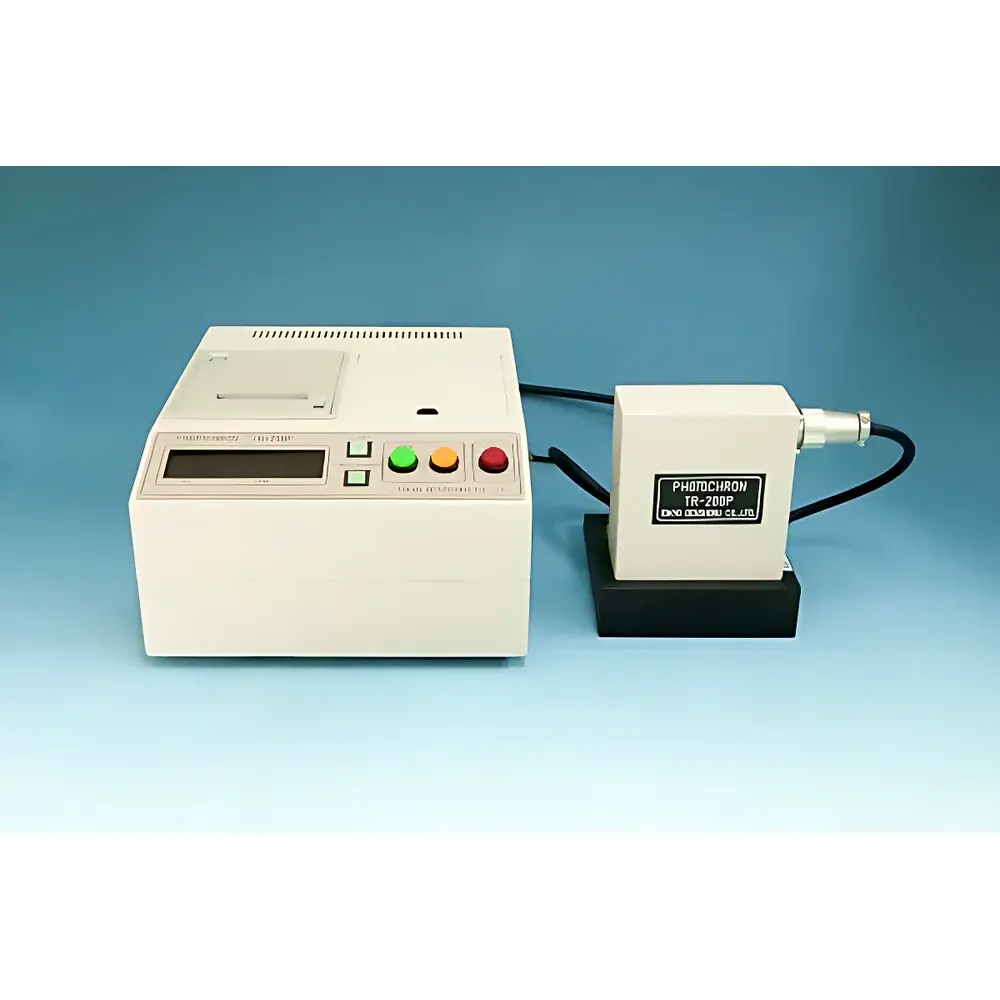
Wintree Photochron TR-200P Densitometer for Carbon Black Color Strength Measurement
| Brand | Wintree |
|---|---|
| Origin | Japan |
| Model | Photochron TR-200P |
| Product Type | Spectrophotometric Densitometer |
| Instrument Form Factor | Benchtop |
| Optical Geometry | 45°/0 (Annular Illumination, Normal Viewing) |
| Light Source | White LED |
| Spectral Range | 400–700 nm |
| Reflectance Measurement Range | 0.00–120.00% |
| Repeatability | ±1% |
| Compliance | ISO 5435:2017, JIS K6217-5:2010 |
| Interface | RS-232C |
| Display | LED Numeric Display |
| Printer | Thermal Printer |
| Calibration | Auto-standard CAL function |
| Dimensions (Main Unit) | 240 × 125 × 290 mm (W×H×D) |
| Detector Head Dimensions | 110 × 120 × 50 mm (W×H×D) |
Overview
The Wintree Photochron TR-200P is a dedicated benchtop densitometer engineered for the quantitative evaluation of color strength (blackness) in carbon black dispersions—primarily used in rubber compounding, pigment formulation, and quality control laboratories. Unlike general-purpose colorimeters or spectrophotometers, the TR-200P implements a fixed 45°/0 optical geometry optimized for diffuse reflectance measurement under standardized illumination conditions. This configuration eliminates directional gloss interference and ensures high reproducibility when assessing the light-absorbing capacity of carbon black samples on standardized white substrates (e.g., ceramic tiles or calibrated reference cards). The instrument operates on the principle that blackness correlates directly with the logarithmic inverse of diffuse reflectance (R), calculated as Blackness = log10(100/R), where R is expressed as a percentage. Its white LED source provides stable, flicker-free output across the visible spectrum (400–700 nm), enabling consistent spectral weighting aligned with CIE photopic luminosity function V(λ). Designed for routine industrial testing rather than full spectral analysis, the TR-200P delivers traceable, repeatable blackness values compliant with international standards governing carbon black performance evaluation.
Key Features
- Benchtop architecture with integrated thermal printer for immediate hard-copy output of measurement results and calibration logs
- 45°/0 annular illumination geometry conforming to ISO 5435:2017 and JIS K6217-5:2010 requirements for carbon black color strength testing
- Stable white LED light source with no warm-up time, minimal spectral drift, and >50,000-hour operational lifetime
- Dedicated silicon photodiode detector with linear response across 0.00–120.00% reflectance range, supporting both low-reflectance (high-blackness) and over-white reference conditions
- Onboard zero adjustment (ZERO), automatic standard calibration (CAL), and single-button measurement (PRINTO) for operator efficiency and procedural consistency
- RS-232C serial interface enabling bidirectional communication with LIMS or QA databases for automated data logging and audit trail generation
- LED numeric display with dual-range resolution: 0.01% for reflectance below 10%, and 0.1% above 10%, ensuring precision across the full dynamic range
Sample Compatibility & Compliance
The TR-200P is validated for use with pressed carbon black pellets, masterbatch films, and rubber sheet specimens prepared per ISO 5435 Annex A or JIS K6217-5 Clause 6. Sample surface flatness, uniformity, and absence of surface contamination are prerequisites for valid measurement. The instrument does not support liquid suspensions or powder beds without prior compression into standardized discs. All measurements require a certified white reference tile (e.g., BaSO4-coated ceramic) for baseline calibration. Regulatory alignment includes full traceability to ISO/IEC 17025-accredited calibration procedures; its design supports GLP-compliant workflows through mandatory calibration timestamping, user ID logging (via external system integration), and non-erasable print records. While not FDA 21 CFR Part 11–certified out-of-the-box, its RS-232C interface enables integration with validated electronic record systems meeting Part 11 requirements for signature, audit trail, and data integrity controls.
Software & Data Management
The TR-200P operates as a standalone instrument with embedded firmware—no host PC software is required for basic operation. However, its RS-232C port supports ASCII-based command protocols (e.g., “MEAS?”, “CAL”, “PRINT”) compatible with custom LabVIEW, Python, or MATLAB scripts for automated batch testing. Third-party LIMS vendors provide preconfigured drivers for seamless ingestion of reflectance values, blackness indices, timestamps, and operator IDs into enterprise QA databases. All printed reports include measurement date/time, calibration status flag, reference tile ID, and instrument serial number—elements essential for internal audit readiness. Firmware updates (if issued) are delivered via manufacturer-provided EPROM replacement kits; no cloud connectivity or remote firmware update capability is implemented, preserving network security in regulated environments.
Applications
- Quality assurance of carbon black grades in rubber manufacturing (tire treads, conveyor belts, seals)
- Batch-to-batch consistency verification during pigment production and masterbatch blending
- R&D screening of surface-treated or oxidized carbon blacks for enhanced dispersion stability
- Validation of mixing efficiency in two-roll mills or internal mixers via blackness trend analysis
- Supplier qualification testing against contractual blackness tolerances (e.g., ±0.5 blackness units)
- Correlation studies between blackness values and physical properties such as UV resistance, electrical conductivity, and tensile reinforcement
FAQ
What is the primary metrological principle behind blackness measurement on the TR-200P?
Blackness is derived from diffuse reflectance measured at 45°/0 geometry using a white LED source; it is calculated as log10(100/R), where R is the percentage reflectance relative to a BaSO4 reference standard.
Does the TR-200P comply with ASTM standards?
No—its design and validation are specifically aligned with ISO 5435:2017 and JIS K6217-5:2010; ASTM D3265 covers carbon black but specifies different instrumentation and sample preparation protocols.
Can the instrument measure colored pigments other than carbon black?
It is not recommended; the blackness algorithm and calibration are optimized for high-absorption black materials and lack chromaticity compensation for hue-dependent reflectance anomalies.
Is periodic recalibration required, and how is it performed?
Yes—daily zero adjustment and weekly standard calibration using the supplied white reference tile are required; full recalibration by an accredited service lab is advised every 12 months or after mechanical impact.
What environmental conditions affect measurement stability?
Ambient temperature fluctuations >±2°C/hour or relative humidity >80% may induce drift in LED output and detector responsivity; operation within 15–30°C and 30–60% RH is specified for optimal repeatability.






