
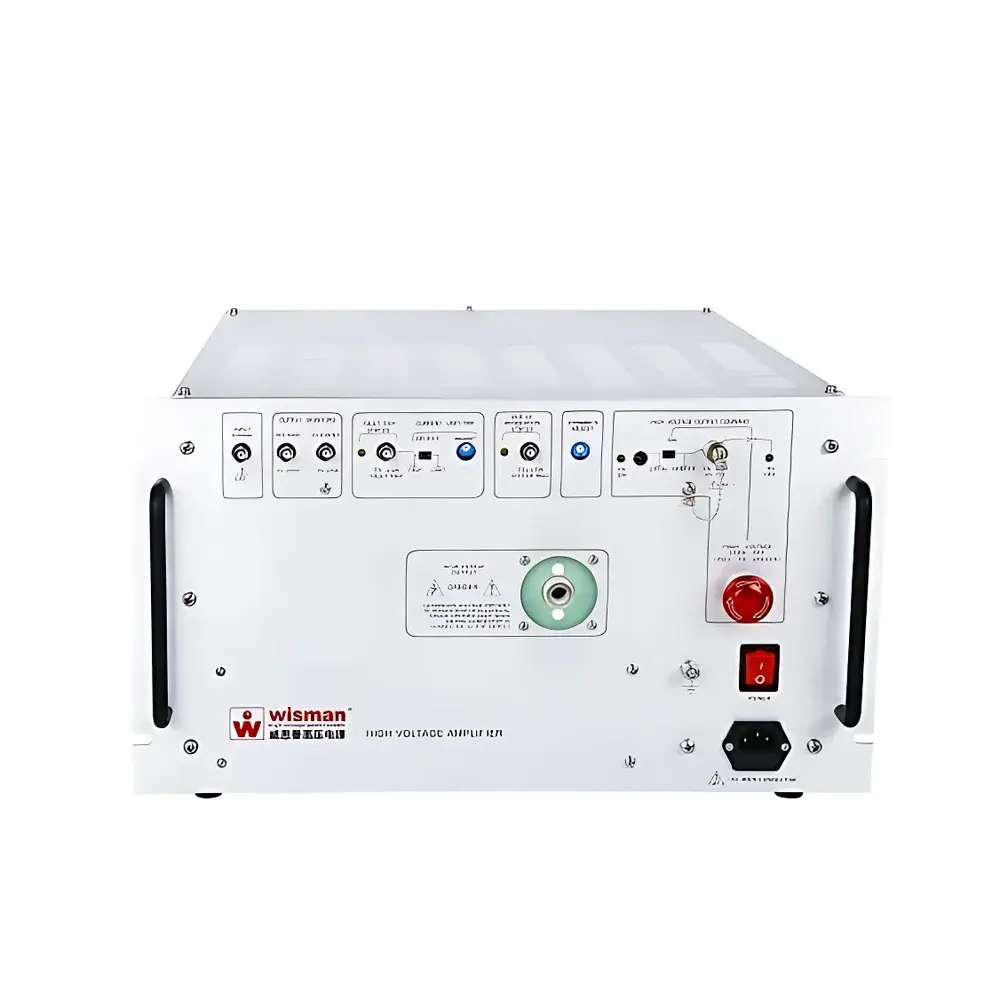
Wisman AML ±7.5 kV / 400 W High-Voltage Power Amplifier
| Brand | Wisman |
|---|---|
| Origin | Shaanxi, China |
| Model | AML |
| Output Voltage | ±7.5 kV DC or AC peak |
| Output Power | 400 W |
| Output Current | ±50 mA DC or AC peak |
| Gain | 750 V/V (DC) |
| Gain Accuracy | < 0.1% of full scale |
| Slew Rate | >1000 V/µs (10%–90%) |
| Small-Signal Bandwidth | DC to >75 kHz (−3 dB) |
| Large-Signal Bandwidth | DC to >15 kHz (1% THD) |
| Output Noise | <0.5 V RMS (voltage), <10 mV RMS (voltage monitor), <30 mV RMS (current monitor) |
| Stability | <50 ppm/hr (non-cumulative) |
| Temperature Coefficient | <25 ppm/°C |
| Input Impedance | 25 kΩ |
| Display Resolution | 1000:1 (voltage), 1 V/12 mA (current) |
| Dimensions | 264 mm H × 483 mm W × 635 mm D |
| Weight | 25 kg |
| Operating Temp | 0–40 °C |
| Humidity | ≤85% RH, non-condensing |
| Altitude | ≤2000 m |
| Compliance | Designed for integration into ISO/IEC 17025-compliant labs and GLP/GMP-adjacent instrumentation environments |
| Primary Application | Mass Spectrometry Biasing, Electrostatic Actuation, Dielectric Barrier Discharge Systems |
Overview
The Wisman AML ±7.5 kV / 400 W High-Voltage Power Amplifier is a precision-engineered, four-quadrant solid-state amplifier designed for demanding scientific and industrial applications requiring stable, low-noise, high-slew-rate bipolar high-voltage excitation. Based on proven high-voltage semiconductor architecture and fully insulated encapsulation, the AML operates across DC to >15 kHz (large-signal, 1% THD) and DC to >75 kHz (small-signal, −3 dB), delivering exceptional fidelity under reactive, capacitive, or highly dynamic load conditions. Its core function is to accurately amplify low-voltage analog control signals—typically from lock-in amplifiers, arbitrary waveform generators, or feedback controllers—into precisely regulated, programmable high-voltage outputs suitable for electrostatic manipulation, field-assisted material characterization, and biasing in vacuum-based analytical instruments such as time-of-flight or quadrupole mass spectrometers.
Key Features
- Four-Quadrant Active Output: Capable of sourcing and sinking current continuously across the full ±7.5 kV output range, enabling true bidirectional energy flow essential for driving high-capacitance loads (e.g., piezoelectric actuators, electro-optic crystals) without voltage droop or phase lag.
- Ultra-High Slew Rate & Bandwidth: >1000 V/µs (10–90%) and large-signal bandwidth exceeding 15 kHz ensure faithful reproduction of fast transient waveforms—including pulsed DC, ramped bias, and modulated RF envelopes—critical for ion trajectory control and real-time polarization studies.
- Low Output Noise & High DC Stability: Voltage noise <0.5 VRMS, drift <50 ppm/hr (non-cumulative), and temperature coefficient <25 ppm/°C support long-duration, high-resolution experiments where baseline integrity directly impacts signal-to-noise ratio (e.g., electrophoretic mobility measurements or ferroelectric hysteresis loop acquisition).
- Integrated Monitoring & Protection: Dual high-fidelity analog monitors (voltage and current) with calibrated scaling (1000:1 and 1 V/12 mA respectively), combined with active short-circuit protection and thermal foldback, enable closed-loop system integration and automated fault logging compatible with SCADA or LabVIEW-based supervision.
- Robust Solid-State Architecture: Fully encapsulated, transformerless design eliminates oil-filled components or vacuum tubes, ensuring maintenance-free operation, EMI resilience, and compatibility with cleanroom and controlled-environment laboratories.
Sample Compatibility & Compliance
The AML is routinely deployed in configurations requiring strict electrical safety and metrological traceability. Its output stage meets IEC 61010-1 (Measurement Category II, Pollution Degree 2) requirements for laboratory equipment. While not certified to UL/CSA as a standalone end-product, it is engineered for OEM integration into systems compliant with ISO/IEC 17025 calibration frameworks and aligned with FDA 21 CFR Part 11 data integrity expectations when paired with audit-trail-enabled software controllers. The amplifier supports biasing of mass spectrometer ion optics, dielectric barrier discharge reactors, electrospinning nozzles, and ferroelectric test fixtures—all under ambient lab conditions (0–40 °C, ≤85% RH, ≤2000 m altitude). Its 47 Ω output impedance ensures predictable termination matching with standard coaxial cabling used in HV instrumentation interfaces.
Software & Data Management
The AML operates as an analog gain stage and does not include embedded firmware or digital communication ports. It is intended for use with external programmable sources (e.g., Keysight 33600A series, Zurich Instruments HF2LI) and data acquisition systems supporting analog voltage/current monitoring inputs. For GLP/GMP-aligned workflows, users integrate its analog monitors into validated DAQ platforms (e.g., National Instruments PXIe-6363 with calibrated input modules) to capture time-stamped, audit-trail-ready voltage and current traces. All front-panel indicators and meter outputs are calibrated per manufacturer’s specification sheet (traceable to NIST-traceable references), and calibration certificates are available upon request for IQ/OQ documentation packages.
Applications
- Mass spectrometry: Ion lens and detector biasing in TOF, Q-TOF, and Orbitrap platforms
- Electrostatic beam steering and particle acceleration in accelerator physics test benches
- Dielectric spectroscopy and polarization hysteresis measurement of ferroelectrics and relaxors
- Electro-optic modulation using LiNbO₃ or BBO crystals under high-field DC or AC+DC bias
- Atmospheric pressure plasma generation via dielectric barrier discharge (DBD) electrode excitation
- Electrophoretic separation systems requiring precise, low-drift field gradients
- Current rheological fluid actuation and electrostatic levitation experiments
FAQ
Is the AML compatible with vacuum chamber feedthroughs?
Yes—its 47 Ω output impedance and low-noise performance make it suitable for integration with SHV or MHV feedthroughs rated for ≥10 kV; proper shielding and grounding per IEEE Std 1100 must be observed.
Can the AML be used in closed-loop feedback systems?
Yes—its four-quadrant capability, fast slew rate, and low phase shift below 10 kHz allow stable operation with external PID controllers monitoring the built-in voltage/current outputs.
Does Wisman provide calibration documentation?
Calibration reports (including gain linearity, offset, noise, and stability test data) are available as optional deliverables with traceability to national standards; contact technical support for certificate specifications.
What safety interlocks are supported?
The unit includes a hardware-enable TTL input (active-low) and chassis ground sense circuitry; integration with external emergency stop chains or door interlock relays is achieved via dry-contact interface.
Is remote programming possible?
No native digital interface exists; however, analog programming (±10 V input, 750 V/V gain) enables seamless integration with any function generator or DAC-equipped controller meeting the 25 kΩ input impedance requirement.



