
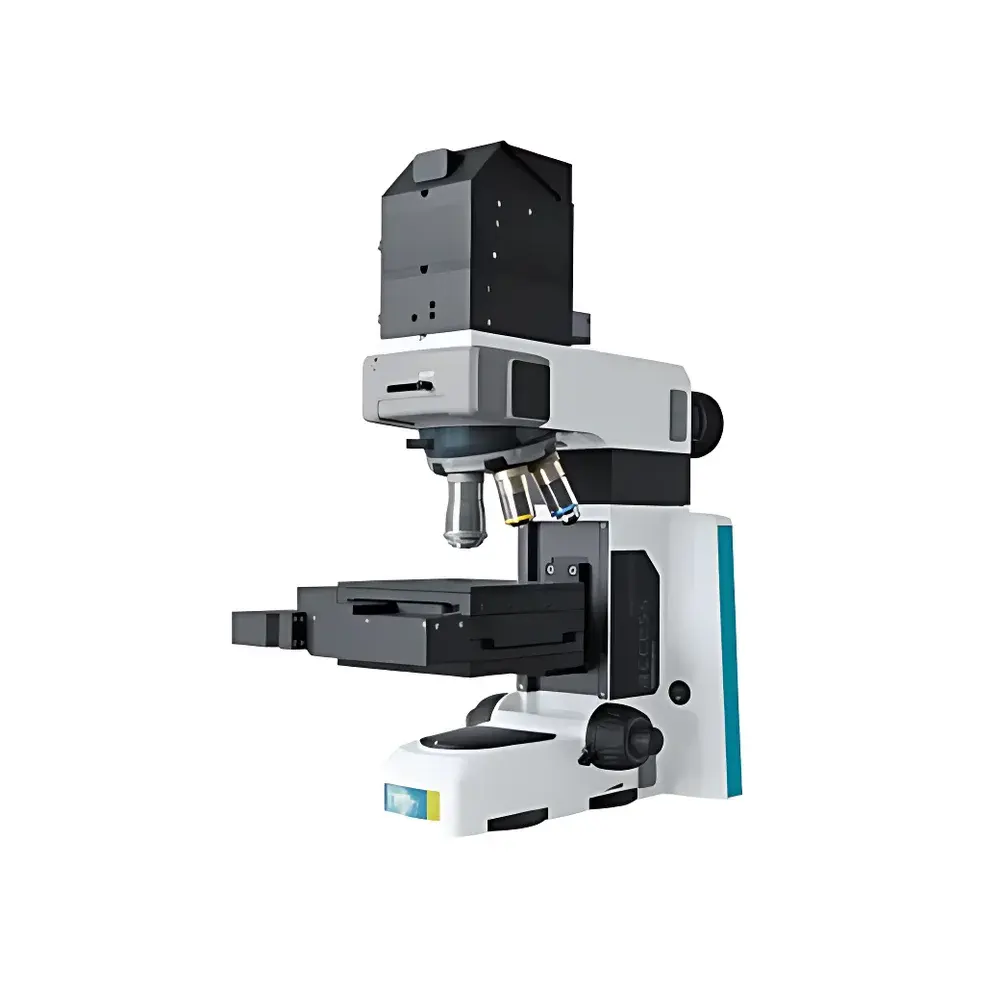
WITec Alpha 300 Access Confocal Raman Microscope
| Brand | WITec |
|---|---|
| Origin | Germany |
| Manufacturer Type | Authorized Distributor |
| Origin Category | Imported |
| Model | Alpha 300 Access |
| Instrument Type | Confocal Micro-Raman Spectrometer |
| Spectral Range | 90–9000 cm⁻¹ |
| Spectral Resolution | ≤0.2 cm⁻¹ |
| Spatial Resolution | Lateral 350 nm, Axial 800 nm |
| Minimum Wavenumber | 10 cm⁻¹ |
| Spectral Reproducibility | ≤±0.02 cm⁻¹ |
Overview
The WITec Alpha 300 Access Confocal Raman Microscope is a research-grade, modular confocal Raman imaging system engineered for high-fidelity single-point spectroscopy and hyperspectral mapping at sub-micron spatial resolution. Built upon the optical and mechanical foundation of a Zeiss upright microscope, it implements true confocal point-scan architecture—where excitation laser focus, confocal pinhole, and detector are aligned in three-dimensional space—to reject out-of-focus signal and deliver depth-resolved chemical contrast. The system operates across a broad spectral window (90–9000 cm⁻¹), with calibrated wavenumber stability better than ±0.02 cm⁻¹ over multi-hour acquisitions—critical for quantitative comparison across time-series or multi-sample studies. Its core optical design prioritizes photon throughput: the UHTS 300 spectrometer (standard configuration for 532 nm and 830 nm lasers) integrates high-efficiency transmission gratings and back-illuminated CCD detection to maximize signal-to-noise ratio without compromising spectral fidelity. Unlike fixed-configuration benchtop Raman systems, the Alpha 300 Access is architecturally open—designed from inception to accept future hardware expansions including motorized XYZ scanning stages, atomic force microscopy (AFM) integration, tip-enhanced Raman spectroscopy (TERS), and near-field optical modules—all sharing common control firmware and data structure.
Key Features
- True confocal geometry with adjustable pinhole and high-numerical-aperture objective coupling for depth sectioning and 3D chemical tomography
- Zeiss-based optical platform ensuring mechanical rigidity, thermal stability, and long-term alignment retention—essential for extended mapping sessions
- UHTS 300 high-throughput spectrometer with selectable grating options, optimized for visible to NIR excitation (e.g., 532 nm, 633 nm, 785 nm, 830 nm)
- Sub-diffraction lateral resolution (350 nm @ 532 nm) and axial resolution of 800 nm—enabling nanoscale domain analysis in layered materials, pharmaceutical formulations, and 2D crystals
- Modular laser interface supporting up to four independently switchable lasers, including optional polarization control and wavelength-stabilized diode sources
- Integrated LED Köhler illumination and high-resolution sample viewing camera for precise ROI selection and correlative optical/Raman imaging
- Firmware-level synchronization between stage motion, laser shutter, spectrometer acquisition, and detector readout—ensuring pixel-accurate spectral maps
Sample Compatibility & Compliance
The Alpha 300 Access accommodates standard microscope slides, silicon wafers, metal substrates, polymer films, biological tissue sections (fixed or cryo-mounted), and encapsulated microfluidic devices. Sample height tolerance extends up to 25 mm with optional long-working-distance objectives. All optical paths comply with ISO 17025-relevant traceability protocols for spectral calibration; factory-certified NIST-traceable polystyrene and silicon standards are included for routine wavenumber and intensity validation. System software supports audit trail logging per FDA 21 CFR Part 11 requirements when configured with user authentication and electronic signature modules. Data files adhere to HDF5 format with embedded metadata (excitation wavelength, objective magnification, integration time, grating groove density, pinhole size), ensuring full experimental reproducibility and third-party interoperability.
Software & Data Management
Control and analysis are unified within WITec’s proprietary Project Series software—a C++-based platform supporting real-time spectrum preview, automated focus optimization, and batch processing of large hyperspectral datasets (>10⁶ spectra). Key capabilities include multivariate curve resolution (MCR), principal component analysis (PCA), cluster analysis, and false-color chemical mapping with overlay on optical images. Raw spectral data are stored in vendor-neutral HDF5 containers, enabling direct import into Python (via h5py), MATLAB, or commercial chemometrics packages. Software architecture supports GLP/GMP workflows through configurable user roles, change logs, and versioned analysis scripts. Optional add-ons include automated particle identification (for pharmaceutical API distribution analysis) and stress/strain tensor mapping derived from Raman peak shifts in crystalline lattices.
Applications
- Pharmaceutical solid dosage form characterization: mapping active pharmaceutical ingredient (API) distribution, polymorph identification, and excipient interaction in transdermal gels or tablet cross-sections
- 2D material science: layer-count determination in graphene, strain profiling in MoS₂ heterostructures, and defect density quantification via D/G band ratios
- Microplastics identification and polymer typing in environmental samples using library-matching against >1,200 reference spectra
- Correlative AFM-Raman studies of nanomechanical properties and local chemical composition in battery electrode composites
- In situ electrochemical Raman monitoring of electrode/electrolyte interfaces under potentiostatic control (with compatible electrochemical cell accessories)
- Biomineralization studies: spatially resolved carbonate/phosphate stoichiometry in bone or dental enamel sections
FAQ
Can the Alpha 300 Access be upgraded to full AFM-Raman functionality?
Yes—its modular base design allows seamless integration of WITec’s alpha300 RA or TrueSurface AFM modules without replacing the optical frame or control electronics.
Is spectral calibration traceable to international standards?
Yes—each system ships with NIST-traceable polystyrene and crystalline silicon standards; calibration certificates document uncertainty budgets per ISO/IEC 17025 Annex A.
What file formats are supported for data export?
HDF5 (native), ASCII CSV, and JCAMP-DX; spectral libraries may be exported as .spc or .txt for third-party chemometric tools.
Does the system support polarization-resolved Raman measurements?
Yes—optional half-wave plates and polarizing beam splitters can be inserted into the excitation and collection paths for tensor component analysis.
How is long-term measurement stability ensured during overnight mapping?
Thermal drift compensation is achieved via active stage feedback loops and reference-beam stabilization; typical positional drift remains below 50 nm over 12 hours at 22 °C ambient.
Related Products





