
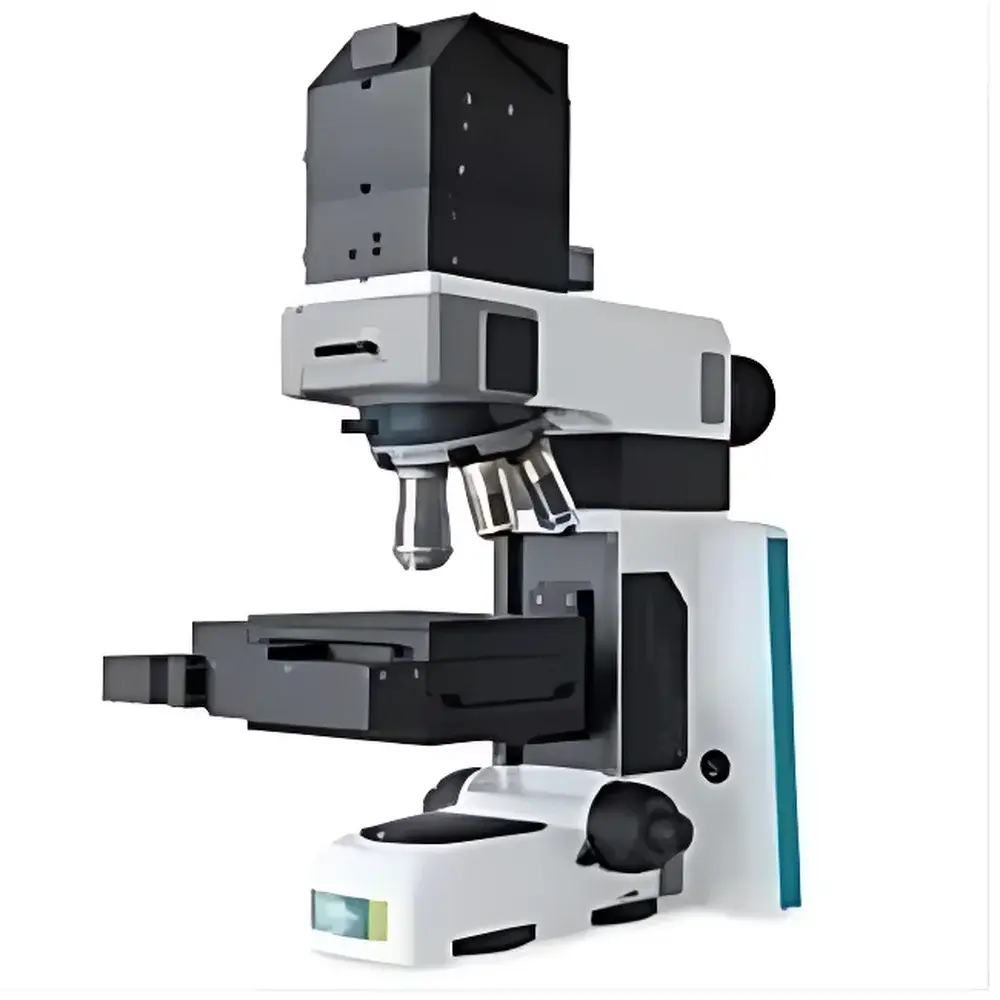
WITec alpha300 access Confocal Raman Imaging Spectrometer
| Brand | Oxford Instruments |
|---|---|
| Origin | Germany |
| Model | alpha300 access |
| Instrument Type | Confocal Micro-Raman Spectrometer |
| Spectral Range | 90–9000 cm⁻¹ |
| Spectral Resolution | ≤0.2 cm⁻¹ |
| Spatial Resolution | Lateral 350 nm, Axial 800 nm |
| Minimum Wavenumber | 10 cm⁻¹ |
| Spectral Reproducibility | ≤±0.02 cm⁻¹ |
Overview
The WITec alpha300 access is a high-performance confocal micro-Raman imaging spectrometer engineered for quantitative chemical identification and spatially resolved molecular characterization at sub-micrometer scale. Based on true confocal point-scan architecture—where excitation and detection pathways share identical optical axes—the system delivers intrinsic optical sectioning capability, enabling depth-resolved spectroscopic mapping without mechanical Z-stacking artifacts. Its core optical design integrates a high-numerical-aperture (NA) research-grade microscope with a back-illuminated, deep-depletion CCD detector and WITec’s proprietary UHTS (Ultra-High Throughput Spectrograph) platform. This combination ensures exceptional photon collection efficiency across the full 90–9000 cm⁻¹ spectral window while maintaining ≤0.2 cm⁻¹ resolution—critical for distinguishing closely spaced vibrational modes in polymorphs, stress-induced shifts in 2D materials, or subtle conformational changes in biomolecules. The system operates with excitation wavelengths commonly at 532 nm, 633 nm, or 785 nm (laser options configurable per application), and supports low-wavenumber extension down to 10 cm⁻¹—enabling analysis of lattice modes, acoustic phonons, and intermolecular vibrations inaccessible to conventional Raman platforms.
Key Features
- True confocal point-scanning architecture with motorized XYZ piezo stage for diffraction-limited spatial resolution (lateral: 350 nm; axial: 800 nm)
- UHTS spectrograph with optimized grating selection and thermoelectric cooling (−60 °C) for maximum signal-to-noise ratio and long-term spectral stability
- Spectral reproducibility of ≤±0.02 cm⁻¹—validated via internal neon calibration line tracking—ensuring traceable wavenumber accuracy across multi-day experiments
- Modular optical design compliant with ISO/IEC 17025 traceability requirements; all optical components sourced from certified German manufacturers
- Integrated auto-alignment routines and real-time focus stabilization (via objective-mounted position sensor) for unattended overnight hyperspectral acquisition
- Future-ready hardware interface: compatible with WITec’s alpha series upgrade path—including tip-enhanced Raman spectroscopy (TERS), time-resolved fluorescence lifetime imaging (FLIM), and correlative AFM-Raman modules
Sample Compatibility & Compliance
The alpha300 access accommodates diverse sample geometries—from standard 1″ × 3″ microscope slides and silicon wafers to irregularly shaped geological specimens, polymer films, biological tissue sections (frozen or FFPE), and battery electrode cross-sections. Its open-sample chamber design allows integration of environmental stages (temperature-controlled from −190 °C to +600 °C; humidity- and gas-controlled variants available). All measurement protocols adhere to ASTM E1840 (Standard Guide for Raman Shift Standards), ISO 8655-7 (volumetric calibration for microfluidic coupling), and USP (Raman spectroscopy for pharmaceutical solid-state analysis). Data acquisition workflows support 21 CFR Part 11-compliant electronic signatures and audit trails when deployed under validated GxP environments.
Software & Data Management
Controlled by WITec Project PLUS software—a Windows-based, multi-threaded platform supporting real-time spectral preview, automated multivariate analysis (PCA, cluster analysis, spectral unmixing), and batch processing of terabyte-scale hyperspectral datasets. Raw data are stored in vendor-neutral HDF5 format with embedded metadata (excitation wavelength, grating position, integration time, objective NA, ambient temperature/humidity). The software includes built-in libraries compliant with NIST RM 8010 (Raman shift standards) and enables export to ASCII, CSV, or JCAMP-DX for third-party chemometric tools (e.g., MATLAB, Python scikit-learn, Unscrambler X). Full version control, user role management, and encrypted database logging satisfy GLP/GMP documentation requirements.
Applications
- Pharmaceutical development: Polymorph screening, API distribution mapping in tablets, counterfeit drug detection
- Materials science: Strain mapping in graphene and transition metal dichalcogenides, phase segregation in perovskite solar cells, carbon nanotube chirality assignment
- Geosciences: Mineral identification in thin sections, fluid inclusion analysis, metamorphic grade assessment
- Life sciences: Label-free cellular component localization (lipids, proteins, nucleic acids), amyloid fibril morphology correlation, single-cell metabolic profiling
- Microelectronics: Contamination identification on wafer surfaces, stress evaluation in SiGe heterostructures, gate oxide integrity verification
FAQ
Is the alpha300 access suitable for routine QC laboratories requiring regulatory compliance?
Yes—its hardware calibration traceability, software audit trail functionality, and documented validation protocols align with ISO/IEC 17025 and FDA 21 CFR Part 11 requirements.
Can the system perform fast mapping without compromising spectral quality?
Yes—using WITec’s TrueMatch™ real-time spectrum matching algorithm and high-speed piezo scanning (up to 100 µm/s), users achieve 1 µm² pixel resolution over 100 × 100 µm fields in under 15 minutes while retaining full spectral fidelity.
What laser safety class does the system operate under?
All integrated laser modules comply with IEC 60825-1:2014 Class 3B or Class 1 (enclosed configuration), with interlocked access doors and automatic beam shuttering during stage movement.
Does the system support external detectors or third-party spectrometers?
No—the alpha300 access uses a fully integrated UHTS spectrograph and CCD detector optimized for confocal Raman performance; however, it provides analog/digital TTL outputs for synchronization with external equipment (e.g., pump-probe lasers, TCSPC modules).





