
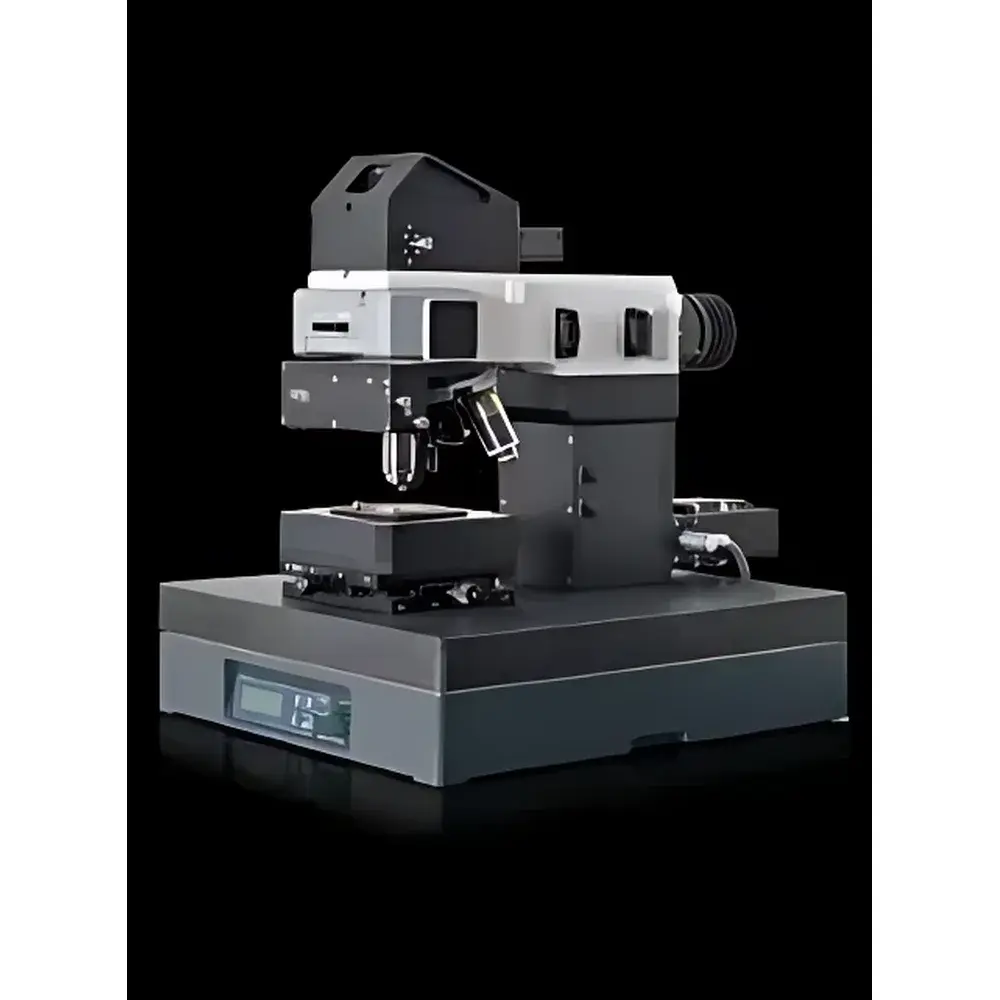
WITec alpha300 A Atomic Force Microscope
| Brand | Oxford Instruments |
|---|---|
| Origin | Germany |
| Model | alpha300 A |
| Instrument Type | Materials-Focused AFM |
| Position Detection Noise | ≤0.5 nm |
| Maximum Sample Diameter | 120 mm |
| Piezo Scanner Travel Range (X/Y) | ≤100 µm |
| Integrated Microscopy | Research-Grade Optical Microscope with Brightfield, Darkfield, Polarization & Fluorescence Capabilities |
| Scanning Technology | TrueScan™ Capacitive Feedback-Controlled Stage |
Overview
The WITec alpha300 A Atomic Force Microscope is a fully integrated, materials-science-optimized AFM platform engineered for high-precision nanoscale topographic and mechanical characterization in conjunction with correlative optical microscopy. Unlike conventional standalone AFMs, the alpha300 A embeds a research-grade upright optical microscope directly into the AFM head architecture—enabling real-time, diffraction-limited optical observation of both sample surface and cantilever tip during operation. Its measurement principle relies on laser beam deflection detection from a microfabricated cantilever, with position-sensitive photodetector feedback enabling sub-nanometer vertical resolution. The system operates under ambient or inert gas environments and is designed for reproducible quantitative imaging, force spectroscopy, and nanomechanical mapping across heterogeneous solid-state samples—including thin films, polymers, ceramics, 2D materials, and functional coatings.
Key Features
- TrueScan™ capacitive feedback-controlled piezoelectric scanner delivering linear, hysteresis-free motion over the full 100 µm × 100 µm lateral range, ensuring traceable spatial fidelity without post-scan correction algorithms.
- Integrated optical microscope with motorized turret supporting rapid switching between brightfield, darkfield, polarization contrast, and fluorescence imaging modes—facilitating precise region-of-interest (ROI) selection prior to AFM acquisition.
- Direct optical access to the cantilever–sample interaction zone via high-numerical-aperture (NA) objective lenses, enabling visual alignment of probe tips with sub-micron accuracy and real-time monitoring of tip–surface contact events.
- Low-noise position detection system with ≤0.5 nm RMS thermal noise floor in Z-direction, optimized for high-stability tapping mode, contact mode, and force-distance curve acquisition.
- Modular sample stage accommodating specimens up to 120 mm in diameter, compatible with standard Petri dishes, silicon wafers, glass slides, and custom substrates—designed for ease of loading and repeatable positioning.
- Robust mechanical architecture with active vibration isolation and acoustic shielding, meeting ISO 25178-6 requirements for areal surface texture measurement stability.
Sample Compatibility & Compliance
The alpha300 A supports a broad spectrum of non-volatile, solid-phase materials commonly encountered in academic and industrial R&D laboratories. Compatible samples include conductive and insulating thin films (e.g., ITO, SiO₂, h-BN), polymer blends, biological scaffolds (dehydrated or air-dried), metal oxides, perovskite crystals, and nanostructured composites. No vacuum requirement enables rapid turnaround between samples and eliminates beam-induced damage risks associated with electron-beam techniques. The system complies with ISO/IEC 17025 calibration traceability frameworks when used with certified reference standards (e.g., NIST SRM 2461, 2462). It supports GLP-compliant documentation workflows through audit-trail-enabled software logging and meets essential criteria for ISO 9001 quality management system integration in analytical service labs.
Software & Data Management
Control and analysis are performed using WITec’s proprietary Project Suite software, a modular platform supporting instrument control, multi-modal data fusion, batch processing, and standardized reporting. All raw AFM images, force curves, and optical metadata are stored in vendor-neutral HDF5 format with embedded experimental parameters (scan size, setpoint, gain, filter settings, timestamp, user ID). The software implements FDA 21 CFR Part 11–compliant electronic signature functionality, including role-based access control, automated audit trails, and immutable data archiving. Export options include TIFF, PNG, ASCII, and MSA-compatible formats for third-party analysis (Gwyddion, MountainsSPIP, MATLAB). Automated scripting via Python API enables integration into automated metrology pipelines and high-throughput screening protocols.
Applications
- Nanoscale morphology mapping of semiconductor gate stacks and dielectric layers for process development and failure analysis.
- Mechanical property profiling (elastic modulus, adhesion, deformation) of polymer electrolytes in solid-state battery research.
- Topographic and phase contrast imaging of graphene domains and transition metal dichalcogenide monolayers.
- Correlative analysis of microphase-separated block copolymers combining fluorescence labeling with nanomechanical stiffness mapping.
- Surface roughness quantification per ISO 25178-2 for optical coating qualification and tribological interface assessment.
- Force spectroscopy-based quantification of single-molecule binding kinetics on functionalized surfaces under ambient conditions.
FAQ
Does the alpha300 A require ultra-high vacuum or cryogenic operation?
No—it is designed for ambient-air or controlled-atmosphere operation; no vacuum pumps or liquid nitrogen cooling are necessary.
Can optical fluorescence imaging be performed simultaneously with AFM scanning?
Yes, via time-synchronized acquisition using external light sources and EMCCD or sCMOS detectors coupled to the microscope port.
Is the TrueScan™ scanner compatible with fast-scan AFM modes such as high-speed tapping?
The scanner is optimized for high-fidelity static and quasi-static imaging; high-speed modes (>1 Hz frame rate) require optional resonant scanners not included in the base alpha300 A configuration.
What calibration standards are recommended for routine performance verification?
NIST-traceable step-height standards (e.g., Veeco TGZ3, NT-MDT SQM series) and pitch standards (e.g., SPI 100 nm line grating) are routinely employed for Z- and XY-axis validation.
How is data integrity ensured during long-duration force-volume mapping experiments?
Project Suite enforces automatic checksum generation, periodic backup snapshots, and hardware-triggered emergency pause on signal loss—ensuring recoverable interruption handling per ISO/IEC 17025 clause 7.7.





