
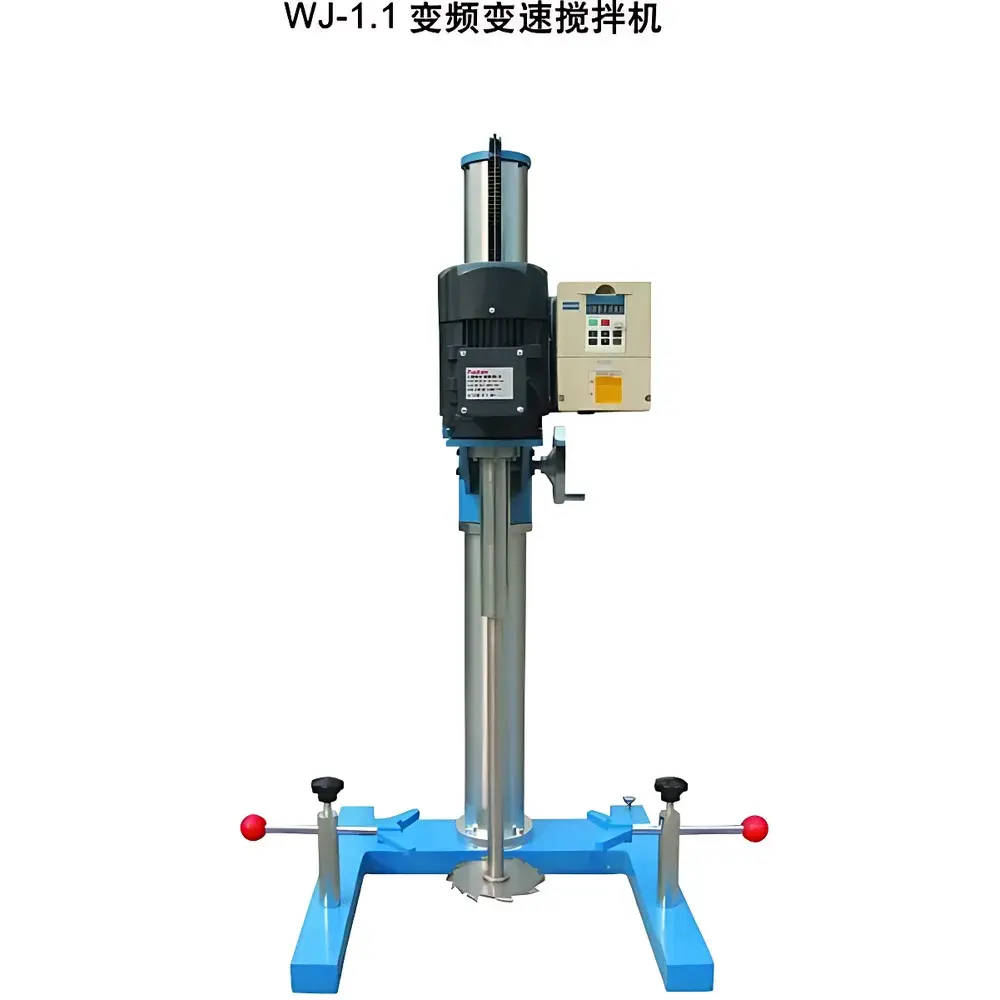
WJ-1.1 Multi-Function Stirring & Dispersion System
| Motor Model | 102-12 |
|---|---|
| Power | 1.1 kW |
| Speed Control | Variable-Frequency Drive (VFD), 0–3000 rpm (no-load) |
| Display | Digital RPM readout |
| Impeller/Disk Diameter | Ø150 mm |
| Vertical Travel | 360 mm |
| Dimensions (W×D×H) | 570 × 570 × 1200 mm |
| Weight | 70 kg |
Overview
The WJ-1.1 Multi-Function Stirring & Dispersion System is an integrated laboratory-scale mixing platform engineered for reproducible, scalable process development in pilot and small-batch production environments. It operates on the principle of high-shear mechanical dispersion combined with controlled axial agitation, enabling simultaneous homogenization, suspension stabilization, emulsification, and particle deagglomeration. Unlike single-mode stirrers or rotor-stator homogenizers, this system consolidates multiple unit operations—low-shear bulk mixing, medium-shear dispersion, and localized high-shear zone generation—into one mechanically robust architecture. Its design prioritizes operational flexibility across diverse rheological regimes, from low-viscosity aqueous solutions to moderately viscous polymer dispersions (up to ~10,000 mPa·s, depending on impeller geometry and fill level). The system is not intended for ultra-high-pressure homogenization or microfluidic-scale nanoparticle synthesis, but rather for applications where scalability from lab to pilot scale demands consistent shear history, precise speed control, and repeatable positioning.
Key Features
- Variable-frequency drive (VFD) motor control delivering continuous, stepless speed regulation from 0 to 3000 rpm under no-load conditions—with stable torque output maintained across the full range, critical for maintaining consistent energy input during viscosity transitions.
- Digital RPM display integrated into the control panel, providing real-time, non-contact rotational speed feedback with ±1 rpm resolution—eliminating reliance on external tachometers and supporting audit-ready documentation.
- Vertically adjustable column with 360 mm travel stroke, enabling precise immersion depth control for optimized power transfer and minimized vortex formation; locking mechanism ensures positional repeatability within ±0.5 mm.
- Modular impeller interface compatible with standard Ø150 mm dispersion disks, anchor paddles, propellers, and custom geometries—facilitating method transfer between mixing configurations without revalidation of mechanical setup.
- Compact footprint (570 × 570 mm base) and lightweight structural frame (70 kg total mass) allow deployment on standard laboratory benches or mobile carts—reducing infrastructure requirements while maintaining mechanical stability during high-torque operation.
- Low-noise motor assembly (<65 dB(A) at 1 m distance) and vibration-damped mounting minimize acoustic interference in shared lab spaces and support long-duration unattended runs under GLP-compliant monitoring protocols.
Sample Compatibility & Compliance
The WJ-1.1 accommodates sample volumes from 500 mL to 20 L in standard jacketed or non-jacketed glass/reactor vessels (e.g., DIN 28120 or ASTM D1298-compliant containers). It supports Newtonian and mildly non-Newtonian fluids, including pigment dispersions, pharmaceutical suspensions, battery electrode slurries, and cosmetic emulsions. While not certified to IEC 61000-6-2/4 or ATEX standards, its electrical components conform to CE marking requirements for industrial equipment (2014/30/EU EMC Directive and 2014/35/EU Low Voltage Directive). The system is routinely deployed in facilities operating under ISO/IEC 17025-accredited testing workflows and supports traceability through manual log entries aligned with FDA 21 CFR Part 11 Annex 11 principles when paired with validated electronic record systems.
Software & Data Management
The WJ-1.1 operates via a dedicated VFD controller with local keypad interface; it does not include embedded firmware or network connectivity. However, analog 0–10 V or 4–20 mA output signals are available for integration with third-party SCADA, PLC, or LIMS platforms—enabling time-stamped RPM logging, start/stop event capture, and trend analysis. Users may configure batch-specific speed profiles (e.g., ramp-up to 1200 rpm over 60 s, hold for 180 s, then ramp down) using external programmable logic controllers. All operational parameters—including total run time, cumulative motor hours, and thermal overload events—are retained in non-volatile memory for maintenance scheduling and regulatory review.
Applications
- Pre-formulation studies of colloidal suspensions in pharmaceutical development (e.g., nanocrystal stabilization, API wet milling pre-dispersion).
- Rheological conditioning of cathode/anode slurries prior to coating in lithium-ion battery R&D labs.
- Colorant dispersion validation for inkjet ink formulations requiring narrow particle size distribution (PSD) control.
- Homogenization of food-grade emulsions (e.g., plant-based dairy alternatives) under sanitary processing constraints.
- Accelerated aging trials involving shear-induced phase separation in polymer blends and composites.
- Method development for ASTM D2196 (viscosity of paints) and ISO 2884-1 (pigment dispersion quality assessment).
FAQ
What is the maximum recommended viscosity for stable operation?
The system maintains reliable torque delivery up to approximately 10,000 mPa·s at lower speeds (≤1200 rpm); above this threshold, cooling and mechanical load considerations require empirical validation per application.
Can the WJ-1.1 be used with explosion-proof reactors?
No—the motor and control unit are not intrinsically safe or rated for hazardous area installation; external explosion-proof enclosures must be independently certified.
Is calibration of the digital RPM display required?
Yes—annual verification against a NIST-traceable optical tachometer is recommended to maintain measurement integrity per ISO/IEC 17025 Clause 6.5.
Does the system support automated data export?
Not natively; however, analog outputs enable seamless integration with external DAQ systems for CSV or database logging.
What maintenance intervals are specified for the VFD and motor?
Biannual inspection of cooling fans, capacitor health, and terminal tightness is advised; motor bearing lubrication is required every 5,000 operational hours or 12 months—whichever occurs first.
Related Products



